

Quick answer: RBT interview questions usually test observation, confidentiality, plan implementation, feedback, role boundaries and escalation. Prepare honest examples of what you did under supervision and how you handled uncertainty. Strong answers protect dignity and explain when to ask the supervisor; they do not pretend an RBT independently diagnoses or designs treatment.
Hiring note: This is general preparation, not an interview script, job guarantee, or legal opinion. Answer honestly, protect confidential information, and use current federal, state, local, credential, and employer requirements.
What should an RBT interview evaluate?
| Interview area | What a strong answer demonstrates |
|---|---|
| Client dignity | Respect for communication, privacy, choice and the written support plan. |
| Data and notes | Objective observations and prompt reporting of errors or uncertainty. |
| Supervision | Recognition of limits and a clear route to ask for help. |
| Employer fit | Questions about paid work, cancellations, training and accessible supervision. |
Job-relevant behavior matters more than memorized jargon
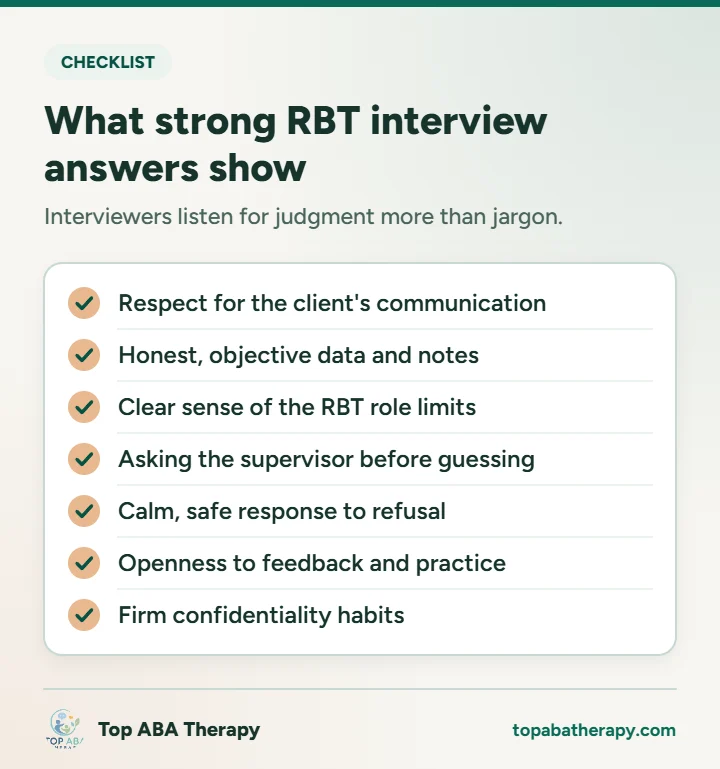
An entry-level candidate may have limited ABA experience. An employer can still evaluate whether the person communicates respectfully, separates observation from interpretation, learns through instruction and feedback, protects privacy, records data honestly, follows role boundaries, and asks for help before uncertainty becomes a client risk.
Employers should show their own standards
A structured interview uses a consistent core rubric tied to essential functions and gives candidates enough context to answer scenarios. A work sample should use fictional data, resemble a relevant task, allow required accommodations, and score observable criteria. It should not become unpaid productive client service or an informal demonstration on a real client. If you are still finishing the credential, review the steps to become an RBT so you can speak confidently about your training.

How should you answer common RBT interview questions?
“Why do you want to become an RBT?”
Connect the supervised direct-service role to a specific interest, such as supporting communication, daily routines, meaningful participation, or careful measurement. Show that you understand the job may include repetition, notes, travel, schedule changes, feedback, and difficult conditions. Avoid savior language, promises to “fix autism,” or presenting the position only as a shortcut to graduate school.
“What does an RBT do?”
Explain that an RBT is a BACB-certified paraprofessional who helps deliver behavior-analytic services under direction and close, ongoing supervision. Mention implementing assigned procedures, recording observations, protecting confidentiality, communicating within role, and seeking guidance. Do not claim independent assessment, diagnosis, plan design, or unsupervised practice. Review what an RBT does before the interview.
“What would you do if a client refused an activity?”
Begin with immediate safety and communication. Observe what the person is expressing, follow applicable assent, break, and safety procedures, reduce unnecessary pressure, check the authorized plan, and contact the responsible supervisor when the response is unclear, repeated, unsafe, or may call for review. Do not prescribe one consequence or say you would force completion without knowing the person, context, plan, and risk.
“What if you do not understand a program?”
Say you would not guess. Pause before implementation when safe, review the authorized instructions, ask the supervisor for clarification or modeling, rehearse as directed, demonstrate understanding, and communicate the issue through the approved channel. A safe answer shows teachability and scope awareness, not instant certainty.
“How do you take feedback?”
Give a real nonconfidential example. Describe listening, restating the expected behavior, asking a focused question, practicing, applying the correction, and checking whether performance improved. If you disagreed, explain how you raised the concern respectfully and escalated it through the right route. Claiming you never make mistakes weakens the answer.
“How would you collect accurate data?”
Mention reviewing the operational definition and measurement method, preparing materials, recording close to the event, distinguishing facts from interpretations, noting meaningful missing-data conditions, protecting records, and asking when a definition or procedure is unclear. Never suggest filling gaps from memory to make a graph look complete.
“What if a caregiver asks you to change the plan?”
Listen and treat the concern seriously. Explain the RBT boundary, avoid changing treatment independently, route the request to the responsible clinician, communicate urgent safety information, and document through approved systems. “That is not my job” is dismissive; inventing a recommendation exceeds the role.
“What if an instruction seems unsafe or unethical?”
Protect immediate safety, seek clarification, identify the concrete concern, use backup and reporting channels, and preserve factual documentation. Do not follow an instruction that would create imminent harm merely to appear compliant. Do not redesign treatment independently or post client details online. The interviewer’s response to this answer can reveal whether the organization welcomes escalation or punishes it.
“How do you protect confidentiality and boundaries?”
Discuss minimum necessary access, private conversations, approved systems, correct recipients, secure devices, clean screens, careful transport, and rapid reporting of a suspected disclosure. For rapport, learn the person’s communication, preferences, culture, boundaries, interests, and signs of comfort or dissent. Avoid gifts, secrets, unnecessary touch, or personal social-media relationships outside policy.
What should an RBT candidate ask the employer?
Supervision, ethics, and clinical support
Ask who will supervise the role, how many technicians and cases that person supports, how direct observation and feedback occur, how to reach qualified help during a session, and what backup exists. Ask how the team handles assent, dissent, AAC, sensory needs, harmless autistic behavior, caregiver priorities, restrictive practices, incidents, and data suggesting burden or lack of benefit.
Schedule, pay, travel, and growth
Clarify whether hours are guaranteed, scheduled, authorized, or estimates; the recent cancellation pattern; rates for sessions, notes, meetings, training, supervision, and travel; mileage and service radius; benefits thresholds; overtime; bonuses; classification; and repayment terms. Use the RBT salary guide to normalize the complete offer.
Safety and applicant protection
Healthcare and social-service work can involve workplace-violence risk. OSHA points employers toward comprehensive prevention programs. Ask how risks are assessed before assignment, what training and equipment are provided, who responds to an emergency, how quickly help can arrive, and how injuries and near misses are reviewed. “Be tough” is not a prevention program. Our guide to ABA careers covers more employer red flags worth spotting early.

Frequently asked questions about RBT interviews
Should I memorize answers to RBT interview questions?
No. Prepare short examples and a reliable reasoning structure, then answer the exact question honestly. Memorized scripts often fail when the interviewer changes the context.
What if I have no ABA experience?
Use relevant examples from school, caregiving, customer service, teaching, coaching, or another supervised role. Focus on observation, feedback, boundaries, documentation, communication, safety, and learning.
Can I discuss a former client in an interview?
Protect confidentiality. Remove unnecessary details and choose a general example that cannot reasonably identify the person, family, school, provider, or event.
What answer is strongest for a safety scenario?
There is no universal procedure. A sound response identifies immediate safety, asks for missing context, follows the authorized plan and emergency process, contacts qualified support, and documents facts.
The bottom line
The best way to prepare for RBT interview questions is to practice honest, scope-aware answers: protect safety and dignity, record data accurately, take feedback well and ask your supervisor whenever a situation goes beyond the role. Then use the interview to vet the employer’s supervision, pay and safety practices. Candidates and families can browse ABA providers near you to see which organizations operate locally.