

Quick answer: A Registered Behavior Technician (RBT) implements a supervisor-approved plan, records observations and reports progress or concerns. RBTs work under qualified supervision; they do not independently diagnose, select treatment goals or redesign care. Good practice also requires clear notes, privacy, dignity and escalation when a situation exceeds the role.
Which duties may an RBT perform, and where are the limits?
RBT certification defines a supervised paraprofessional role
The BACB defines RBT certification as a paraprofessional certification in behavior analysis. That distinction matters: an RBT can perform valuable direct-service work but practices under close, ongoing supervision.
| Credential layer | What it does and does not show |
|---|---|
| RBT certification | Shows that BACB certification requirements were met; does not grant independent clinical authority or prove competence for every client |
| State requirement | May impose separate registration, background, or worker rules; does not establish current BACB status or employer authorization |
| Employer training | May establish competence for assigned procedures; does not replace a credential or adequate clinical supervision |
| Payer approval | May permit work within a covered service model; does not prove clinical fit, safety, or payment |
| Job title such as BT | Describes an employer-defined technician role; does not establish active RBT certification |
What an RBT may do during a session
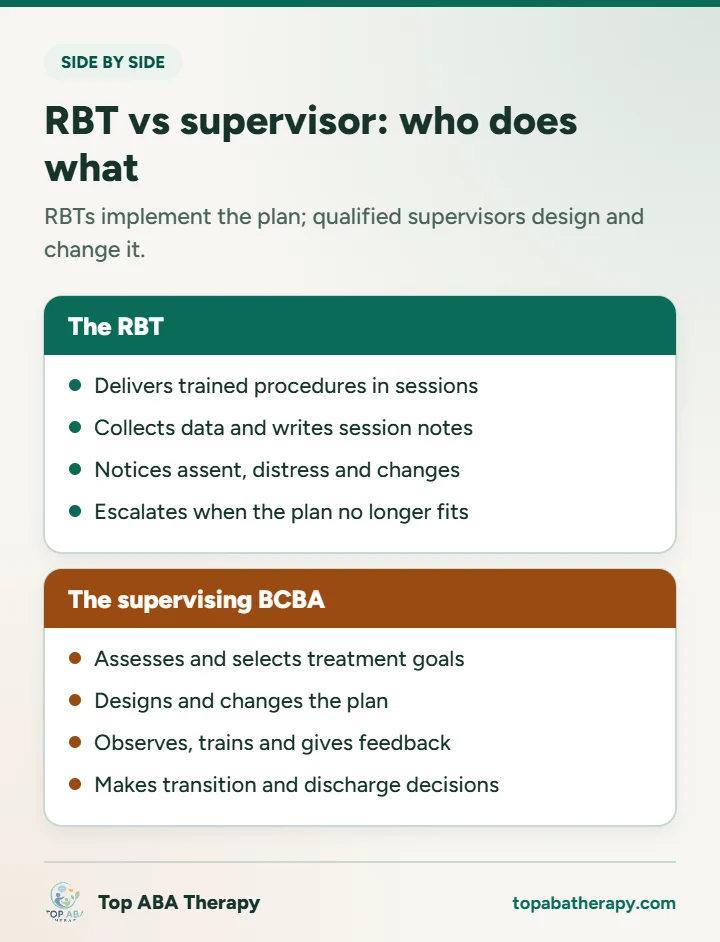
Assigned duties depend on the client, plan, setting, competence, supervisor, organization, law, and payer. A session may involve preparing materials, reviewing current instructions, building rapport, implementing trained procedures, supporting communication or daily-life goals, collecting observable data, writing notes, noticing assent or risk, communicating within defined boundaries, and seeking direction when the plan no longer fits.
The RBT implements; the clinical supervisor decides
In a tiered ABA model, the supervisor commonly owns assessment conclusions, goal selection, treatment design, material plan changes, clinical analysis, and transition decisions. The RBT contributes essential direct observation and implementation data but should not be left to invent treatment. Our comparison of BCBA vs RBT roles shows exactly where those responsibilities split, and what a BCBA does covers the supervisor’s side.
How do data, supervision, assent, and safety shape RBT work?
Data collection and session notes
RBTs may record frequency, duration, latency, interval, trial, task-analysis, prompt, or other data defined by the supervisor. Accurate data help determine whether a skill is improving, a procedure is implemented correctly, or a plan needs review.
Good documentation distinguishes observation from interpretation. It records material changes and incidents without stigmatizing language, speculation, copied notes, or billing inflation. The RBT should ask when definitions are ambiguous or technology fails and never fabricate precision.
Supervision should be visible in practice
The 2026 RBT Handbook requires close, ongoing supervision and describes a minimum percentage of monthly behavior-analytic service hours, along with additional supervision conditions. Requirements can change, and minimum certification compliance does not prove enough supervision for a complex case.
Consent, assent, dignity, and boundaries
RBTs spend substantial time with clients and therefore play an important role in noticing communication, preferences, discomfort, and changes. They should know how the plan defines consent and assent processes and how to respond to withdrawal.
Safety and escalation
Technicians should receive client-specific training before implementing safety or crisis procedures. They need clear thresholds for contacting the supervisor, caregiver, clinical support, emergency services, or another authorized route.

How do RBT duties and expectations change by setting?
RBT duties across settings
Home
The RBT may embed teaching in routines and report environmental factors. Privacy, siblings, pets, household hazards, caregiver presence, travel, personal spaces, and off-hours contact need clear rules.
Center
The RBT may move among individual and shared spaces. Verify client-to-staff assignments, transitions, peer consent, personal care, cameras, pickup, incident response, and access to the supervisor.
School
The technician’s employer and authority must be clear. A school employee, district contractor, and outside clinical RBT can have different plans, records, supervisors, and responsibilities. Read school-based ABA explained before assuming an insurance-funded role controls an educational program.
Community or telehealth
Community work adds transportation, public privacy, environmental risk, and emergency questions. Telehealth adds client-location, technology, privacy, caregiver-role, and connection-failure requirements. An RBT should not deliver remotely from or to a jurisdiction unless the responsible organization has verified authorization.
What families should expect from an RBT
Families should expect a clear role, employer, and supervisor; respectful interaction; knowledge of the current plan; prepared and accurate implementation; attention to communication, assent, pain, and context; protected records; honest limits; prompt escalation; and openness to supervisor observation and feedback.
How should families and job candidates evaluate an RBT role?
Questions families should ask
Ask whether the person holds active RBT status, who supervises and covers absences, what client-specific competencies were checked, how often direct observation occurs, which procedures are allowed, how the team handles assent and incidents, who checks data accuracy, and where a family can report concerns.
Questions RBT job candidates should ask
Supervision and clinical support
Verify the supervisor’s eligibility, protected direct-observation time, client-specific competency checks, live support across assigned settings, and the response to missed supervision.
Employment, ethics, and growth
Clarify classification; paid session, training, note, travel, cancellation, and preparation time; expense reimbursement; schedule stability; benefits and leave; prohibited procedures; complaint protection; paid development; and any fieldwork arrangement separate from RBT supervision. Before comparing offers, read our guide to realistic RBT salary and paid hours.
Becoming and maintaining RBT certification
Current BACB materials place the 40-hour course and initial competency check inside a larger sequence covering eligibility, application, examination, ethics, continuing supervision, and certification maintenance. Significant RBT changes took effect or transition during 2026, including updated training, examination, competency, and professional-development materials.
Do not use an undated article as the definitive checklist. Read the current RBT Handbook and transition guidance, verify jurisdiction availability, and obtain employer or supervisor guidance. The BACB alone determines certification eligibility and status. For the full step-by-step path, see how to become an RBT.
Verify the person and supervision relationship
Families can check a technician’s certification status in the BACB Certificant Registry and ask the provider to confirm the assigned supervisor in writing. A directory listing can help you find providers, but it cannot confirm who will work with your child, their competence or current availability.

Frequently asked questions about RBT duties
Is every behavior technician an RBT?
No. “Behavior technician” can be an employer-defined job title. Active RBT status is a specific BACB certification that must be verified for the individual. State, employer, and payer rules may also apply.
Can an RBT write or change an ABA treatment plan?
An RBT should not independently select goals, design treatment, or make material clinical changes. The technician implements assigned procedures, reports observations, and seeks direction when the plan is unclear, ineffective, unacceptable, or unsafe.
Who supervises an RBT?
The provider should identify the qualified RBT Supervisor and, when applicable, the RBT Requirements Coordinator responsible for certification requirements. Families and technicians should know who offers live support and who covers absences.
What should an RBT do when a client is distressed?
Recognize the signal, follow trained safety and assent procedures, pause when appropriate, document observable facts, and contact the supervisor through the defined escalation route. Distress should prompt review, not unapproved improvisation or blame.
The bottom line
So, what does an RBT do? An RBT delivers the plan, collects accurate data, notices the client’s communication and comfort, and escalates whenever a situation goes beyond the role, all under close, visible supervision. Families should expect respectful, prepared technicians and a reachable supervisor; candidates should expect the same support. To see who offers ABA services locally, browse verified ABA providers near you.