

Quick answer: “ABA therapist salary” is ambiguous because the title may mean a technician, RBT, BCaBA, trainee or BCBA. Identify the actual credential and duties before comparing numbers. Use current local offers and realistic paid hours, including cancellations, travel, indirect work, benefits and expenses, to compare annual compensation.
Compensation note: Figures here are dated market context, not a wage, hiring, tax, classification, contract, or legal guarantee. Verify the role, location, written terms, and current authoritative requirements. Job-board estimates reflect their own methods and samples.
What does ABA therapist mean in a salary listing?
| Job title | How to compare pay |
|---|---|
| Behavior technician / RBT | Hourly rate multiplied by realistic paid hours; separate training and certification conditions. |
| BCaBA | Pay basis, supervision, responsibilities and state authorization. |
| BCBA | Base pay, caseload, billable targets, indirect work and bonus conditions. |
| Clinical leader | Management scope, direct care, on-call work, staffing responsibility and incentives. |
Identify the credential and authority
“ABA therapist” is not a BACB credential. An employer may use it for a behavior technician who implements assigned services under supervision, an RBT with a current paraprofessional credential, a BCaBA-level assistant working under BCBA supervision, a graduate trainee, a BCBA independent practitioner, or a school position defined by local rules. Those jobs differ in entry requirements, decision authority, liability, supervision, schedule, and labor market.
The BACB describes RBTs as paraprofessionals who work under close, ongoing supervision. Its BCBA materials describe graduate-level professionals authorized for independent behavior-analytic practice and supervision within the credential’s boundaries. State licensing, employer policy, payer contracts, and personal competence may add conditions. A shared job title cannot erase those distinctions. For a side-by-side view of the two most common credentials, see how BCBA and RBT responsibilities differ.
Read the minimum credential, license, degree, duties, reporting line, setting, population, caseload, supervision, travel, and schedule. Ask who performs assessment, writes plans, makes clinical changes, supervises staff, communicates with payers, handles incidents, and signs records. If the duties exceed the posted qualification or the employer cannot identify the responsible clinician, compensation is not the only concern.
Treat salary sources as different instruments
A current national average was not established for this ambiguous job title. Compare dated local postings that identify the credential, duties and pay basis, and confirm the terms in the written offer.
Job-board estimates, employer postings and written offers answer different questions. An estimate reflects that site’s own sample and method, a posting shows what one employer chose to advertise, and only the written offer describes the terms you would actually receive. Before you compare any two numbers, check that they describe the same thing:
- The date the figure was collected or posted
- The credential and duties the role actually requires
- The pay basis: hourly, salary, per session or per visit
- Whether bonuses, differentials or overtime are included in the headline
- The location and setting: home, center, school or telehealth

How can applicants calculate real ABA compensation?
Model paid hours, not theoretical hours
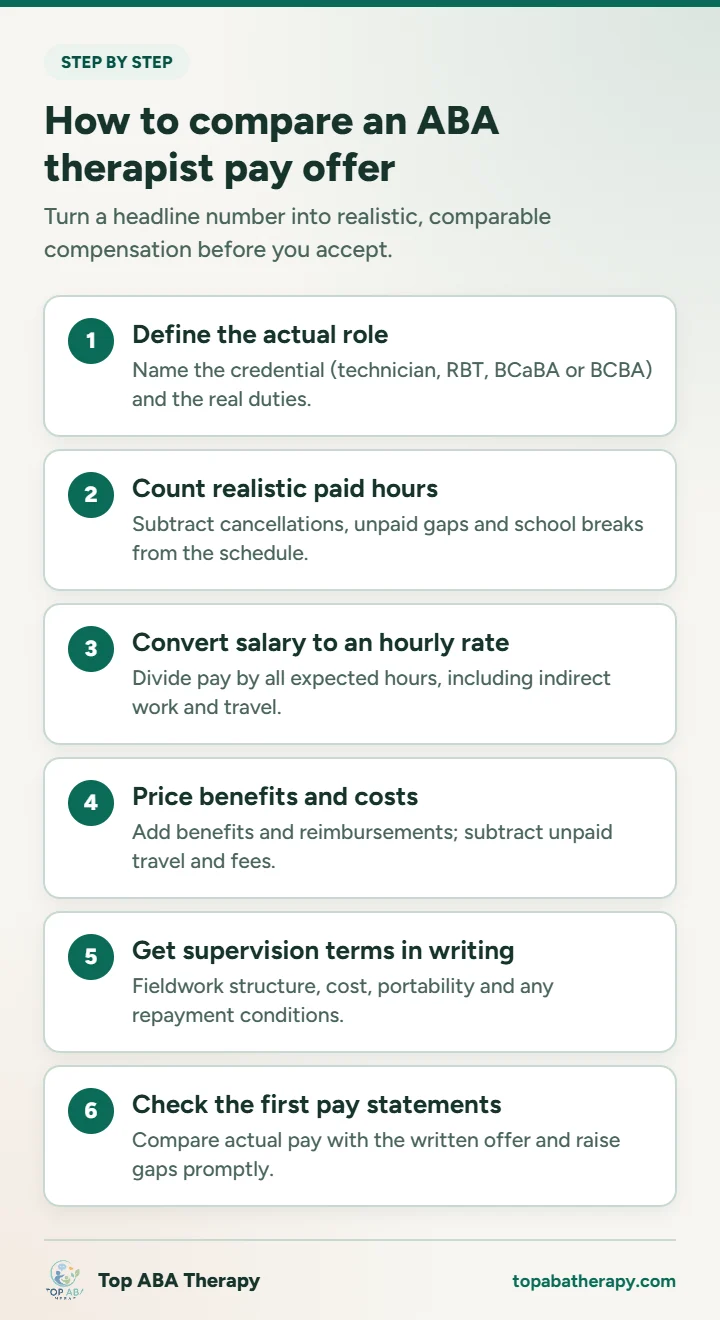
For an hourly offer, start with a simple formula: hourly rate × realistic paid hours per week × paid weeks per year. Then add the value of benefits and subtract unreimbursed costs such as unpaid travel.
If an offer pays $25 per hour for 25 hours a week across 48 weeks, the arithmetic illustration is $30,000 before taxes and benefits. Multiplying $25 by 2,080 would produce $52,000 and assume 40 paid hours for 52 weeks. The $22,000 gap is not small. It comes from assumptions the offer may never promise. Our guide to RBT pay, hours and benefits applies the same paid-hours math to technician roles.
Convert salary to an effective workload measure
For a salary, calculate an effective hourly rate: annual salary ÷ (expected weekly hours, including indirect work, documentation and travel × working weeks). Compare that figure, not the headline salary, with hourly offers.
Model low, expected, and high workload. Include vacancies, authorization delays, assessment bursts, client transitions, staff turnover, incidents, and supervisor leave. Ask how the billable target changes when those events consume time. A bonus should enter dependable compensation only after the employer explains the formula, exclusions, historical attainment for comparable staff, repayment terms, and payout timing. If you are weighing a supervisory role, compare caseload and billable targets with our BCBA pay and caseload guide.
Price supervision and restrictions
When an offer includes supervised fieldwork, request the written agreement, qualified supervisor, observation and contact structure, documentation process, cost, paid status, portability, contingencies after supervisor departure, and any repayment or employment commitment. Low-cost supervision may have real value. Poor-quality or nonportable fieldwork can delay a career path, and a large clawback can convert the benefit into risk.
How do location, education, and job quality change the offer?
A master’s degree does not name the job
A person can hold a master’s degree and work in a technician role, accrue supervised fieldwork, hold a BCaBA, qualify for BCBA examination, or work in an adjacent discipline. Degree, credential, state license, payer recognition, competence, and employer title are separate. Ask whether the position uses graduate-level duties and whether a written education differential applies.
Local evidence beats a national shortcut
Local labor markets differ, but an all-occupation wage average does not measure ABA pay. Use role-specific local evidence rather than relabeling broader occupational statistics.
Job quality can defeat a high headline rate
Ask how the organization sets capacity, covers cancellations, protects documentation time, supervises staff, responds to injuries, handles billing disagreement, and supports assent and person-valued goals. A higher rate may not compensate for unstable hours, unsupported billing pressure, unsafe travel, weak supervision, or a workload that pushes clinical duties off the clock.
Check the offer against the first pay period and again after onboarding. Record promised rate, differential, guaranteed hours, mileage method, training pay, benefit start date, supervision arrangement, caseload, schedule, and bonus formula, then compare each item with the pay statement and actual work. Raise discrepancies promptly through the stated payroll or HR route and preserve the posting, offer, policy, time records, and response. A high-quality employer should be able to explain its own calculation clearly.
Top ABA Therapy can organize dated career listings and role information. It does not guarantee a salary, classify a worker, validate an employer’s job quality, or endorse a listing.

Frequently asked questions about ABA therapist pay
How much do ABA therapists make?
There is no single rate for the ambiguous title. Identify the credential and duties, then compare dated local postings with the complete written offer.
Can I multiply an hourly rate by 2,080?
Only if 40 paid hours for 52 weeks are genuinely expected. Many roles have cancellations, unpaid gaps, school calendars, leave, or variable schedules.
Does a master’s degree automatically increase pay?
No. Pay depends on the job, credential, license, authority, duties, market, and employer policy. Ask whether a written differential exists.
Is a BCBA salary comparable with an ABA therapist rate?
Not until the ABA therapist role is defined. Compare equivalent credentials, duties, locations, schedules, workloads, and benefits.
Is travel time paid in ABA therapist jobs?
It depends on the employer’s written policy and the rules that apply to the role. Ask whether drive time between clients is paid, how mileage is reimbursed and what happens when a session cancels late. Unpaid travel can noticeably lower your effective hourly rate, so include it when you compare offers.
The bottom line
An ABA therapist salary only means something once you know which role it describes. Define the credential and duties, convert every offer into realistic paid hours and an effective hourly rate, and weigh benefits, supervision and job quality alongside the headline number. Keep the posting, the written offer and your first pay statements so you can confirm that promises match practice. Families and professionals alike can browse ABA providers near you to see how local organizations describe their teams and settings.