
Quick answer: To become a BCBA, select the BACB rules that apply to your eligibility date, complete qualifying graduate education and supervised fieldwork, document requirements, apply and pass the exam. Check transition rules before choosing a program. Certification does not replace state authorization or competence for a particular population and service.
Credential and legal note: BACB and jurisdictional requirements change. Use the current BCBA Handbook, official transition materials for upcoming requirement changes, the relevant state authority, and current employer or payer rules. No article, school, supervisor, or recruiter can determine your individual eligibility or authorize practice.
What should you verify before enrolling in a BCBA pathway?
Understand what the credential establishes
The Board Certified Behavior Analyst credential is a graduate-level behavior-analysis certification. Within the BACB framework, BCBAs are independent practitioners and may provide behavior-analytic services or supervise implementers within their competence. “Independent” does not erase state licensing, title, setting, payer, employer, consent, or competence limits. For how the role compares with the technician credential, see BCBA and RBT responsibilities side by side.
Separate the authorities that control the path
The BACB decides certification eligibility, examination, ethics, and maintenance. A university controls admission, curriculum, academic standing, and degree conferral. Fieldwork depends on BACB rules, a qualified supervisor, a written agreement, qualifying activity, and accurate evidence. A state authority decides whether and how behavior analysis may be practiced or titled there. Employers and payers add their own lawful credentialing and work conditions.
Price the whole education plan
Compare tuition, mandatory fees, books, technology, travel, residency, childcare, reduced work, fieldwork or supervision charges, transcripts, application, exam, licensure, and likely interruption costs. Review course availability, time to degree, accessibility, transfer and leave rules, refund and teach-out policies, faculty turnover, fieldwork support, and outcomes with clear cohort definitions.
Ask which exact BACB pathway the program supports, which requirements and application year it assumes, the degree shown on the transcript, its current accreditation or recognition status and dates, who completes required attestations, and what happens if the rules or program status change. Marketing staff cannot guarantee BACB approval.

Is the BCBA path right for you?
Before committing years and tuition, test the fit of the work itself. The BCBA role centers on assessment, treatment design, supervision, data analysis, documentation, and communication with families and other professionals, often across several cases at once. Reading about what a BCBA does day to day and talking with practicing BCBAs can show whether that mix suits you.
- Do you enjoy analyzing data and adjusting a plan when it is not working?
- Are you comfortable training other staff and giving direct feedback?
- Can you explain clinical decisions in plain language to families with different priorities?
- Are you prepared for documentation, payer requirements, and ethical gray areas?
- Do you value client assent, dignity, and quality of life as much as measurable progress?
Many candidates gain direct experience first. Working as a technician, for example after learning how to become an RBT, shows you the implementation side of ABA and can help you meet a fieldwork supervisor. Just confirm separately that any paid role and any fieldwork arrangement meet the applicable rules.
What are the BCBA requirements and steps in 2026?
The handbook reviewed for this article was checked on August 16, 2026. Because the BACB has also published upcoming requirement changes, build an earliest realistic application scenario and a delayed scenario. Include transcript processing, fieldwork interruptions, supervisor changes, application action items, and anything else outside your direct control.
Put a buffer between the last required event and the rule transition. Degree conferral may occur after classes end, a registrar may need time to release the official transcript, and a fieldwork discrepancy may require correction before a final form can be signed. Ask the program and supervisor which dates they control, what their normal processing steps are, and what evidence they will provide. Do not plan around an informal promise to make an exception.
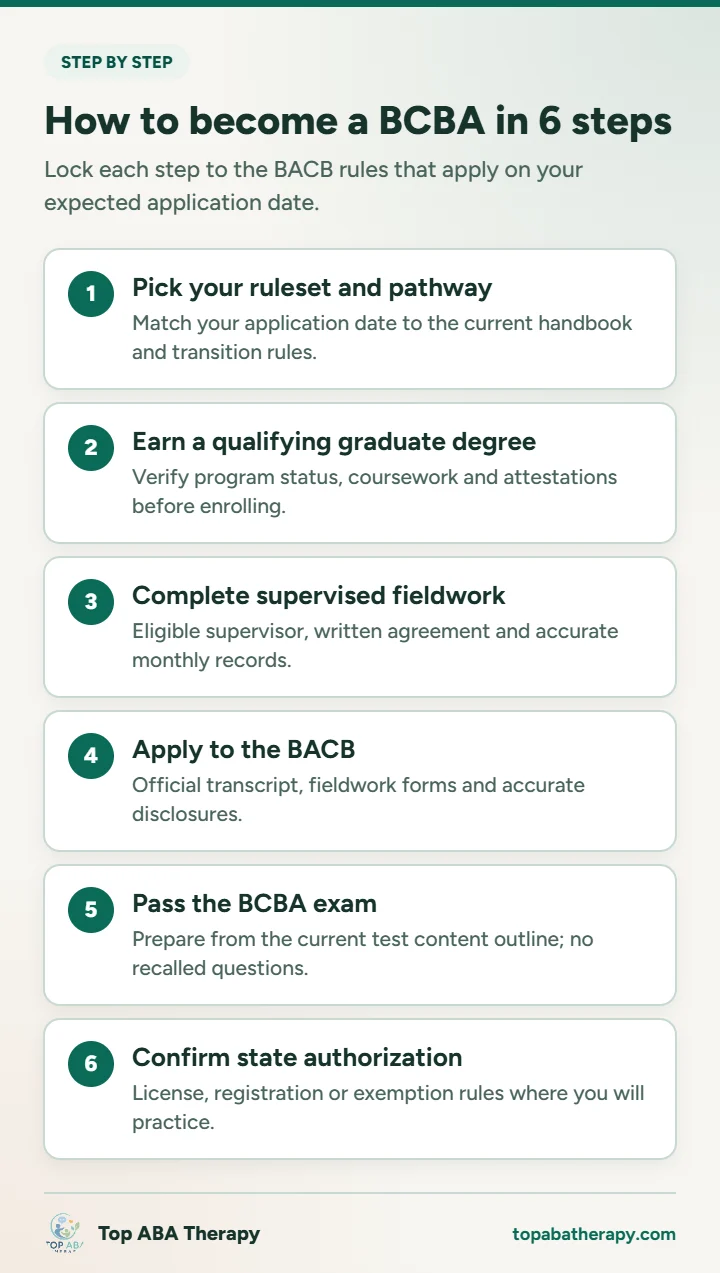
| Stage | Decision and evidence to lock |
|---|---|
| Ruleset and pathway | Expected application date, current handbook, transition guidance, and eligible pathway |
| Degree and education | Qualifying graduate degree, institutional or program status, coursework, and required attestations |
| Fieldwork | Eligible supervisor, agreement, activities, contacts, observations, monthly evidence, and final verification |
| Application | Accurate identity, official transcript, pathway evidence, fieldwork forms, disclosures, and current versions |
| Examination | BACB approval, current test content outline, authorization, scheduling, and accommodation process |
| State practice | Official license, registration, exemption, title, telehealth, and renewal rules for the service location |
| Employment and maintenance | Competence, payer or facility requirements, ethics, continuing education, self-reporting, and recertification |
Do not infer that any master’s degree with “ABA,” psychology, or education in its name qualifies. Degree level, institutional or program status, coursework, dates, pathway, and application rules matter. Verify an ABAI program’s current accreditation or recognition through its official lookup and reconcile that evidence with the applicable BACB pathway.
How should you plan and audit BCBA fieldwork?
Fieldwork is supervised professional development under detailed conditions, not a bucket of job hours. The applicable handbook governs supervisor qualifications, training, contract timing, activity types, contacts, observations, documentation, monthly and final verification, and any restricted or unrestricted limits. Job title and billable status do not determine whether an activity qualifies.
Restricted work generally concerns direct implementation, while unrestricted experience develops analytical and professional behavior-analyst work, subject to the handbook’s definitions. A meeting is not automatically unrestricted, data entry is not automatically restricted, and ordinary job duties do not automatically count. Document what you did and why it meets the applicable rule.
Red flags include selling signatures, backdating forms, blanket claims that every work hour qualifies, little direct observation, excessive supervisor loads, pressure to omit discrepancies, unsecured client information, or retaliation for raising a compliance concern. A technically complete form cannot repair poor training or invented evidence.

What happens from application through practice?
The BACB makes the certification decision. If it requests an action item, use the specified channel and deadline. After approval, prepare from the current BCBA Test Content Outline and official exam policies. Avoid recalled questions, copyrighted exam content, and guaranteed-pass claims. Request accommodations through the official process with enough time for review.
Do this before promising a start date. State processing, primary-source verification, background checks, jurisprudence steps, employer onboarding, professional insurance, or payer enrollment may continue after certification. Ask which status is required before orientation, nonclinical work, supervision, assessment, billing, or direct service. A job offer cannot grant authority that the jurisdiction reserves to a regulator.
Time and cost cannot be reduced to a universal promise. Admission, degree sequence, fieldwork intensity, supervisor availability, interruption, documentation, application, exam scheduling, retakes, and state processing all affect the timeline. Model expected and disrupted paths before borrowing or accepting a repayment agreement.
Frequently asked questions about becoming a BCBA
Do you need a master’s degree to become a BCBA?
The BCBA is a graduate-level certification, but the exact degree, institution or program status, coursework, and pathway requirements depend on the applicable handbook and application date. Verify your individual route officially.
Does any master’s program in ABA qualify?
No. A program name alone proves nothing about pathway eligibility. Check current accreditation or recognition, degree details, coursework, dates, attestations, and the rules in force when you expect to apply.
Can all paid ABA work count as BCBA fieldwork?
No. Activities must satisfy the applicable fieldwork definitions and supervision conditions. Employment pay status and fieldwork eligibility are separate questions.
What happens if a fieldwork supervisor leaves?
Stop assuming new hours qualify, secure completed records, review the agreement and handbook, and establish an eligible replacement before counting work that requires that relationship. Plan this contingency in advance.
Can I work while completing BCBA fieldwork?
Many candidates do, often in technician or related roles, but paid work and qualifying fieldwork are separate questions. Activities count only when they meet the applicable fieldwork definitions, supervision conditions, and documentation rules. Agree in writing with your employer and supervisor how fieldwork activities will be identified and recorded.
The bottom line
Knowing how to become a BCBA starts with one decision: which BACB ruleset applies to your expected application date. From there, choose a program that clearly supports that pathway, plan supervised fieldwork you can document, prepare honestly for the exam, and confirm what your state requires before you practice. Build in buffers for the steps you do not control. When you want to see how organizations structure the role, look up ABA providers near you.