

Quick answer: A BCBA generally assesses, designs and reviews behavior-analytic services; an RBT implements an approved plan under supervision and records observations. BCBA is a graduate-level certification, while RBT is a paraprofessional credential. Verify each person’s actual duties, supervision, competence and applicable state authority rather than relying on the job title.
How do BCBA and RBT credentials, duties, and accountability differ?
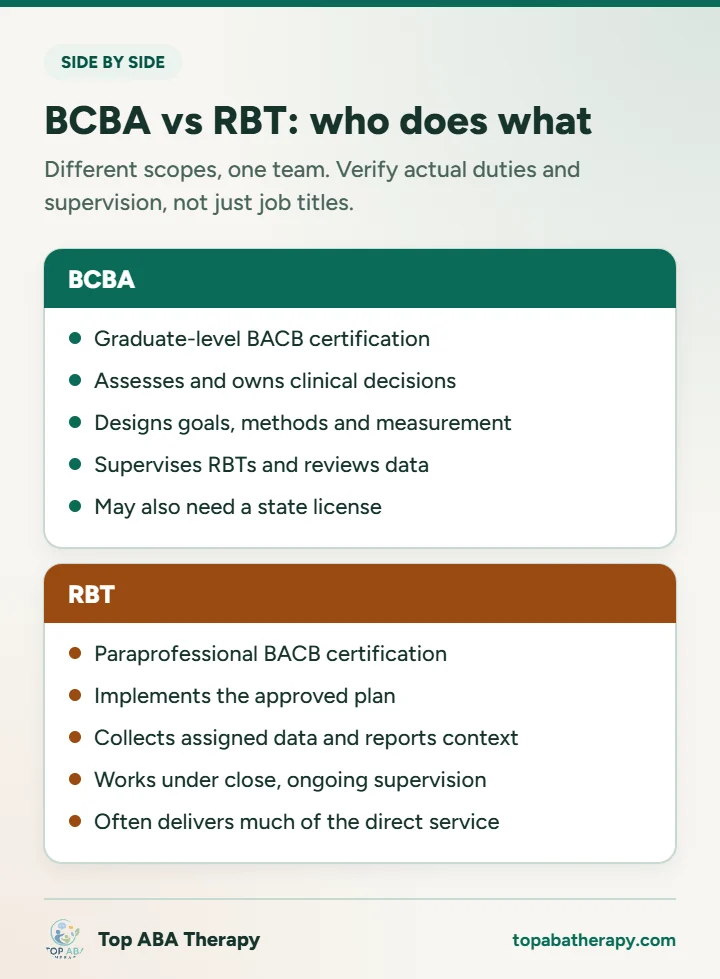
BCBA vs RBT comparison table
| Domain | BCBA | RBT |
|---|---|---|
| BACB credential level | Graduate-level certification | Paraprofessional certification |
| Practice relationship | May provide behavior-analytic services independently in the certification hierarchy | Must practice under close, ongoing qualified supervision |
| Assessment | Conducts or owns clinical interpretation and decisions; may delegate qualified components with oversight | May assist with specifically delegated data or preference activities when trained |
| Goals and plan | Collaboratively selects, designs, approves, and materially changes | Implements the current supervisor-approved plan |
| Direct service | May provide direct treatment, consultation, or assessment | Often provides a substantial share of direct implementation |
| Data | Designs measurement and analyzes clinical meaning | Collects assigned data and reports context accurately |
| Supervision | May supervise RBTs when requirements are met | Receives required supervision and feedback |
| Family communication | Explains assessment, rationale, material changes, outcomes, risks, and transition | Shares session-level information within role and routes clinical decisions |
| Accountability | Owns or shares accountable clinical decisions as defined by role and law | Accountable for ethical, competent implementation and escalation within role |
| Licensure | May require state license or registration | Separate state or employer requirements may apply |
This is a general framework. State law, payer rules, setting, employer structure, and individual competence may modify duties. Ask the organization for its written responsibility map.
Education and certification differ
BCBA pathways involve graduate education, behavior-analytic training, supervised fieldwork, application, examination, and certification maintenance. An RBT candidate follows a different sequence: eligibility screening, qualifying coursework, a competency check, application, and examination, followed by ethics and supervision duties while certified.
Who performs the assessment?
The BCBA commonly conducts or oversees the clinical assessment and interprets its results. Activities may include interviews, observation, record review, baseline measurement, skill and preference assessment, environmental analysis, and functional behavioral assessment when relevant. To see where assessment fits in the wider cycle, read about the stages of ABA care.
Who selects goals and designs treatment?
The accountable clinician collaborates with the client and authorized supporters to select meaningful goals, choose methods, establish measurement, address consent and risk, and define generalization, review, transition, and discharge. The BCBA typically owns these behavior-analytic decisions.
Who delivers direct ABA sessions?
Either role may provide direct service, but tiered programs often rely on RBTs for frequent implementation while the BCBA performs assessment, planning, supervision, analysis, and family consultation.
How supervision connects the roles
The BACB requires RBTs to practice under close, ongoing supervision. Certification requirements include a monthly minimum, but minimum compliance does not prove that supervision is sufficient for a particular person’s complexity or risk.
- direct observation of the RBT working with the client;
- modeling and behavioral skills training;
- immediate and delayed performance feedback;
- review of data definitions, accuracy, notes, and treatment integrity;
- competency checks for the individual plan;
- analysis of progress, distress, adverse effects, and environmental change;
- documented decisions and follow-up;
- support during uncertainty, incidents, or emergencies.
How should families and candidates evaluate a tiered ABA team?
Route each question to the accountable role
Routine scheduling, materials, and session details may start with the RBT or scheduling team. New goals, methods, settings, stalled progress, and treatment changes belong with the BCBA, informed by RBT observations. Distress or injury requires the immediate safety plan and prompt accountable review. Credential, supervision, billing, authorization, and complaints may require a clinical director, compliance contact, payer, registry, licensing board, or another independent route.
What neither credential guarantees
Neither BCBA nor RBT status by itself guarantees:
- current state authorization;
- competence for a particular age, communication profile, setting, goal, or risk;
- ethical or effective treatment;
- adequate staffing or supervision;
- insurance network participation or payment;
- availability, continuity, or a short waitlist;
- respectful assent and communication practices;
- positive outcomes.
What families should observe during sessions
The RBT should know the plan, prepare appropriately, interact respectfully, offer communication and choices, collect accurate data, protect privacy, and seek help instead of improvising beyond competence. The BCBA should directly observe often enough to evaluate both implementation and client response. For warning signs beyond staffing, see our broader ABA red flags guide.
Red flags in a tiered ABA team
- no one can identify the accountable BCBA;
- the RBT independently writes goals or changes procedures;
- the BCBA rarely or never observes direct service;
- supervision consists only of signatures or note review;
- staff cannot explain how to reach clinical support during a session;
- frequent substitutions occur without individual training;
- families receive material plan changes through the technician alone;
- the RBT is blamed for outcomes while carrying an unsafe caseload or unclear plan;
- the BCBA’s caseload prevents timely assessment, feedback, or incident review;
- titles are used ambiguously to imply credentials people do not hold.
Questions to ask before starting services
Verify the people and supervision model
- Who is the accountable BCBA and is their certification and license current?
- Who will provide direct sessions, and is each person an RBT or another technician type?
- What individual training occurs before a technician works without the supervisor present?
- How often and in what format will the BCBA directly observe?
- How many clients, RBTs, trainees, sites, and travel hours does the BCBA oversee?
- Who handles evenings, absences, turnover, incidents, and emergencies?
Verify decisions and accountability
- Which decisions may the RBT make and which require the BCBA?
- How are data accuracy, treatment integrity, assent, adverse effects, and outcomes reviewed?
- How can the client or family request changes, records, a second opinion, or a different staff member?
- What are the complaint, transition, step-down, and discharge routes?
For organization-level due diligence, work through the ABA provider selection guide.
Career implications of BCBA vs RBT
RBT jobs often involve direct implementation, variable settings, close client contact, data collection, and required supervision. BCBA jobs usually add assessment, treatment design, risk decisions, supervision, documentation, payer communication, and accountability across cases and staff.
Verify credentials from primary sources
Use the BACB Certificant Registry for certification status and the applicable state board for licensure. Match the full name, credential, location, employer, and any restrictions. Ask the organization to explain discrepancies.
From Top ABA Therapy, readers can reach provider records, job resources, geographic indexes, care-setting guides, insurance information, and comparisons. Directory information must preserve source and checked dates but cannot guarantee current status or suitability.


Frequently asked questions about BCBA vs RBT
Is a BCBA higher than an RBT?
The credentials carry different scopes, not merely different rank. A BCBA may independently provide behavior-analytic services within applicable rules and commonly owns clinical decisions. An RBT is a supervised paraprofessional whose direct implementation remains essential but does not include independent treatment design.
Can a BCBA provide the direct sessions an RBT usually delivers?
Yes, when competent and authorized. Some BCBAs provide substantial direct service; others concentrate on assessment, consultation, supervision, and analysis. Ask how many hours each role will deliver and how that matches the written plan and authorization.
Can an RBT perform an assessment?
An RBT may collect defined data or assist with a delegated activity after training, but should not independently interpret the assessment or make diagnostic and treatment decisions. The provider should identify the accountable BCBA and review process.
Who should change an ABA goal or procedure?
The accountable clinician should assess and approve a material change with the client and authorized supporters. The RBT contributes observations, reports concerns, and implements the revised plan after receiving adequate training.
How do I check whether a BCBA or RBT is certified?
Search the person’s full name in the BACB Certificant Registry, then check the state licensing board if your state licenses behavior analysts. Match the credential, location, and current status, and ask the organization to explain any mismatch before services begin.
The bottom line
BCBA vs RBT comes down to scope and accountability: the BCBA assesses, designs, supervises, and owns clinical decisions, while the RBT implements the approved plan under close, ongoing supervision. Neither title guarantees quality, so verify credentials in the registry, ask how often direct observation happens, and know who to contact when something changes. Families and professionals alike can browse ABA providers near you and compare how each team divides these roles.