

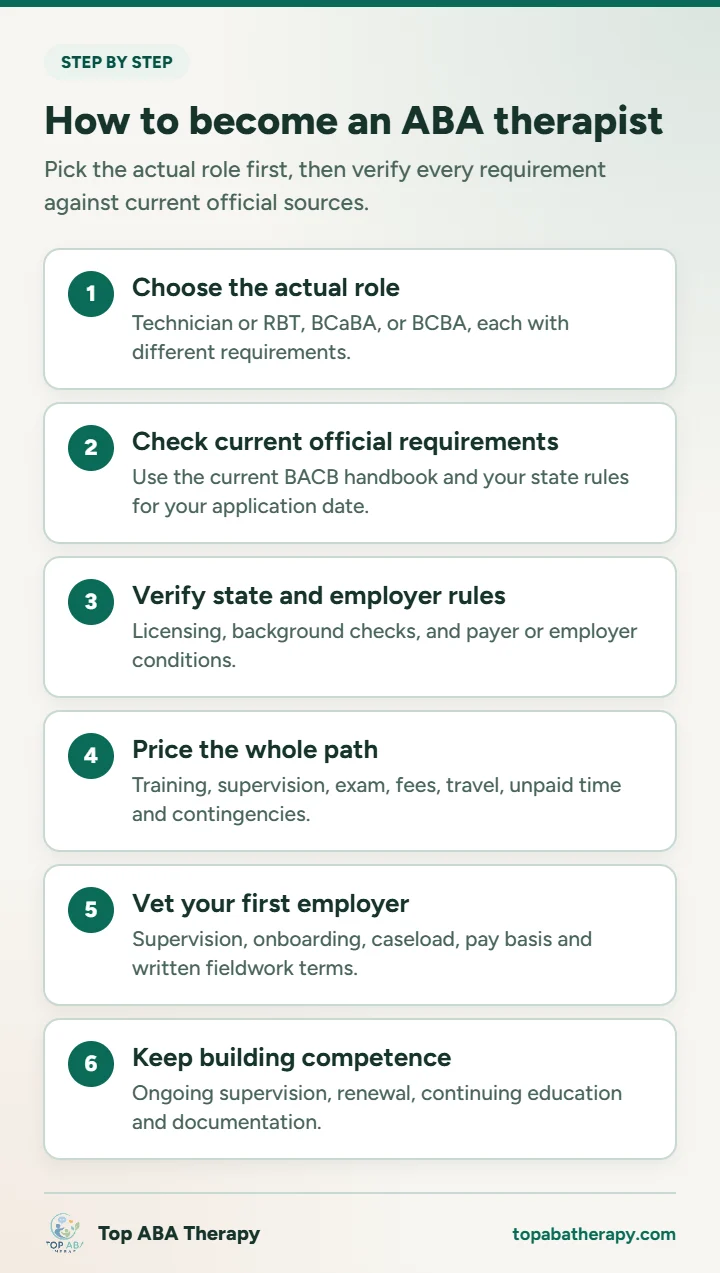
Quick answer: To become an ABA therapist, first choose the responsibility level: technician or RBT, supervised BCaBA, or graduate-level BCBA. These roles have different education, training, supervision and authorization requirements. Check the current official pathway and local job duties before paying for a course marketed under the broad “ABA therapist” title.
Career boundary: This guide does not guarantee certification, state authorization, admission, an examination result, supervision, a job, salary, or timeline. Requirements change and can depend on application date and jurisdiction. Use current official sources and qualified advice for individual education, employment, contract, tax, or legal questions.
How do you choose and complete the right ABA career path?
Replace ABA therapist with a defined role
Employers may use ABA therapist, behavior therapist, behavior technician, behavioral technician, ABA instructor, RBT, clinical assistant, or another local title for overlapping work. None of those words alone proves certification, a license, independent-practice authority, job duties, or payer recognition.
| Career path | Role and education direction | Evidence to verify before committing |
|---|---|---|
| Behavior technician or RBT | Supervised implementation; RBT adds a defined paraprofessional certification path | Jurisdiction, eligibility, training, assessment, application, examination, employer onboarding, and ongoing supervision |
| BCaBA or graduate trainee | Assistant-level practice under BCBA supervision, or employment while accruing graduate fieldwork | Education, fieldwork, supervisor, documentation, local demand, permitted duties, and portability after job change |
| BCBA | Graduate-level independent behavior-analytic practice within competence and applicable authority | Degree pathway, behavior-analytic coursework, fieldwork, application-date rules, examination, certification, state licensing, and payer or employer conditions |
Before choosing, observe the ordinary work if a provider can arrange a lawful, consented, privacy-protective introduction. Ask people in each role how they spend a normal week, which decisions they may make, what supervision looks like when a case is difficult, how much work occurs outside direct service, and what they wish they had checked before training. Do not request access to confidential sessions merely for career exploration. Informational interviews, public role descriptions, university events, and fictional workflow demonstrations can reveal the work without turning a service recipient into a recruiting exhibit.
Use the current RBT sequence for entry-level certification
Start with the current RBT Handbook published by the BACB, which sets out the official requirements. Before buying a course, verify application availability in the jurisdiction and the current age, education, background, abuse-registry, training, competency assessment, application, examination, and maintenance requirements. Employers may add driving, language, health, schedule, setting, or payer qualifications. Our step-by-step guide on becoming a Registered Behavior Technician walks through that sequence.
Plan the BCBA path by application date
BCBA certification is not an automatic promotion after technician experience. It requires a qualifying graduate-level pathway, behavior-analytic education, supervised fieldwork, application, and examination under the applicable rules. The BACB publishes transition material when requirements change, including changes tied to future application dates. Map requirements to the date you expect to apply, not only the date you enroll. See our BCBA degree, fieldwork and exam guide for the full pathway.
Keep your own contracts, monthly records, final verification documents, course records, syllabi where relevant, and correspondence. Do not rely on a school or employer saying “BACB approved” without identifying the exact current pathway and evidence.
How do you verify education, supervision, and a first employer?
Add state, employer, and payer authority
Certification and state licensing or registration are separate. Check where the services will physically occur, including telehealth. Verify title restrictions, scope, supervision, background checks, business rules, renewal, and complaint routes. An employer or payer may require additional enrollment, credentialing, training, or experience.
Do not assume that moving states, changing employers, or earning a certification automatically transfers every permission. Build a dependency timeline for official documents, state processing, payer enrollment, employer onboarding, and supervision. Start dates advertised by a school or recruiter may omit those gates.
Price the whole path and its failure points
Include tuition or training, books, assessment, supervision, application, examination, transcripts, background checks, state fees, renewal, continuing education, travel, technology, unpaid time, and lost income. Use official dated fees. Add a contingency for repeated coursework, delayed documents, supervisor departure, or a longer job search without assuming any will occur. Then weigh those costs against realistic earnings with our RBT pay and hours guide.
Interview the employer’s systems
Ask for the exact title, credential, duties, reporting line, supervisor qualifications, observation schedule, feedback, backup coverage, paid onboarding, meetings, notes, training, travel, cancellations, caseload, geographic radius, schedule, safety plan, incident support, and worker-injury process. Request the supervision or fieldwork agreement before accepting.
Request a realistic onboarding map. It should name paid orientation, background and health clearances where required, credential checks, case-specific training, competency observation, record-system access, emergency contacts, first client assignment, supervisor coverage, and the point at which a new employee may work with less immediate support. Ask what happens when the new hire says no to an assignment outside competence. An employer that cannot describe safe onboarding should not be treated as safe because its mission statement sounds caring.
Verify the application destination and recruiter identity before sending personal records. Use an employer-controlled domain or authenticated portal, confirm the legal organization and location, and ask why sensitive documents are needed at that stage. A legitimate employer can explain retention, access, background-check vendors, and accommodation routes. Never send client information, a current employer’s proprietary forms, or login credentials as proof of experience.
Maintain competence after the entry gate
A credential shows that defined requirements were met. It does not establish competence for every person, population, procedure, setting, or risk. Seek case-specific training, supervision, consultation, or referral when work exceeds current skill. Maintain ethics, supervision, renewal, continuing education, documentation, and state authority.
Top ABA Therapy can organize career listings and official-source guides. It does not certify an employer’s job quality, guarantee a credential, validate fieldwork, or promise that a listing meets state or payer rules.


Frequently asked questions about becoming an ABA professional
Is ABA therapist a universal credential?
No. It is an informal job title. Verify whether the actual role is technician, RBT, BCaBA, trainee, BCBA, or another position defined by the employer or jurisdiction.
Do I need a degree to start as an RBT?
Use the current RBT handbook for eligibility and education rules. Employers and jurisdictions may add requirements. A training advertisement is not the official standard.
Does RBT certification allow independent practice?
No. The BACB defines the RBT as a paraprofessional working under close, ongoing qualified supervision.
Is BCaBA simply a temporary BCBA title?
No. It is a distinct assistant-level certification requiring BCBA supervision. Verify education, fieldwork, local authority, job demand, and fit with any later BCBA plan.
How long does it take to become an ABA therapist?
It depends on the role. An entry-level technician or RBT path is usually far shorter than the BCBA route, which requires a qualifying graduate degree, supervised fieldwork and an exam. Timelines also depend on training schedules, background checks, exam availability and state processing, so map each step with current official sources.
The bottom line
If you are asking “how do I become an ABA therapist,” the first answer is to choose the real role: technician or RBT, BCaBA, or BCBA. Each has its own education, supervision and authorization requirements, so verify them against current BACB and state sources for the date you expect to apply. Price the whole path, interview employers about supervision and onboarding, and keep your own records. Families and professionals can browse ABA providers near you to see how local teams describe their roles and settings.