
Quick answer: ABA techniques include reinforcement, prompting and fading, modeling, shaping, chaining, task analysis, discrete-trial teaching and naturalistic teaching. No technique fits every goal or person. Ask what staff will do, why that method fits, how consent and assent affect practice, and how benefit, harm and real-life use will be measured.
What do common ABA techniques involve?
Principles, procedures, and programs are different
A behavioral principle describes a relationship, such as how consequences may affect future behavior. A procedure specifies what people will do. A comprehensive program combines multiple procedures, staffing roles, settings, schedules, and goals. Marketing often collapses these levels into “ABA,” making evidence and risk hard to evaluate. For the bigger picture of how these pieces fit into a full program, see what ABA therapy is.
Positive reinforcement
Positive reinforcement means a consequence follows behavior and increases its future likelihood under relevant conditions. The outcome might be an activity, item, attention, sensory experience, feedback, or natural result. Its effect, not staff intention, defines reinforcement. Preferences change, and providers must not control food, comfort, communication, breaks, relationships, or essential regulation coercively. Good programs also plan from the start how artificial reinforcers will fade into natural ones.
Prompting and fading
Prompts add verbal, visual, gestural, modeled, positional, or physical assistance; fading reduces that help so natural cues control the skill. The plan should measure independent responding separately, guard against dependence, and explain removal from the start. Physical prompting needs added scrutiny around bodily autonomy, consent, assent, permitted contact, less intrusive options, staff competence, and withdrawal.
Shaping, task analysis, and chaining
Shaping reinforces successive approximations toward a functional outcome. Task analysis divides a multi-step activity, and chaining teaches its linked steps in a chosen sequence. Each requires an accessible starting point, pace, data, and meaningful endpoint. Communication method, privacy, health, motor access, culture, safety, choice, and other professional input may matter; finishing a task is not enough if the result is unwanted or unusable.
Discrete-trial and naturalistic teaching
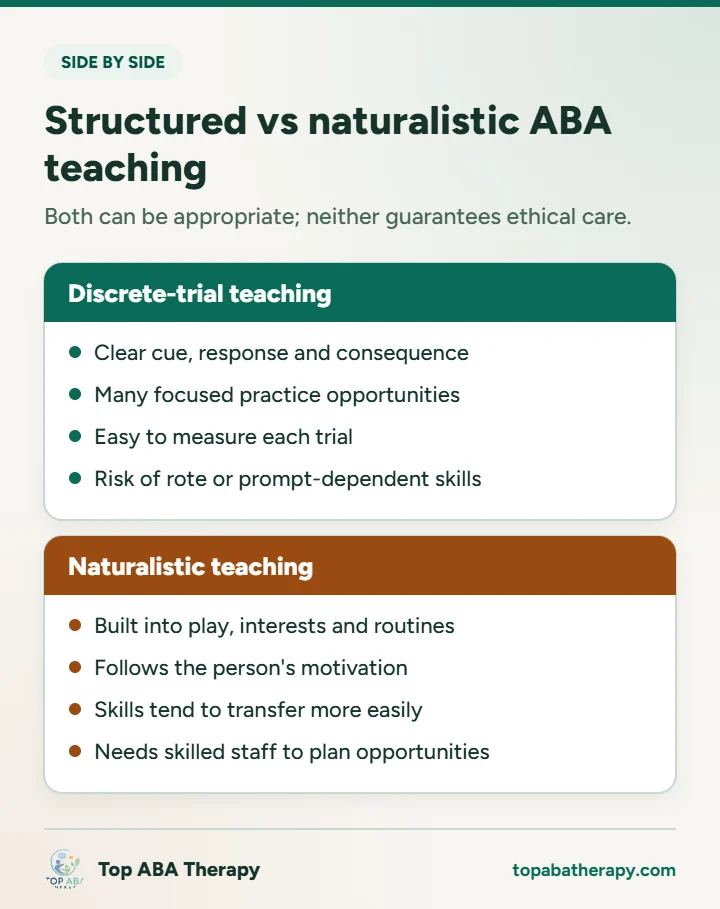
Discrete-trial teaching arranges repeated opportunities with a cue, response, consequence, and data; it can support focused practice but risks rote responding, prompt dependence, fatigue, and weak transfer. Naturalistic teaching embeds opportunities in play, interests, and routines. Neither format proves ethical care: communication, real choice, distress, prompting, data, and generalization still require review across people, materials, and contexts.
Functional communication training
Functional communication training teaches an accessible response related to the function of behavior of concern through speech, AAC, sign, gesture, pictures, writing, or another reliable mode. The response must work efficiently and receive meaningful consequences. A break request that adults routinely deny is not functional. Medical, sensory, trauma, task, environmental, and relationship factors still require attention.
Modeling, skills training, and environmental strategies
Modeling demonstrates a skill; behavioral skills training combines instruction, modeling, rehearsal, and feedback. Attendance does not prove competence, and caregiver coaching should build sustainable support while keeping relatives out of unpaid staffing roles. Antecedent strategies change instructions, difficulty, timing, predictability, communication access, sensory conditions, choices, materials, or the environment. Accommodation may be the correct outcome when the barrier is avoidable noise or an inaccessible task.
Differential reinforcement
Differential reinforcement provides reinforcement according to a defined pattern, such as reinforcing an alternative, incompatible, or other response while changing consequences for another behavior. The full procedure determines its ethical and practical meaning; the acronym alone does not.
Extinction and planned ignoring require explicit disclosure
Extinction means discontinuing reinforcement that previously maintained behavior. Planned ignoring is a narrower arrangement that may withhold a particular form of attention. These procedures can be misunderstood and misused.
They should never mean ignoring pain, danger, communication, abuse disclosure, medical symptoms, consent withdrawal, or the person. Behavior can temporarily intensify or change, and implementation can create risk. Ask about functional assessment, alternatives, consent, monitoring, crisis planning, staff competence, and less intrusive options.
Generalization and maintenance programming
Generalization helps a skill occur with relevant people, materials, settings, cues, and situations beyond the original teaching arrangement. Maintenance concerns whether the skill persists over time.

How should an ABA technique be selected and reviewed?
ABA techniques for autistic people
Autism does not determine a standard technique list. Selection should begin with the autistic person’s priorities, communication and AAC access, sensory and motor profile, health, environment, age, culture, risks, preferences, and response to prior support. An approach appropriate for learning a chosen communication skill may be irrelevant to pain, motor access, trauma, sleep, or a speech-language disorder and may require another professional.
Do not target eye contact, harmless movement, quiet hands, indistinguishability, or suppression of autistic traits simply because a procedure can change them. Ask what functional or quality-of-life outcome the technique supports, what alternatives exist, how assent and refusal work, and how adverse effects will change or stop the plan.
| Decision domain | Evidence to request | Stop or review signal |
|---|---|---|
| Goal and assessment | Person-valued outcome, baseline, function, health, communication, preferences, and context | Goal serves normalization, or relevant causes remain unassessed |
| Evidence and intrusiveness | Applicable research and less intrusive or environmental options | Burden exceeds plausible benefit, or alternatives were dismissed |
| Consent and competence | Accessible assent process, qualified designer, trained implementers, and direct observation | Withdrawal is ignored, or staff work beyond competence |
| Measurement and exit | Independent benefit, generalization, burden, harm, fading, and decision thresholds | Nonresponse, adverse effects, weak transfer, or no credible exit |
Procedures that demand heightened review
Restrictive, punishment-based, escape-extinction, response-cost, restraint, seclusion, blocking, overcorrection, or crisis procedures require direct identification. Names vary, so request operational descriptions of what staff do and what the person experiences. Our guide to ABA criticism, evidence and safety explains why these procedures deserve extra scrutiny.
How can families evaluate provider claims about techniques?
About the goal and method
- Who selected the goal and how did the person participate?
- What is the exact procedure in plain language?
- What will staff do when the person refuses or becomes distressed?
- Which alternatives and accommodations were considered?
- How will prompts, artificial reinforcers, and staff presence fade?
About people and evidence
- Who is clinically accountable and what competence matches the technique?
- How are implementers trained and directly observed?
- What evidence applies to this goal, person, and setting?
- How are treatment integrity and data accuracy checked?
- Which outcomes, adverse effects, generalization, and maintenance are measured?
About control and exit
- Who can pause the procedure immediately?
- How can the client or family request a change or second opinion?
- What complaint and incident routes exist?
- What triggers referral, step-down, or discontinuation?
Evaluate the organization beyond its technique list with the ABA provider selection checklist.
Avoid DIY clinical use from an article
Examples can clarify terminology, but they cannot replace individualized assessment, competence, consent, risk review, and supervision. Applying a consequence without understanding function can strengthen the wrong behavior, suppress communication, create escalation, or miss a medical problem.
Verify what the provider actually does
A directory profile may list techniques a provider says it offers, but you still need to confirm that trained staff, supervision, consent practices and current availability exist for your child’s service. Bring a written set of questions to ask an ABA provider so every option is judged the same way.

Frequently asked questions about ABA therapy techniques
What is the most common ABA technique?
There is no useful universal answer because programs combine procedures and label them differently. Ask which exact method applies to the person’s goal, what assessment supports it, and what staff will do during a session.
Is positive reinforcement always positive for the person?
No. The term describes an effect on future behavior, not the person’s experience or the method’s ethics. Providers still need to protect basic needs, choice, communication, dignity, and access to breaks.
What is the difference between DTT and naturalistic teaching?
DTT arranges discrete, repeated teaching opportunities. Naturalistic teaching embeds opportunities in interests and routines. Either can involve prompting, reinforcement, and data, and neither guarantees generalization, assent, or person-centered goals.
Why must prompts be faded?
Prompts are temporary assistance. Without a planned and measured fade, performance may depend on a particular adult, cue, or arrangement. Independent responding and transfer should be reported separately from prompted success.
The bottom line
The right ABA therapy techniques depend on the person, the goal and the setting, not on a provider’s favorite method. Ask what staff will actually do, why it fits, how assent and refusal shape the plan, and how real-life benefit and any harm will be measured. When you are ready to compare programs, find ABA therapy providers near you and ask them to explain their techniques in plain language.