

Quick answer: Positive reinforcement means a consequence follows behavior and that behavior increases under relevant future conditions. Attention, activities, feedback or other outcomes may serve as reinforcers, depending on observed effects. Ethical use requires a worthwhile goal, genuine choice and protected basic needs; calling something a reward does not prove it reinforces behavior.
How do function, preference, examples, and bribery differ?
The functional definition matters
People often use “reinforcement” as a synonym for praise, reward, or encouragement. In behavior analysis, the term depends on what happens to future behavior.
- A behavior occurs in a context.
- A consequence is added after the behavior.
- The behavior becomes more likely in relevant future conditions.
Preferred items and reinforcers are not identical
A preference assessment may help identify items, activities, people, or sensory experiences a person selects under certain conditions. Preference can change with time, health, context, access, satiation, relationships, and how choices are presented.
Examples of positive reinforcement
| Situation and added consequence | Outcome that would support the reinforcement claim |
|---|---|
| An accessible request produces the requested toy | Independent requesting increases across relevant people and settings |
| A chosen daily-living step produces feedback and an activity | Independent completion increases while prompts fade |
| An accurate work entry produces useful feedback and task progress | Accuracy and independence improve in the actual workplace |
| Speech, AAC, gesture, or another agreed break request produces a break | Safe, efficient communication increases and remains honored |
These examples are conceptual, not prescriptions. The person’s communication, goals, health, setting, competence of the implementer, and risks determine whether an arrangement is appropriate.
Positive reinforcement versus bribery
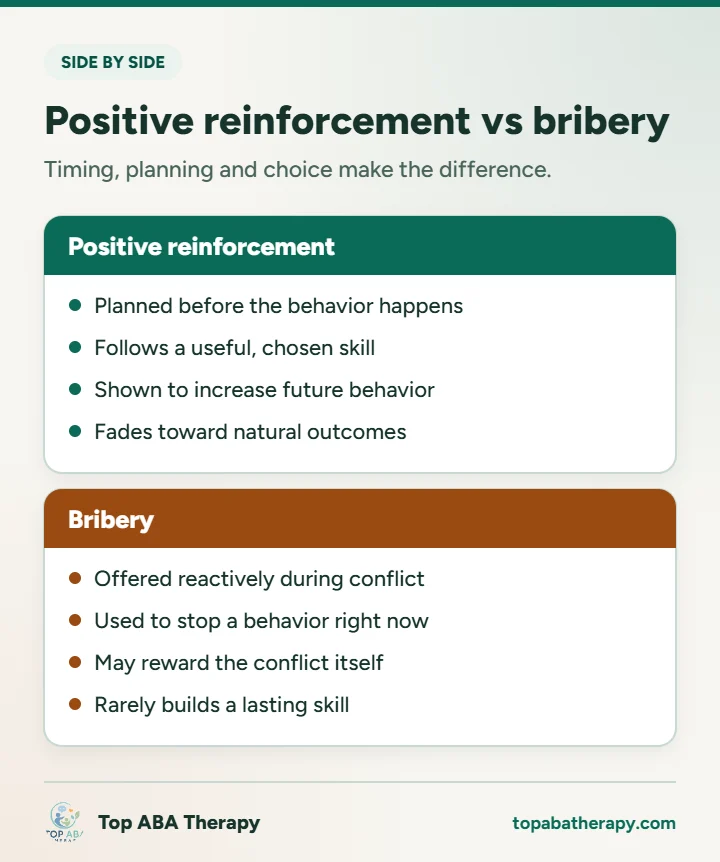
A common distinction is that reinforcement is planned and follows behavior, while a bribe is offered reactively to influence behavior. A bribe may be offered during conflict or to induce improper conduct. Everyday language is less precise, and timing alone does not make a practice ethical. Reinforcement is one of several ABA therapy techniques, and it should always be judged as part of the whole plan.

How do schedules, tokens, praise, food, and natural outcomes work?
Natural and contrived reinforcement
Natural reinforcement follows from the skill itself, such as a request producing access or navigation reaching a destination. Contrived outcomes such as tokens may support early learning, but the provider should connect the skill to durable real-life results. Fading should shift schedules and contexts gradually while checking that the behavior remains useful and voluntary.
Reinforcement schedules
A schedule states when reinforcement is available. Continuous and intermittent arrangements can affect acquisition, persistence, predictability, and frustration. Changes should follow learning data, not cost reduction or arbitrary delay. During thinning, monitor skill loss, distress, earlier behavior, urgent communication, and whether natural outcomes have actually become available.
Tokens and conditioned reinforcers
Tokens can gain value through reliable exchange and may support delayed access or choice. Risks include confusing rules, revoked earnings, excessive delay, stigma, manipulation, and constant transactions. The person should understand the system, choose outcomes, retain earned access, opt out where possible, and move toward natural support; public boards can expose private treatment information.
Praise and social attention
Praise is reinforcing only if it increases behavior. Some people value enthusiastic public praise; others find it embarrassing, infantilizing, overwhelming, or meaningless. Feedback can be specific and respectful without demanding a social performance in return.
Food and access to basic needs
Food use raises concern when it depends on deprivation, cannot be declined, or ignores health, feeding, dental, nutrition, allergy, swallowing, or cultural needs. Water, meals, toileting, sleep, pain relief, communication, safety, sensory regulation, and humane interaction are not bargaining chips. Edible consequences require appropriate expertise, alternatives, ordinary access, consent, limited quantity, and fading.
How do assent, misuse, and extinction change the ethical analysis?
Reinforcement and assent
An attractive consequence does not prove voluntary participation. A person may comply because staff control nearly all preferred access or because refusal has historically been ignored. Our guide on ABA criticism and safety explains why assent matters so much here.
Differential reinforcement and extinction
Differential reinforcement reinforces a defined response pattern while consequences for another behavior differ. The arrangement may include extinction, meaning the discontinuation of reinforcement that previously maintained behavior, even when the marketing description emphasizes positivity.
Ask for the complete procedure. What happens after the other behavior? Is communication still honored? Could behavior intensify? What safety plan, consent, monitoring, and alternative skill apply? Ignoring pain, danger, abuse disclosure, medical symptoms, or assent withdrawal is never justified by calling it planned ignoring.
Common misuse and warning signs
Warning signs include calling every preferred item a reinforcer, manufacturing deprivation, targeting compliance or typical appearance, controlling essentials, changing schedules without review, revoking earned tokens unpredictably, ignoring changes in health or assent, reporting prompted performance as independence, omitting distress, or using “positive reinforcement only” to conceal other components.

How should families review a reinforcement plan?
Goal, consequence, and power
Identify who benefits, how the person chose the goal, whether the response is accessible, and which accommodation could help. Ask how preference is reassessed, what remains freely available, whether essentials or relationships are controlled, and how the person can decline or request a break.
Data and exit
Separate independent from prompted performance. Track generalization, maintenance, distress, burden, and adverse effects, then define schedule thinning, natural outcomes, and thresholds for modification, referral, pause, or discontinuation.
Reinforcement at home and school
Families and educators already use consequences in daily life, often without formal labels. Clinical recommendations should fit relationships and routines without making every interaction transactional.
Do not infer quality from “positive” language
Positive reinforcement can support communication, independence, participation, and useful learning. It can also be embedded in a coercive system. Evaluate the whole arrangement: goal, deprivation, choice, consent, assent, implementation, schedule, alternatives, experience, outcomes, and control over exit.
Verify provider claims
A provider profile may say it uses positive reinforcement, but that cannot show how individual staff control access or respond to refusal. Ask for plain-language procedures, observe a session when possible, and compare answers using our questions to ask an ABA provider.
Frequently asked questions about positive reinforcement
What does “positive” mean in positive reinforcement?
It means something is added after behavior. It does not mean pleasant, ethical, or beneficial. Those judgments require separate evidence about goals, experience, access, power, and outcomes.
Is a preferred item automatically a reinforcer?
No. Preference predicts possible value, while reinforcement requires a measured increase in behavior under relevant conditions. Both preference and effect can change across time and contexts.
Is positive reinforcement the same as bribery?
Not exactly, but timing alone does not settle the ethics. Examine whether expectations are reasonable, the person can decline, essentials remain available, and the goal serves them.
Can food or tokens be used as reinforcement?
They can function as reinforcers, but use requires consent, clear rules, health review, proportionality, ordinary access, meaningful alternatives, privacy, and a plan to fade arranged control.
The bottom line
Positive reinforcement in ABA is defined by what actually happens to future behavior, not by calling something a reward. Used well, it builds communication and independence around goals the person values, keeps basic needs off the table, respects refusal and fades toward natural outcomes. Ask any provider to explain their reinforcement plan in plain language, then compare ABA therapy providers near you on how they answer.