

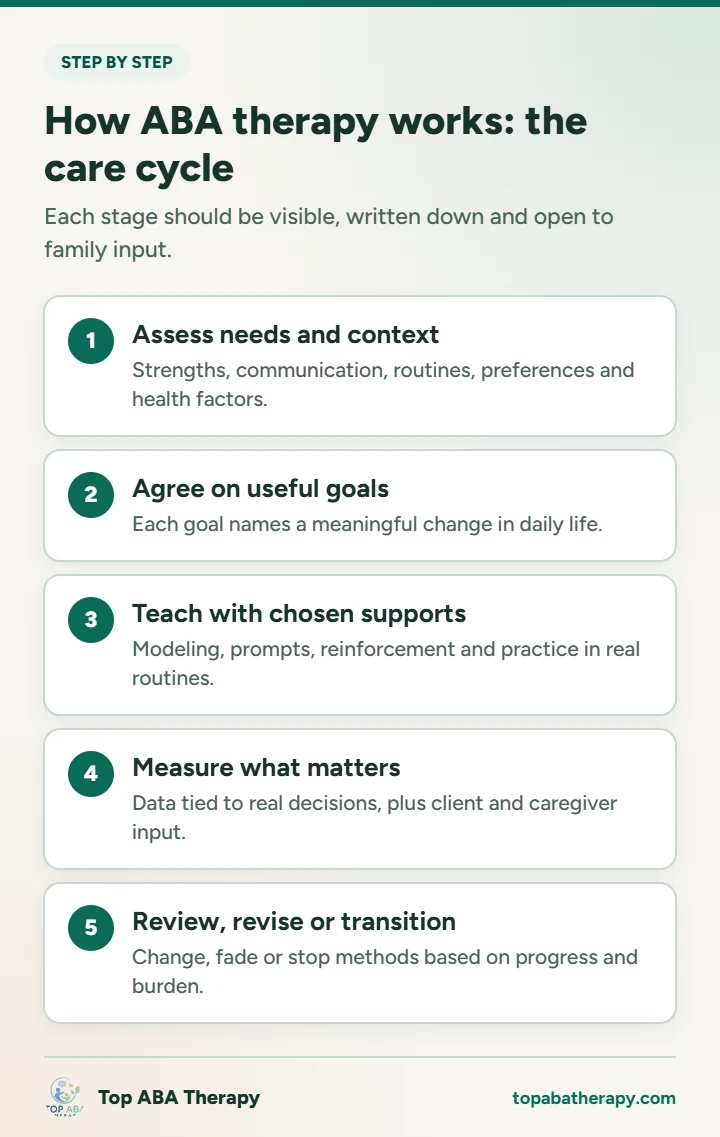
Quick answer: ABA therapy follows a cycle: assess needs and context, agree on useful goals, choose supports, collect data and revise the plan. Teaching may include modeling, prompts, reinforcement and practice in daily routines. The provider should explain what will change, how progress is measured and when a method will be modified or stopped.
How do assessment and shared goals shape ABA?
“ABA services” can describe several parts of care: intake, benefits verification, behavior-analytic assessment, treatment planning, direct service, protocol modification, supervision, caregiver guidance, reassessment, coordination, and transition. Not every provider offers every service. Payer billing categories also do not decide what is clinically appropriate.
- What useful change is being pursued?
- Why does it matter to the person receiving services?
- How will the team know whether it happened in daily life?
- What burden, distress, refusal, or unintended effect would trigger review?
| Weak goal language | More useful goal language |
|---|---|
| Improve behavior | Use an accessible way to request a break during difficult routines |
| Increase compliance | Participate in a necessary safety routine while retaining a way to pause or refuse |
| Reduce stimming | Address injury or a concrete barrier while preserving harmless self-regulation |
| Improve social skills | Initiate a preferred shared activity and recognize when another person is unavailable |

What happens during teaching, and who does what?
There is no universal ABA session. Teaching may use structured practice, play, daily routines, community activities, caregiver coaching, or a mix. Our guide to what ABA therapy is explains why the term covers focused practices and larger programs.
Care boundary: ABA does not replace medical assessment of pain, sleep, seizures, gastrointestinal problems, medication effects, or other health concerns. A sudden or unexplained change should not be treated as a behavior problem until relevant health and environmental causes are considered.
Common teaching methods families may see
- Modeling: an adult or peer shows the skill first.
- Prompting and fading: help such as a gesture, a model, or a verbal hint is offered, then reduced as the person succeeds.
- Reinforcement: something the person values follows a successful attempt, so the skill becomes more likely.
- Structured practice: short, repeated opportunities in a defined activity.
- Naturalistic teaching: practice built into play, snacks, outings, and routines the person already cares about.
Who does what on the team
A behavior analyst usually assesses, writes and adjusts the plan, and supervises. A behavior technician, often an RBT, delivers many sessions and records data. Check what BCBAs and RBTs are each responsible for before you agree to a staffing plan. Caregivers are part of the team too: coaching helps skills carry over into evenings, weekends, and places the therapist never visits.
Where sessions happen shapes what can be practiced, so weigh home and center settings against the goals you agreed on.
How should measurement lead to review and transition?
ABA is often called data-driven, but a count or graph is useful only when it answers a real decision. Communication data should show whether requests are independent, understood, and honored across routines. Safety data should come from ethical practice opportunities, not manufactured danger. A reduction in visible distress does not prove that the person feels safer.
Different goals need different measures. A communication goal may track independent requests across people and routines while also checking whether adults honor them. A daily-living goal may record which steps occur with less help, without turning speed into the only outcome. A safety goal should use planned ethical opportunities and never manufacture danger merely to collect data. Client report, accessible preference indicators, and caregiver observations can add information that a frequency count misses.
Transition should be planned from the start, not announced at the end. A good plan describes how prompts and session hours will be reduced as skills hold, how caregivers, teachers, or other providers will take over support, and how the team will check that skills last after services change. Ask when the next reassessment is due and what result would lead to fewer hours or discharge.
The Top ABA Therapy provider directory can organize identities, locations, and reported services using dated evidence. It cannot prescribe care or decide that a program is clinically suitable. Use it to create a shortlist, then verify credentials, supervision, current availability, goals, safeguards, cost, and transition directly.

What should families ask at each stage of ABA?
Each stage of the ABA cycle has a different job, so the most useful questions change as care moves forward.
- Intake: Who will be the responsible clinician, and what will you need from us before the assessment?
- Assessment: What did you observe, which settings did you see, and what was outside your scope?
- Goals and plan: How does each goal improve daily life, and how was the person’s preference considered?
- Teaching: Which methods will you use, how will prompts be faded, and how is refusal handled?
- Review: Which data will we see, how often, and what would cause you to change the plan?
- Transition: How will support be reduced, and who will maintain skills afterward?
Keep the answers in one place. Comparing them over time makes it easier to notice when a plan drifts from what was agreed.
Frequently asked questions about how ABA works
Who creates an ABA treatment plan?
A qualified behavior analyst typically conducts or oversees the behavior-analytic assessment and develops the plan within applicable law and competence. Ask for the responsible clinician’s name, credential, role, and actual availability for the case.
What does an RBT do during ABA therapy?
An RBT may implement assigned procedures, collect data, and communicate observations under ongoing supervision. An RBT does not independently assess, diagnose, or redesign clinical treatment.
Does every ABA session involve rewards?
Reinforcement is a core learning principle, but ethical implementation is broader than handing out rewards. The team must understand current preferences, preserve ordinary rights, avoid coercion, and connect support to a meaningful skill.
What happens if ABA is not working?
The team should review the target, method, context, implementation, health factors, burden, and measurement. A defensible plan identifies in advance what would cause modification, referral, reduction, pause, or discharge.
How long does it take to see progress in ABA?
It varies with the goal, the person, and how consistently skills are practiced across settings. Rather than waiting for a fixed date, agree on a review point when the plan starts and ask what change the team expects to see by then. If nothing meaningful has changed, the plan, not the person, should be reexamined.
The bottom line
How does ABA therapy work when it is done well? It moves through a visible cycle: assess the person and their context, agree on goals that matter in daily life, teach with respectful supports, measure what actually informs decisions, and review or transition on a schedule everyone knows. If a provider cannot show you each step in writing, keep asking until they can. When you are ready to compare teams, search ABA providers in your area.