

Quick answer: Ask an ABA provider who assesses, supervises and delivers care; how goals and methods are chosen; how refusal and communication affect sessions; and how benefit and harm are measured. Also ask about staffing, coverage, costs, complaints and discharge. Use the same questions with each finalist and record specific answers.
How should you prepare and record provider answers?
Write down the person’s strengths, communication methods, preferences, goals, health and safety context, desired settings, schedule limits, payer, travel range, and accessibility needs. Do not send detailed health records until you have verified the organization, purpose, recipient, and secure channel.
| Evidence status | How to interpret the answer |
|---|---|
| Verified | Confirmed through an authoritative registry, payer, current document, or direct observation |
| Provider-reported | Stated by the organization but not independently confirmed |
| Conditional | Applies only to a named person, payer, service, setting, schedule, or date |
| Unknown | Evidence is unavailable or the decision has not been made yet |
| Refused or conflicted | The provider will not answer, or credible sources disagree and need resolution |

Questions 1–25: accountability, goals, methods, and communication
Credentials and clinical responsibility
- Who is the accountable clinician, and what are their full name, role, credential, employer, and applicable license?
- Where can I verify current credential and license status, including restrictions?
- What competence matches this person’s age, communication, goals, setting, and co-occurring needs?
- Who performs each assessment component, and who owns and signs the conclusions?
- Who decides when clinical judgment, operations, family preference, and payer rules conflict?
Certification, state authorization, payer enrollment, and competence are distinct. A current credential does not prove individual fit.
Assessment and treatment planning
- Which assessment methods will you use, and how does each answer the referral question?
- How will pain, health, sleep, communication, sensory needs, trauma, education, and environment be considered?
- How will the person and family identify priorities in accessible ways?
- Which other professional expertise might be needed, and how do referral and coordination work?
- When will we receive understandable findings, limitations, recommendations, and available records?
Assessment should answer real questions. Ask how each finding will connect to a specific goal or support in the plan.
Goals, autonomy, and assent
- How do you decide whether a goal improves the person’s life instead of adult convenience or typical appearance?
- How can the person choose, reject, or revise goals through their own communication method?
- How do staff recognize assent, withdrawal, avoidance, shutdown, distress, or a request to stop?
- Do you target eye contact, stimming, quiet hands, typical play, or compliance; if so, what person-valued function justifies it?
- How do you support refusal, boundaries, self-advocacy, and access to trusted help?
Ask for a goal the organization would decline as unethical. Values become credible when they create limits, not only attractive language.
Methods and restrictions
- Which teaching and behavior-support methods might be used, in plain language?
- What happens after an error, refusal, distress, attempt to leave, or behavior creating risk?
- Can plans use physical prompting, blocking, planned ignoring, extinction, response cost, punishment, restraint, seclusion, or crisis procedures?
- Which methods are prohibited, and which require specific consent, review, oversight, data, and fading?
- How are communication access, health evaluation, environmental accommodation, and less intrusive options considered?
“Positive only” is not a procedure. The ABA therapy red flags guide distinguishes clarification from clinical, compliance, protective, or emergency action.
Communication and coordinated care
- How do you support speech, AAC, sign, gesture, writing, movement, or other effective forms?
- Will staff ever remove a communication device or require speech before honoring a message?
- How do you work with speech-language, occupational, medical, psychological, educational, or other professionals?
- How are permission, records, roles, and conflicting recommendations handled?
- How do you avoid duplicated services and an overall schedule the person or family cannot sustain?
ABA does not replace every profession. Coordination needs permission, boundaries, purpose, and an owner.
Questions 26–50: staff, outcomes, safety, costs, and exit
Direct staff and supervision
- Who will deliver sessions, and what credential or technician role does each person hold?
- What person-specific training and competency check happens before unsupervised implementation?
- How often will the accountable clinician directly observe this person and technician together?
- What are the supervisor’s caseload, staff-turnover, substitution, coverage, and after-hours practices?
- How can a person or family request a staff change or report a concern without retaliation?
Written supervision promises should match records. The BCBA vs RBT guide separates decisions from supervised implementation.
Progress, benefit, and harm
- Which baseline and ongoing measures will be collected, and can we understand the definitions and graphs?
- Are independent, prompted, corrected, unavailable, and generalized responses separated?
- How are treatment integrity, observer agreement, generalization, and maintenance checked?
- How are quality of life, social validity, assent, burden, and possible adverse effects monitored?
- What evidence triggers change, fewer hours, referral, pause, step-down, transition, or discharge?
Attendance is not an outcome. Ask to see a de-identified sample progress report so you know what you will receive.
Safety, privacy, and complaint rights
- What are the emergency, incident, injury, illness, elopement, suspected-abuse, and crisis procedures?
- Who reviews incidents, what gets reported, and how are corrective actions tracked?
- How do you govern cameras, recordings, personal devices, telehealth, shared spaces, vendors, retention, and breaches?
- Which boundaries cover transport, gifts, messaging, social media, private spaces, siblings, peers, and personal care?
- What internal and external complaint routes exist, and how is retaliation prevented?
HIPAA coverage depends on the organization, information, and activity, so ask concrete privacy questions. Immediate danger or suspected abuse needs an appropriate emergency or protective route.
Schedule, setting, and family role
- Why does the proposed home, center, school, community, telehealth, or hybrid setting fit each goal?
- Which days, times, travel, attendance, cancellation, makeup, holiday, and substitution terms apply?
- What caregiver participation is expected, who requires it, and how will it remain accessible and sustainable?
- How will services preserve sleep, school or work, play, relationships, healthcare, and community life?
- What happens if staffing, schedule, health, preference, location, or family capacity changes?
An opening is not a fit when its burden is unsustainable. Confirm the schedule and family role before scarcity drives the decision. If you are still deciding on a setting, compare in-home and center-based options first.
Insurance, costs, and leaving care
- Is the exact entity, location, and rendering professional in network, and how can we verify independently?
- Which assessment, treatment, caregiver, group, telehealth, supervision, travel, or noncovered costs may apply?
- Which estimate, authorization, attendance, cancellation, refund, collection, and change notices will we receive?
- What are the clinical and operational criteria for step-down, transition, referral, pause, and discharge?
- How are records, continuity, final reporting, authorizations, balances, and referrals handled when care ends?
Coverage neither proves fit nor guarantees payment. Member notices control appeal rights and deadlines. Before the call, check your plan’s ABA benefits so you can compare the provider’s answers with the plan’s.

How should you compare ABA provider answers?
Strong answers identify a person, policy, evidence source, exception, and follow-up date. Useful examples include: “The BCBA decides after assessment using these criteria”; “this technician is not assigned, and here is the competency process”; or “the payer quoted this benefit under this reference number, but payment is not guaranteed.”
Weak answers rely on universals: every child gets the same proven program, the BCBA supervises everything, treatment is always positive, insurance covers it, parents must participate, or incidents never happen. Ask once for details. A repeated pattern of evasion matters more than polished branding.
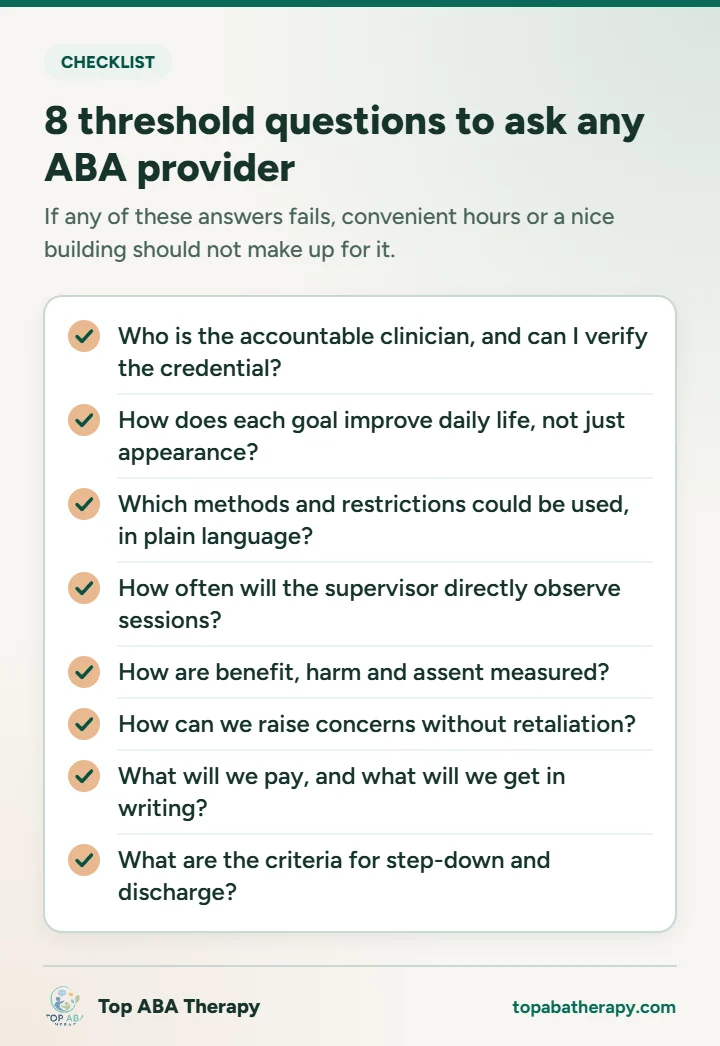
Do not average a safety failure with convenient hours. Identity and credentials, person-valued goals, disclosed methods, real supervision, benefit-and-harm measurement, complaint protection, financial clarity, and a workable exit are threshold domains. Compare schedule, décor, amenities, and convenience only after those thresholds are acceptable.
Ask for current policies, credential and supervisor details, consent and privacy forms, attendance and financial terms, a sample de-identified plan or report structure when available, secure-record instructions, complaint contacts, and the next intake stage. Do not expect another client’s protected information.
Top ABA Therapy distinguishes corroborated directory fields from provider-reported claims and dates its evidence. Inclusion is not endorsement, and paid enhancements cannot prove fit or quality. Use the directory to organize a search, then verify the actual clinician, site, service, payer, and policies.
Frequently asked questions about interviewing ABA providers
Should I ask all 50 questions in one call?
Not necessarily. Use a short prescreen first, then send detailed questions before assessment, plan approval, or financial commitment. Keep the same core domains across providers so comparison remains fair.
What if the intake coordinator cannot answer clinical questions?
That can be appropriate. Ask who can answer, how to reach them, and when. The concern is not one person’s limits; it is an organization with no accountable clinical route.
Is a BACB credential enough to verify a provider?
No. Verify the individual credential, applicable state license, competence, employer role, payer status, supervision, and current assignment. Each layer answers a different question.
What if a provider refuses to share proprietary procedures?
Trade secrets do not erase informed consent. Families need an understandable description of proposed methods, risks, alternatives, restrictions, data, and exit. Protected client information and legitimate proprietary detail can remain private.
The bottom line
The best questions to ask an ABA provider are the ones that produce verifiable answers: a named clinician, written goals and methods, a real supervision schedule, honest measures of benefit and harm, clear costs, and a defined exit. Ask the same core questions of every finalist, record whether each answer is verified or only reported, and treat safety and accountability as thresholds rather than tradeoffs. Then compare ABA therapy providers near you with your answers in hand.