

Quick answer: ABA hours should follow an individualized assessment, meaningful goals and ongoing response. No weekly number fits every child, teen or adult. Ask why the proposed schedule is needed, how it fits school, sleep and ordinary life, and what data would support reducing, changing or ending services.
What does current evidence say about ABA hours?
Hours measure resources, not outcomes
Attendance, scheduled time, billable units, and authorization describe service use. They do not show whether communication, autonomy, safety, participation, relationships, daily life, or quality of life improved. A plan that meets its hour target can still fail its person-valued goals.
A research range is not an individual prescription
The 2025 National Academies report distinguishes focused practices, broader programs and individual needs. It does not supply one schedule for every person. Ask the clinician to explain the goal-level rationale for proposed hours and what evidence would support a change. Good goals come first; see meaningful ABA treatment goals for examples.
The 2025 AHRQ evidence map identifies unanswered questions about optimal use, intensity, long-term outcomes, and discontinuation. Evidence is especially limited for adults, direct dosage comparisons by goal, adverse effects, and separating hours from selection and implementation quality. A population result cannot decide whether one person needs 2, 10, 20, 30, or another number.
Comprehensive and focused work should not be conflated
A multi-domain early program and a focused intervention for one functional goal answer different questions. Total weekly hours can also combine assessment, direct teaching, caregiver consultation, group work, protocol modification, supervision, telehealth, and indirect analysis. Two “20-hour” plans may expose a person to very different staff, procedures, settings, and demands.

How should an individual ABA schedule be built?
Connect each goal to real opportunities
A daily routine can offer frequent natural opportunities without long formal sessions. A rare safety event may call for environmental protection, simulation, periodic practice, communication access, or caregiver support. A new response may need distributed use with several people and settings.
| Scheduling decision | Evidence to examine |
|---|---|
| Service type and qualified person | Goal, competence, role boundaries, supervision, other professions, and payer rules |
| Session length and weekly frequency | Opportunity, stamina, pain, sleep, medication, transitions, travel, recovery, and response across time |
| Setting and modality | Natural context, privacy, staff access, peers, technology, safety, and generalization purpose |
| Total duration of care | Baseline, progress, maintenance, uncertainty, burden, changing priorities, and exit criteria |
| Caregiver role | Consent, accessibility, learning goal, available time, family workload, and whether the task belongs to a professional |
Map the whole week
Plot sleep, meals, healthcare, school or work, commutes, other therapies, play, interests, exercise, relationships, community, personal care, downtime, and caregiver responsibilities. Add preparation, waiting, documentation, home intrusion, sibling impact, transportation, and lost work even when insurance pays the clinical bill.
Session length and frequency create different burdens
The same total can be delivered in a few long visits or many short ones. Long sessions may exceed stamina or serve staff scheduling. Short visits can create excessive travel, transitions, handoffs, and interruption. Review data across session duration, goal timing, setting, supervisor presence, cancellations, and makeup policies instead of optimizing only for convenience.
Treat assent and health as decision data
Sitting through a schedule is not proof of benefit. Monitor approach, choice, communication, withdrawal, avoidance, shutdown, distress, fatigue, sleep, appetite, health, and recovery through accessible methods. Persistent rejection of a person, setting, goal, or procedure calls for analysis and change, not automatic exposure.
Autistic-led ethics guidance emphasizes autonomy, person-defined goals, evidence, and quality of life. That means an intensity review cannot rely only on caregiver convenience, reduced visible difference, or clinician-rated compliance. The person’s accessible report and behavior, including refusal and recovery after sessions, belongs beside performance data.

What should change ABA hours or the plan?
When more service might make sense
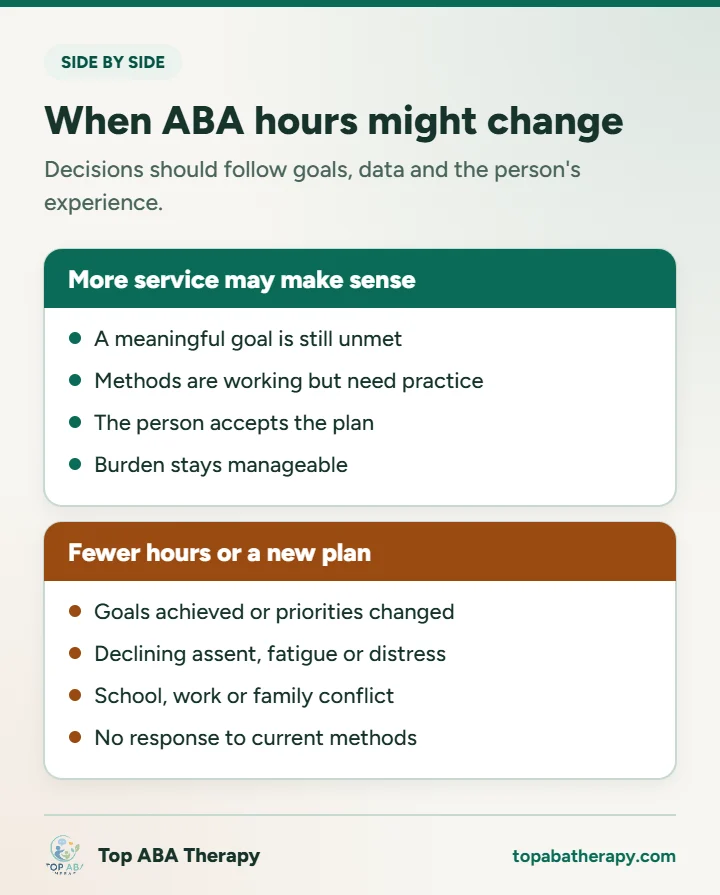
Additional service may be reasonable when a meaningful unmet goal has credible evidence, current methods are implemented competently, more useful opportunities are likely to help, the person accepts the plan, burden remains manageable, and environmental changes or other supports do not answer the need.
When fewer hours or a different plan might fit
Reasons include achieved goals, increasing independence, effective natural support, changed priorities, declining assent, fatigue, adverse effects, family burden, school or work conflict, nonresponse, another profession’s role, unstable staff, or evidence favoring another method or setting.
Let progress data support, not replace, judgment
Reports should separate independent and prompted performance, show baseline and changes, test generalization and maintenance, audit implementation, and include social validity, quality of life, burden, and possible harm. Nonresponse does not automatically justify more hours. A favorable graph does not justify continuation when the goal has lost value or transfer is absent. Our guide to how ABA progress is measured explains which data deserve the most weight.
Keep payer permission separate from clinical need
A payer may authorize fewer, equal, or more units than requested. That is a funding determination under plan rules, not an instruction to use every unit or proof that the amount is optimal. Ask the clinician for the independent rationale and the payer for the written scope. Track scheduled, delivered, documented, billed, and remaining units by service type.
Only a qualified, individualized assessment can support a recommendation for hours. When you compare providers, ask each one to explain its proposed schedule goal by goal, and use our prior authorization guide to check what your plan actually approved.
Frequently asked questions about ABA frequency and hours
How many hours of ABA does a child need?
There is no universal number. Goals, baseline, methods, opportunities, health, school, other support, assent, family capacity, burden, response, and transition all matter. Ask for a goal-by-goal rationale.
Is 10 to 20 hours a standard recommendation?
No. A weekly range cannot replace an individual assessment. Ask which goals require the proposed hours, how the schedule fits daily life, and what would justify reducing or changing it.
Are longer ABA sessions more effective?
Not inherently. Longer sessions may add opportunities or may add fatigue and distress. Compare goal timing, performance across the session, recovery, travel, setting, and ordinary-life disruption.
Should hours increase when progress is slow?
Not automatically. Reassess goals, measurement, health, communication, staff competence, supervision, method, setting, assent, generalization, burden, and alternatives before changing intensity.
The bottom line
The right ABA session frequency and hours come from individualized goals, real opportunities to practice, the person’s health and assent, and the realities of family life, not from a standard package or the maximum a plan will approve. Ask for a goal-by-goal rationale, map the whole week, and review intensity as data and priorities change. When you compare programs, find ABA therapy providers near you and ask how they set and adjust hours.
Sources
- Intensive behavioural interventions based on applied behaviour analysis for young children with autism: An international collaborative individual participant data meta-analysis.
- The National Academies Press | The Comprehensive Autism Care Demonstration: Solutions for Military Families: Evaluating ABA Services, Access, and Recommendations for the TRICARE Program
- For Whose Benefit?: Evidence, Ethics, and Effectiveness of Autism Interventions – Autistic Self Advocacy Network