
Quick answer: ABA treatment goals should describe useful, measurable changes that matter to the person, such as communication, safety, access or daily participation. Goals need a baseline, clear success criteria and review rules, including real-life use and possible harm. Typical appearance, obedience and adult convenience should not be default treatment outcomes.
How should meaningful ABA treatment goals be selected?
Who should choose ABA goals?
Goal selection should be collaborative. The person receiving services should participate through speech, AAC, gesture, supported decision-making, observation of preferences, or other accessible means. Families or authorized representatives may contribute priorities and context. The clinician contributes assessment and evidence, while other professionals may bring relevant expertise.
Start with strengths, access, and environmental fit
Assessment should identify strengths, interests, communication, successful environments, relationships, routines, health, sensory needs, barriers, and existing supports instead of documenting only deficits.
A goal-quality rubric
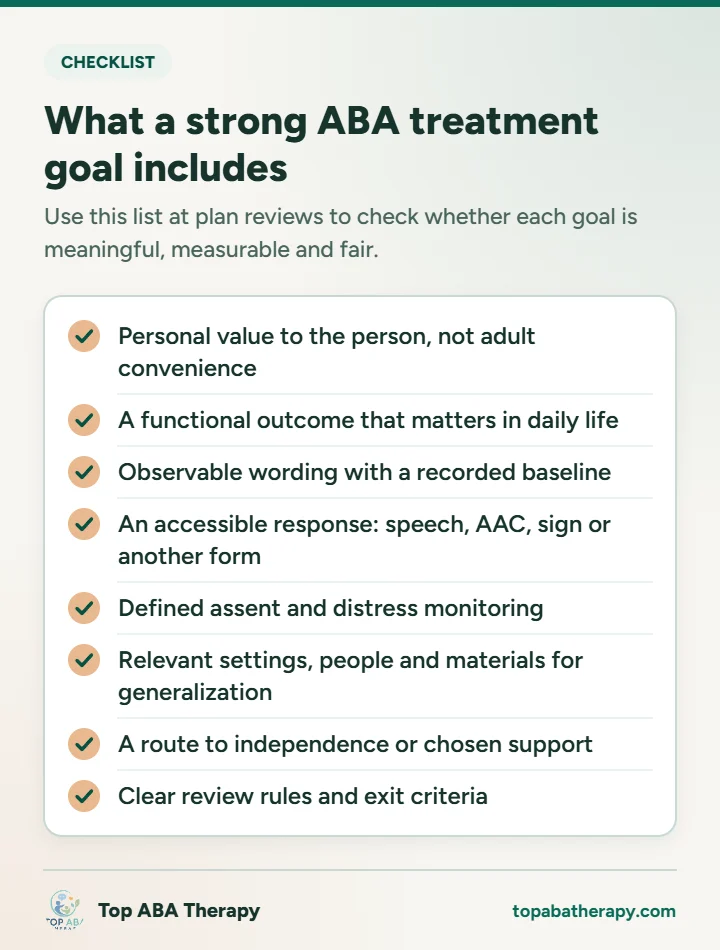
A strong goal has personal value, a functional outcome, observable wording, an accessible response, defined assent, relevant contexts, a route to independence, goal-specific evidence, multidimensional review, and exit criteria. Warning signs include adult convenience, compliance without benefit, vague wording, inaccessible response demands, ignored distress, one-room mastery, prompted performance presented as independence, generic evidence, accuracy-only review, and indefinite continuation.
Communication goals
Communication goals may support requesting, refusing, asking for help, reporting pain, sharing information, making choices, commenting, repairing misunderstandings, social connection, or self-advocacy. Effective forms may include speech, AAC, sign, gesture, pictures, writing, movement, or combinations.
Daily-living and autonomy goals
Daily-living goals can involve dressing, hygiene, meals, household participation, money, schedules, transportation, technology, healthcare routines, or community navigation. The goal should reflect what the person wants or needs, the supports available, privacy, culture, health, and other professional expertise.
Safety goals without generalized compliance
Safety goals may address communication in emergencies, identifying trusted support, responding to relevant hazards, community navigation, medical cooperation with consent, or alternatives to behavior creating serious risk.
Social, relationship, and play goals
Social goals should expand access to desired relationships and participation rather than enforce typical eye contact, facial expression, body movement, conversation style, or play. Autistic people may prefer parallel activity, focused interests, direct language, AAC, fewer relationships, or different social rhythms.
Learning, school, work, and community goals
Goals can support task initiation, asking for clarification, using accommodations, planning, self-monitoring, transitions, workplace routines, transportation, or community access. They should complement accessible instruction, education rights, job accommodations, and competent support from other professions rather than replace them.
Goals related to behavior creating harm or barriers
When behavior creates a serious safety risk or prevents meaningful access, the team should define it observably and assess health, pain, communication, sensory, trauma, task, relationship, and environmental factors. A careful functional behavior assessment helps the team choose skills and supports that address the likely cause rather than only reducing the behavior.
Examples: weak wording versus stronger direction
| Weak or risky target | Stronger direction to assess collaboratively |
|---|---|
| “Will make eye contact 80% of the time” | Will access and respond to relevant communication using a comfortable orientation or signal |
| “Will have quiet hands” | Will use preferred regulation strategies safely and communicate when accommodation is needed |
| “Will comply with adult demands” | Will understand relevant requests, choose or negotiate, refuse unsafe demands, and ask for help or a break |
| “Will reduce tantrums” | Will access communication and environmental supports addressing the assessed need, with distress and safety monitored |
| “Will play appropriately” | Will expand chosen leisure or shared-play options while preserving authentic interests |
| “Will be independent in hygiene” | Will direct or complete chosen hygiene steps with accessible supports, privacy, and consent |
These are reframing examples, not individual treatment recommendations. Each requires assessment and the person’s priorities.
What does a well-written ABA treatment goal look like?
Here is an illustrative goal for a child who becomes distressed when activities get hard and has no reliable way to ask for help:
During play and snack routines at home and at the center, the child will request help or a break using their AAC device, a sign or speech, without prompts, across two different adults. Staff will also record signs of distress or refusal, and the team will review the goal monthly with the family.
Notice what each part does:
- Personal value: asking for help or a break gives the child more control, not just more compliance.
- Accessible response: any effective form of communication counts.
- Real contexts: it names the routines, settings and people where the skill matters.
- Independence: success means unprompted use, not prompted performance.
- Assent and review: distress is tracked, and there is a set point to revisit the goal.
Before the goal starts, the plan should also record a baseline and the specific mastery criterion, so everyone can tell whether it is working. This example is for illustration only; real goals depend on assessment and the person’s priorities.
How should goals be measured, reviewed, and retired?
Measurement should match the real outcome
An observable goal needs a baseline, definition, measurement method, context, mastery criterion, generalization test, maintenance interval, and review rule. But the easiest metric may not be the most meaningful. Counting correct responses at a table is easy, for example, but whether the person uses the skill at home, at school or with friends usually matters more.
Generalization and maintenance belong in the goal
If a skill matters at home, school, work, or in the community, the plan should name the relevant people, materials, and conditions. Generalization should be tested directly rather than inferred from one teaching setup.
Assent and adverse effects
Every goal needs a plan for recognizing approach, engagement, refusal, avoidance, shutdown, distress, fatigue, and other indicators of experience. Legal consent from a representative does not make the person’s communication irrelevant.
Review intensity goal by goal
Weekly hours should not be the primary goal. The plan should explain which goals require which opportunities, what can occur naturally, what other services or life activities compete for time, and how response and burden affect intensity.
Red flags in a goal plan
Red flags include diagnosis-based templates, appearance or obedience targets, inaccessible choice, excluded AAC, prompted performance reported as independence, no real-world rationale, missing distress data, dismissed accommodations, unchanged goals despite nonresponse, and no transition or discharge criteria. Compare your plan with these other warning signs to watch for across the wider program.
Questions to ask at treatment-plan review
Ask who requested and benefits from each goal, how the person can reject it, which strength or barrier informs it, what baseline and method apply, which alternatives were considered, who implements and supervises, what the person experiences, how benefit and burden are measured, and what triggers change, referral, pause, transition, or discharge. If you are still choosing a provider, bring our questions to ask before services start to the intake meeting.
Verify directory and provider claims
The directory home page offers routes into providers, locations, service settings, insurance, comparisons, and education. A directory cannot inspect an individual’s treatment plan or guarantee that listed providers use person-centered goals. Ask to review the process and sample de-identified structures.

Frequently asked questions about ABA treatment goals
Who should choose ABA treatment goals?
The person should participate through accessible communication and supported decision-making, with family context, clinical evidence, and relevant professional input. A prewritten diagnosis-based list is not shared choice.
Must every ABA goal target independence?
No. Interdependence, directing support, assistive technology, partial participation, accommodation, and chosen help may be more useful than unaided performance.
Are eye contact and quiet hands appropriate goals?
Not merely for typical appearance. Ask whether a target improves person-valued access or safety and whether harmless autistic communication, movement, or regulation would be suppressed.
How should an ABA goal be measured?
Use baseline, independent performance, relevant context, generalization, maintenance, personal benefit, burden, adverse effects, and a rule for changing or retiring the goal.
How often should ABA treatment goals be reviewed?
There is no single schedule for every plan, and providers or payers may set their own review periods. Ask how often the supervising BCBA reviews data, when formal plan updates happen, and what triggers an earlier review, such as no progress, new distress, a health change or a shift in the person’s priorities.
The bottom line
Good ABA treatment goals describe changes the person would value, such as communicating, staying safe or taking part in daily life, and they are written so everyone can see whether they are working. Insist on a baseline, accessible responses, real-world contexts, assent monitoring and clear rules for changing or retiring each goal. Treat appearance and obedience targets as red flags, and keep the person at the center of every review. When you are ready, search ABA providers in your area and ask to see how each one writes goals.