

Quick answer: ABA progress is measured by comparing a credible baseline with repeated data on an agreed goal. Reports should distinguish independent from prompted performance and check real-life use, maintenance, burden and possible harm. Attendance, billed hours and a rising graph do not establish meaningful improvement by themselves.
What should ABA measurement show?
Start with an outcome worth measuring
A precise measure can still track a trivial, unwanted, or harmful goal. Before collecting data, the team should ask who selected the outcome, who benefits, and whether it supports communication, access, autonomy, safety, relationships, participation, daily life, or quality of life. Participation may use speech, AAC, gesture, supported decision-making, preference information, or another method accessible to the person receiving services. Our guide to writing meaningful ABA goals covers how those outcomes are chosen.
Establish a credible baseline
Baseline describes the starting pattern before a new intervention or meaningful plan change and may include frequency, rate, duration, latency, accuracy, opportunity, prompt level, context, or a lasting product of behavior. The right unit depends on the decision: a count without observation time can mislead, while a percentage based on three opportunities can look more stable than it is.
Measure independence, context, and experience
A correct response after a prompt is not the same result as an independent response. Reports should distinguish independent, prompted, corrected, refused, unavailable, and missed opportunities when those distinctions affect the decision. Hidden cues matter too: a learner may appear independent while one technician, one room, or materials arranged in a familiar order do much of the work.
| Measurement question | Useful evidence | What can create a false impression |
|---|---|---|
| Did the target change? | Baseline and repeated data using a defined, suitable measure | Tiny samples, changing opportunities, selective dates, or vague definitions |
| Is the skill usable? | Independent performance with relevant people, materials, settings, and natural outcomes | Prompted clinic trials presented as everyday mastery |
| Is the change beneficial? | Person and family input, access, safety, participation, quality of life, and goal-specific outcomes | Adult convenience or lower behavior counts treated as benefit |
| Is the plan acceptable? | Assent, withdrawal, distress, adverse effects, burden, and preference over time | Missing harm data interpreted as evidence of safety |
| Can the result guide care? | Data quality, implementation checks, uncertainty, and a stated decision rule | A graph shown without context, missingness, or an action threshold |

How should ABA data be collected and interpreted?
Match the method to the question
Frequency counts events. Rate adds a time unit. Duration measures how long something lasts, while latency measures time between a relevant event and a response. Interval methods sample whether behavior occurred during defined periods. Trial data may record accuracy, prompts, errors, and opportunities. Task analyses separate a routine into steps, and permanent-product measures examine a result left behind.
Check whether data collection itself is dependable
Operational definitions should let trained observers identify the same event consistently. Interobserver agreement compares independent records and can reveal ambiguity or observer drift. Treatment-integrity measures ask whether relevant plan steps occurred as intended. Both strengthen interpretation, but neither proves the goal was valuable or that the intervention caused the result.
Sampling should reflect the stakes and likely sources of error. Staff turnover, plan changes, surprising trends, rare high-risk events, and complex procedures may require closer checks. Missing data need labels and explanations. Staff must never be pressured to improve numbers for productivity, authorization, or marketing.
Read graphs with context and uncertainty
Repeated measures are often graphed across time, with plan changes marked as phases, while reviewers may consider level, trend, variability, immediacy of change, overlap between phases, and whether similar changes repeat. Those features can support a clinical judgment; an uncontrolled trend does not establish that treatment caused the change.
Test generalization and maintenance deliberately
Generalization asks whether a skill works with relevant people, materials, settings, cues, and situations outside the teaching arrangement. Maintenance asks whether it persists after time passes or teaching support decreases. Neither should be inferred from mastery with the original technician.
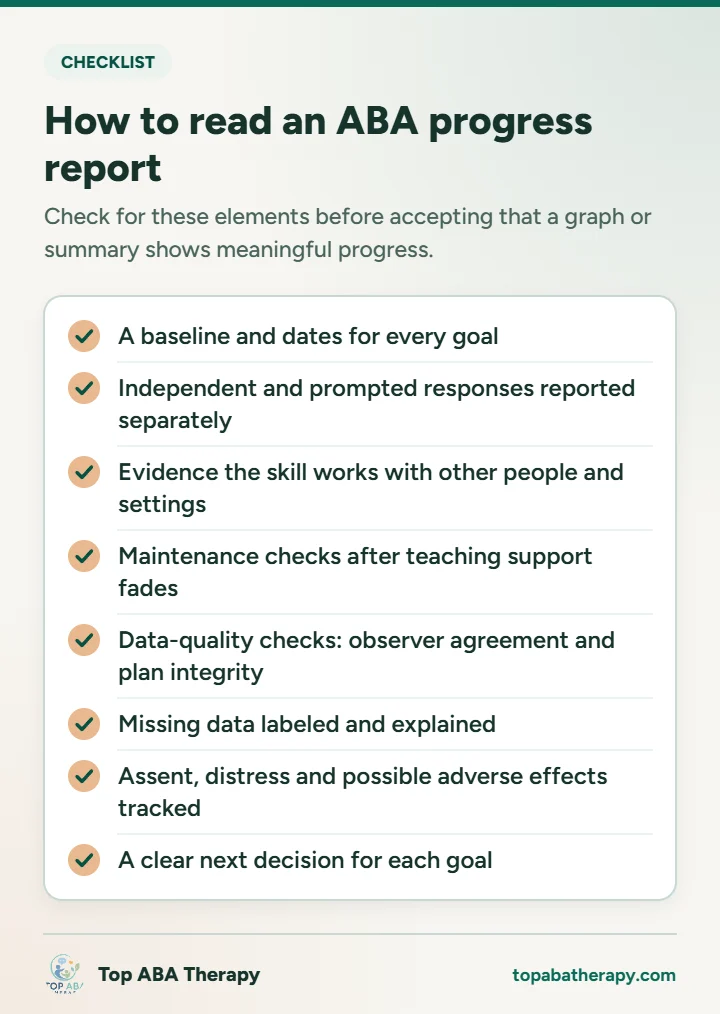
What should an ABA progress report help you decide?
Connect each result to an accountable action
A useful report states the goal rationale, baseline, method, intervention dates, current results, prompts, variability, missing data, integrity checks, generalization, maintenance, lived experience, uncertainty, and next decision. That decision might be to continue, modify, reduce, refer, pause, transition, or end a goal. “Continue because authorization remains” is not a clinical rationale.
Include social validity, burden, and possible harm
Social validity asks whether goals matter, procedures are acceptable, and outcomes are significant. It should include the person receiving services through accessible methods, not only clinician or caregiver satisfaction. Direct report, AAC, choice, preference, assent and withdrawal patterns, engagement, interviews, and observation may all contribute. Preferences can change, so one intake form is not enough.
Possible adverse effects also require active measurement. Examples include fear, avoidance, shutdown, injury, fatigue, loss of trust, prompt dependence, reduced spontaneous communication, masking, generalized compliance, or displacement of valued activities. Family workload and staff safety can matter without overriding the person’s experience. The research literature has not measured harms consistently, so absence of recorded events cannot be treated as proof of safety.
Protect access, comprehension, and privacy
The person and authorized stakeholders should receive reports they can understand. Technical terms can remain when plain-language explanations accompany them. Ask who reviews raw data, how corrections are handled, and how records can be requested. A family should be able to trace a summary claim to the measurement behind it. Knowing what the supervising BCBA is responsible for helps you direct these questions to the right person.
Behavioral records may include health, family, school, location, audio, video, and incident details. Providers should explain which devices and platforms collect data, who can access it, how recordings are authorized, how long records are retained, and whether information is reused for training, research, or marketing. Applicable privacy rules still require case-specific advice; a directory cannot resolve an individual records dispute.
Audit the report before accepting its conclusion
Red flags include billed hours presented as outcomes, identical narrative copied across periods, mastery that combines prompted and independent trials, clinic-only evidence for an everyday goal, a graph without baseline or dates, declining behavior without replacement-skill or well-being evidence, and goals that continue without review or exit criteria. For warning signs beyond the report itself, see our list of ABA program red flags.
Questions to ask at your next progress review
- Which goals changed most since the last report, and how do you know the change is independent?
- Where has each skill been tested outside the teaching setting, and with whom?
- Which goals have not moved, and what will change as a result?
- What have you observed about my child’s comfort, assent and distress during sessions?
- How were the recommended hours decided, and what would lead you to reduce them?
- Can I see the raw data behind one goal you describe as mastered?

Frequently asked questions about measuring ABA progress
Is session accuracy enough to show ABA progress?
No. Session accuracy may show performance under one teaching arrangement. Meaningful progress also considers independence, prompt level, relevant contexts, generalization, maintenance, acceptability, and daily-life benefit. The required evidence should match the goal.
How often should ABA data be reviewed?
There is no responsible universal interval. Review frequency depends on risk, service intensity, data stability, the decision being made, and how quickly harm or nonresponse must be detected. Families can ask who reviews the data and what triggers action between formal reports.
What does an ABA graph prove?
A graph displays a pattern in recorded measures. Its strength depends on definitions, data quality, design, implementation, missingness, phase changes, competing events, and replication. A favorable slope alone does not prove causation, broad benefit, or safety.
What if behavior decreases but the person seems more distressed?
That conflict requires investigation. The team should assess distress, assent, health, communication, environmental conditions, suppression, replacement access, and possible adverse effects. A lower count should not outrank credible evidence that well-being has worsened.
The bottom line
So, how is ABA progress measured? Credibly, by comparing a real baseline with repeated, well-defined data on goals the person values, while separating independent from prompted performance and testing whether skills hold up in everyday life over time. A strong report also tracks assent, burden and possible harm, and ends with a clear decision for each goal. Billed hours and rising graphs alone are not proof. When you are comparing teams, find ABA therapy providers near you and ask each one to show you a sample report.
Sources
- Project AIM: updated systematic review and secondary analysis (2023; reference correction 2026)
- Social Validity of Pivotal Response Treatment for Young Autistic Children: Perspectives of Autistic Adults.
- The National Academies Press | The Comprehensive Autism Care Demonstration: Solutions for Military Families: Evaluating ABA Services, Access, and Recommendations for the TRICARE Program