

Quick answer: ABA prior authorization is a payer’s review of specified assessment or treatment before or during care. Approval may limit services, units, dates, provider and setting. Ask what was approved and when renewal is due. Authorization does not guarantee payment or establish that the recommended care is clinically appropriate.
What should happen before an ABA authorization request?
Before anything is submitted, make sure everyone agrees on these four basics:
| Authorization item | Question to resolve |
|---|---|
| Covered service | Which diagnosis, service code, setting and professional roles qualify? |
| Approved units | Which units and dates were approved, and how does the provider track use? |
| Renewal | Which reports are needed and who submits them before the end date? |
| Denial | What is the written reason, appeal deadline and route for urgent review? |
Separate the requirements
A referral routes a member under plan rules. A prescription or order records a qualified professional’s recommendation when required. Benefits verification reports plan terms. Prior authorization decides a specified request. A claim asks for payment after service. One does not automatically replace another. If you have not confirmed benefits yet, start with our ABA insurance verification call script.
Assessment should drive the packet
A qualified clinician should assess strengths, communication, preferences, health and safety context, environments, existing support, baseline, priorities, and service options. Payer criteria may require certain tools or report components, but paperwork should not predetermine the findings, goals, setting, or hours.
The National Academies’ 2025 review criticized burdensome mandatory measures in the TRICARE demonstration when they were poorly aligned with treatment planning. A clinician can meet applicable documentation rules while explaining an instrument’s limitations and preserving individualized judgment. Insurance requirements never authorize practice outside competence or erase consent, assent, privacy, and referral duties.
Build an accurate, reviewable request
Requirements differ, but the packet may include:
- member, plan, eligibility, referral, diagnosis, or order information;
- provider entity, identifiers, location, enrollment, credentials, and supervision;
- assessment methods, findings, baseline, limitations, and medical-necessity rationale;
- person-valued goals, participants in goal selection, procedures, and settings;
- requested services, units, frequency, duration, dates, modality, and staff model;
- progress, generalization, maintenance, social validity, adverse-effect, transition, and discharge measures;
- prior response, coordination, safety, and less intrusive alternatives when relevant;
- required signatures, consent, attestations, and supporting records.
CPT-related details can identify the requested services, but they are not universal coding or coverage instructions. Never sign blank or inaccurate forms. The provider should explain what is sent and use a verified secure channel.
Submission is incomplete until receipt is confirmed
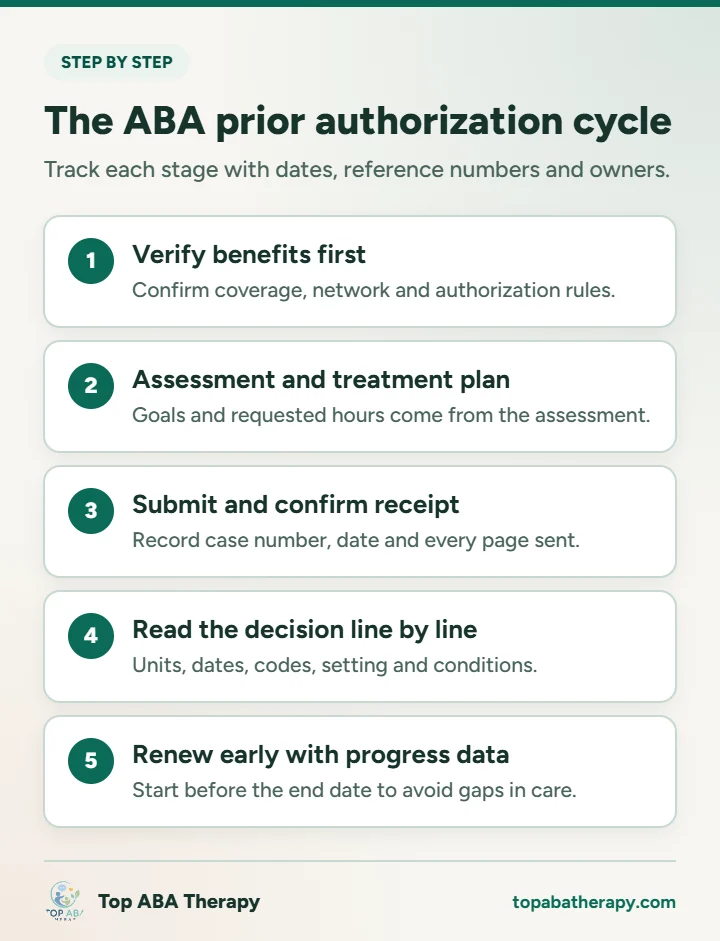
Record the date and time, portal confirmation or transmission evidence, recipient, case number, page count, filenames, request type, and quoted decision period. A successful fax or upload does not prove every page reached the right case.

How should you read and track an ABA authorization?
Replace “pending” with a specific state
Possible states include received, incomplete, pending clinical review, additional information requested, peer review offered, approved, partly approved, modified, administratively closed, withdrawn, or denied. For every contact, record the representative, reference number, exact status, missing item, owner, due date, and next check.
Read the determination line by line
Check the correct member and plan, legal provider and location, rendering identifiers, service type, unit definition, approved amount, frequency limits, effective and expiration dates, setting, modality, progress-report conditions, reassessment requirements, and determination type. The notice should also identify review or appeal routes for a reduction or denial.
Compare those fields with the proposed schedule. An approved total cannot automatically move to another code, provider, setting, modality, or date. Ask for correction before service when possible. The family may decline an approved service or request a clinical change.
Reconcile service, documentation, billing, and remaining units
The provider should compare scheduled, delivered, documented, billed, and remaining units by service type. Families can keep a high-level secure log of dates and status without copying sensitive clinical detail.
What happens at renewal, change, reduction, or denial?
Renewal needs current outcome evidence
Begin early enough for reassessment, family participation, report review, submission, payer questions, and correction, using the plan’s real deadline. A continuation packet may update goals, baseline, progress, nonresponse, prompts, generalization, maintenance, social validity, quality of life, possible adverse effects, implementation, staffing, supervision, setting, health, communication, family context, requested units, alternatives, and transition.
More or fewer hours needs a goal-by-goal rationale
Neither a provider package nor a payer maximum should dictate intensity. Requested service should connect to individualized goals, opportunities, health, sleep, school or work, other care, response, preferences, family capacity, burden, and transition.
Provider and setting changes can alter approval
A new legal entity, site, rendering clinician, home-to-center move, telehealth change, or payer reassignment may require an amendment or new request. Ask whether the current approval survives, which identifiers or place-of-service facts change, who submits the amendment, how receipt is confirmed, what happens to unused units, and whether consent or assessment must change.
Do not assume approval follows a brand across franchises, subsidiaries, or states. Confirm before the transition, especially when service continuation or financial responsibility is uncertain.
Use the actual adverse notice
Denials and partial approvals may involve eligibility, network, enrollment, missing records, medical-necessity criteria, unsupported intensity, documentation, duplication, an exclusion, late submission, coding, or a modified service. Do not appeal a guessed reason. For broader coverage questions, see does insurance cover ABA therapy and, for state plans, Medicaid ABA coverage.
Read the notice for the stated reason, the evidence the plan relied on, the deadline and whether an expedited review applies. Provider assistance with paperwork is helpful, but only the payer can grant authorization.

Frequently asked questions about ABA prior authorization
Is prior authorization the same as insurance coverage?
No. Benefits, network status, referral, authorization, claims, and clinical recommendations are distinct. Authorization approves or denies a scoped request under current rules; payment can still depend on other facts.
Does ABA assessment require separate authorization?
It depends on the plan, provider, service, and setting. Some plans separate assessment from treatment. Verify before a billable evaluation and keep the written answer.
How long does an ABA authorization decision take?
There is no safe universal timeline. Use the member’s plan, current policy, applicable law, request type, urgency criteria, receipt date, and notice. Ask for the exact status and deadline.
What if approved units are not used before expiration?
Unused units do not automatically roll over. Ask whether the approval can be amended, extended, renewed, or must expire, and how delayed claims affect the remaining-unit display.
The bottom line
ABA prior authorization goes smoothly when the request is built on a real assessment, receipt is confirmed, every approval is read line by line and renewals start early with current progress data. Keep your own simple log, and respond to denials using the plan’s exact written reason. Once coverage is in place, search ABA providers in your area that handle authorizations for your plan.
Sources
- The National Academies Press | The Comprehensive Autism Care Demonstration: Solutions for Military Families: Evaluating ABA Services, Access, and Recommendations for the TRICARE Program
- How to appeal an insurance company decision | HealthCare.gov
- Early and Periodic Screening, Diagnostic, and Treatment (EPSDT) Guide for States: Coverage in the Medicaid Benefit for Children