Quick answer: Parent training in ABA is collaborative coaching on selected supports for daily goals. A qualified clinician should explain, model, practice and adapt strategies with the caregiver while considering the person receiving support. It should build usable skills without blaming families, demanding constant therapy or replacing the provider’s responsibilities with unpaid caregiver work.
What is parent training in ABA supposed to do?
Support a family-selected outcome
Caregivers may need information, emotional and practical support, environmental problem-solving, communication access, coordination, advocacy, and a clear view of progress. The clinician should ask what the family wants help with, what already works, which routine is difficult, what the person receiving services wants, and what duties must remain with professionals.
“Parent” may include a parent, grandparent, foster parent, guardian, adult supporter, or another caregiver only when appropriate and consented to. The person receiving services remains central even when the billed participant is someone else. An autistic-led ethics framework centers autonomy, goals defined by the person, evidentiary support, and quality of life; caregiver convenience cannot be the only outcome.
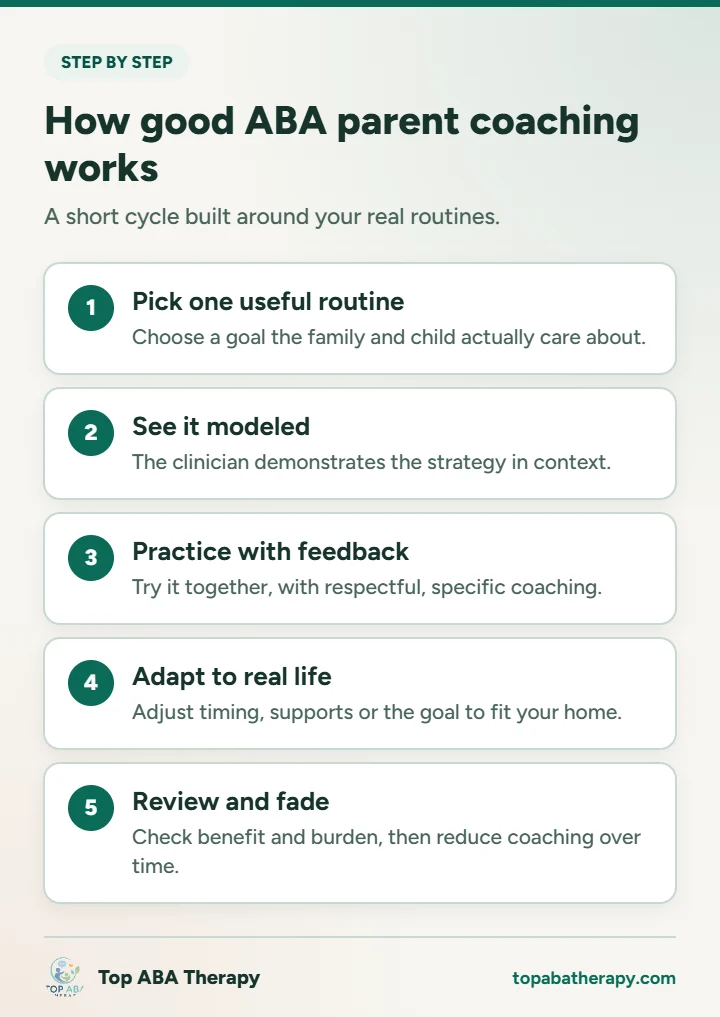
Define the coaching cycle
| Coaching step | What it can involve | Safeguard to verify |
|---|---|---|
| Shared priority and explanation | Choose one useful routine or communication outcome and explain options | The person and caregiver can reject provider-selected goals |
| Modeling and supported practice | Clinician demonstrates; caregiver rehearses with feedback | Consent, accessible pacing, privacy, no humiliation, and competent trainer |
| Adaptation and observation | Change environment, task, prompt, timing, or communication support | Fit real family conditions and honor assent or withdrawal |
| Outcome and burden review | Examine person outcome, caregiver feasibility, generalization, and possible harm | Caregiver accuracy alone does not establish benefit |
| Transition | Fade formal coaching as natural support and family skill grow | No indefinite dependency or transfer of clinical responsibility |
Behavioral skills training often combines instruction, modeling, rehearsal, and feedback. It may help teach a clearly defined, low-risk skill when the trainer is competent and the strategy fits the person and family. Knowing the steps is not enough: review whether the caregiver can use them flexibly and whether the person actually benefits. Progress should be visible in the routine itself, so ask how the team will track it; our guide to how ABA progress is measured explains what good data look like.
Complex feeding, toileting, trauma, medical concerns, physical prompting, restraint, crisis, or serious risk cannot be reduced to a generic handout or internet example. Appropriate interdisciplinary expertise, safety controls, and direct professional responsibility remain necessary.
How should caregiver coaching work in daily routines?
Choose the smallest useful change
Potential goals include supporting AAC or another communication form, making one transition predictable, honoring a request for help or a break, adjusting the environment, using a visual support, or practicing one selected daily-living step. Goals should not enforce typical appearance, suppress harmless autistic behavior, or increase generalized obedience.
Preserve real family life
Meals, dressing, play, community trips, and transitions can create natural learning opportunities. The family chooses which routines are open to clinical involvement and which remain private or unstructured. A provider should not expect staged trials, restricted preferred activities, correction, or recording all day.
Make communication broader than requesting items
Coaching may help caregivers recognize speech, AAC, sign, gesture, pictures, writing, movement, or another accessible form; arrange access; wait; repair misunderstanding; and honor communication consistently. The plan should include refusal, pain, help, break, choice, reporting, and self-advocacy.
Do not remove an effective AAC system or require speech before responding. Device selection and communication assessment may require a qualified speech-language pathologist or AAC specialist. ABA providers should coordinate instead of claiming universal expertise. Coaching works best when it supports meaningful ABA treatment goals the family helped choose.
Test generalization and maintenance without assigning a new job
Define where, with whom, and under which natural cues the skill should work. Separate independent use from prompting, plan how arranged consequences fade, and check maintenance after coaching decreases. Family implementation is one generalization route, not the only one; providers should also vary staff, materials, settings, and cues.

How should family consent, burden, privacy, and boundaries be protected?
Clarify why participation is requested
Ask whether coaching is a clinical recommendation, provider attendance policy, payer condition, or actual program requirement. These are different. The family should know the purpose, activity, frequency, duration, participants, whether the service recipient is present, what is billed, possible member cost, data or recordings, and what happens if work, disability, language, technology, transport, or other care prevents attendance.
Design for access, not compliance
Useful accommodations may include interpretation, translated or plain-language material, visual examples, captions, screen-reader support, AAC access, flexible scheduling, shorter visits, in-person demonstration, or low-bandwidth telehealth. The clinician should check understanding through respectful demonstration and problem-solving.
Literacy, education, disability, language, culture, and stress affect instructional design; they do not measure commitment or intelligence. A school or clinic routine should not be copied into a household without adaptation.
Measure the person’s outcome and family cost
Possible measures include caregiver understanding, confidence, flexible use, the person’s independent outcome, generalization, maintenance, assent, distress, quality of life, adverse effects, caregiver time and stress, feasibility, satisfaction, sibling impact, sleep, work, relationships, and whether professional support can decrease.
Protect siblings and role boundaries
Siblings have their own privacy, preferences, needs, and right not to participate. They are not automatic peer models, reinforcers, or unpaid staff. Consider shared spaces, belongings, attention, transport, meals, safety, and protected nonclinical time.
Caregivers are partners, not employees supervised by a BCBA. Define boundaries for messaging, social media, gifts, babysitting, transport, private rooms, meals, photographs, recordings, off-hours calls, and emergencies. Dependence on service must never be used to compel testimonials, research, fundraising, marketing, or unrelated home access.
How should telehealth coaching and provider fit be evaluated?
Telehealth can reduce travel and let a clinician see an actual routine. It also requires a professional authorized for the person’s location, informed consent, appropriate technology, privacy, accessibility, and modality fit. HHS telehealth guidance highlights preparation, technology, and participant needs rather than assuming video works for everyone.
Before you commit, ask how coaching sessions are scheduled, whether they are covered by your plan, and what happens if you cannot attend. Families comparing remote options can read our guide to telehealth ABA therapy, and our questions to ask an ABA provider include caregiver-training questions.
Frequently asked questions about parent training in ABA
Is parent training required for ABA therapy?
Sometimes a clinician, provider, payer, or program requests participation, but those sources have different authority. Ask for the written basis, expected activity, accommodations, cost, and consequence of declining.
Does parent training mean parents deliver ABA all day?
No. Coaching should focus on selected meaningful routines and sustainable support. Families need ordinary relationships, privacy, rest, and freedom from continuous data collection or correction.
Can caregiver coaching happen without the child present?
Yes, depending on the purpose. Discussion, planning, review, or rehearsal may not require the person. Observation and live practice require appropriate consent, assent, privacy, and a reason.
What if the recommended strategy does not fit our family?
Say what is inaccessible, burdensome, culturally mismatched, ineffective, or unacceptable. The clinician should examine alternatives, environmental changes, another format, other expertise, or whether the goal itself should change.
The bottom line
Good parent training in ABA is collaborative coaching that makes everyday routines easier, respects your family’s limits and keeps the person receiving support at the center. It should be clear why participation is requested, adapted to your language and schedule, and reviewed for real benefit and burden. When you compare programs, find ABA therapy providers near you and ask how their caregiver coaching works week to week.