
Quick answer: An IEP and clinical ABA can address overlapping needs, but they serve different systems. The IEP team makes individualized education decisions; a clinical team works through professional, consent and payer requirements. Share relevant information with permission and clarify responsibilities. A private treatment plan does not automatically determine a school program.
Education and legal note: This national overview is general information, not legal advice. Federal law supplies a baseline; state rules, decisions, district procedures, payer contracts, facts, and deadlines can change the answer. Use current local guidance for an individual dispute.
How do school and clinical ABA roles differ?
Keep the decision standards separate
An IEP records special education, related services, supplementary aids, program changes, staff supports, annual goals, placement, and progress reporting for an eligible student. The IEP team, including the parent and required school participants, makes decisions from evaluation data and educational need.
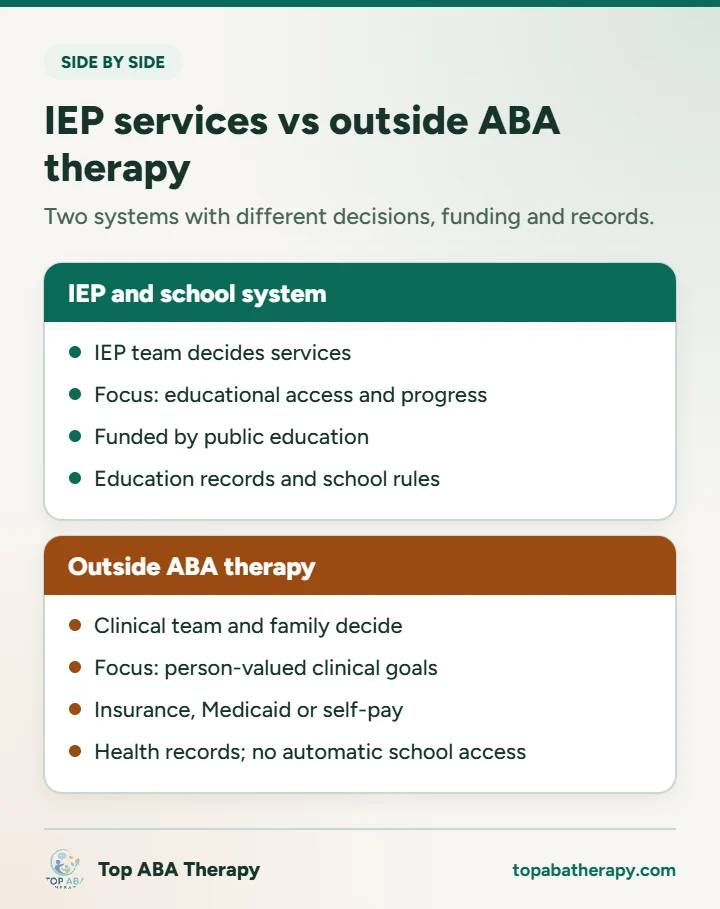
| Decision point | IEP and school system | Outside ABA treatment |
|---|---|---|
| Primary question | What does the student need for educational access and progress? | What clinically meaningful goal and service fit the person? |
| Decision-makers and record | Legally constituted IEP team; evaluations, IEP, notices, and education records | Service recipient or authorized decision-maker and qualified team; assessment, plan, consent, authorization, and clinical record |
| Funding and setting | Public education when the service belongs in the program; IEP-determined settings | Insurance, Medicaid, self-pay, or other funding; authorized clinical settings, with no automatic school access |
| Progress standard | Measurable annual goals, implementation, educational participation, and reporting | Person-valued clinical outcomes, generalization, maintenance, benefit, burden, and possible harm |
Start with evaluation, not a program label
“Does the school provide ABA?” treats ABA as one indivisible package. A better starting question is what this student needs to communicate, access instruction, participate, build autonomy, remain safe, and make appropriate educational progress. Our overview of school-based ABA explains the different arrangements behind the label.
Understand FBA and BIP decisions
A functional behavioral assessment examines behavior in context and develops cautious hypotheses about relevant variables. A behavior intervention plan describes selected prevention, environmental, teaching, communication, reinforcement, response, safety, data, training, review, and exit steps. Neither should be a form, diagnosis, or punishment schedule. Our guide to functional behavior assessment explains how a good FBA is done.
Make implementation observable
“Behavior support,” “consultation,” or “ABA strategies” does not specify a service. Ask what will occur, which role delivers and supervises it, required qualifications, frequency, duration, location, grouping, staff training, data owner, report schedule, and review trigger.
How should families coordinate, review data, and prepare for meetings?
Define outside-provider coordination in writing
Before records, observations, or meetings are shared, identify the purpose, minimum information flowing each way, consent authority, withdrawal process, school and clinic contacts, provider role, payment for outside time, visitor or background rules, confidentiality, recommendation handling, responsibilities, and review date.
Review progress for meaning and implementation
A graph does not explain itself. Ask whether definitions stayed stable, relevant settings and people were represented, staff implemented the plan, absences changed exposure, communication and accommodations were available, and the measure reflects something the student values. For more on reading graphs and reports, see how ABA progress is measured.
Use a meeting agenda that produces decisions
Before the meeting, review evaluations, goals, progress reports, attendance, discipline records, and relevant clinical summaries. Ask who will attend and in what role. Request interpretation or accessible material, decide how the student can participate meaningfully, and send concise documents early enough for review.
Recognize red flags without making legal conclusions
Warning signs include either system claiming automatic control over the other; diagnosis replacing individual evaluation; goals for masking, eye contact, quiet hands, or universal compliance; an FBA with unrepresentative data; a BIP centered on exclusion, restraint, seclusion, loss, or punishment; vague service details; untrained implementers; purposeless record sharing; and promised legal outcomes.
When you look for an outside provider, ask exactly what school-related service it offers: consultation, observation with permission, a district contract or direct services. A provider listing cannot determine eligibility, require school access or promise education or insurance funding.

Which questions should you bring to an IEP meeting about ABA?
A short list of focused questions keeps the meeting on decisions rather than labels. Adapt these to your child:
- What evaluation data explain the behavior or skill gap we are discussing?
- Which specific supports, accommodations or services will address it at school?
- Who will deliver and supervise each support, and what training do they have?
- How will progress be measured, how often will we see it, and what triggers a review?
- How will my child’s own communication and preferences shape the plan?
- If an outside ABA provider is involved, what information will be shared and why?
Write down agreed actions, owners and dates before the meeting ends, and request the updated documents in writing.
Frequently asked questions about ABA therapy and the IEP
Can a doctor or private BCBA require ABA in an IEP?
No outside recommendation automatically binds the IEP team. The team should consider relevant evidence and make an individualized educational decision under applicable rules. Case-specific disputes require current local guidance.
Does an IEP replace medically necessary ABA therapy?
Not automatically. Educational and clinical systems use different standards, teams, documents, and funding. Ask each to explain what need and service it recognizes instead of assuming one cancels the other.
Must a school allow an outside ABA provider to observe?
Access is not automatic. District policy, privacy, safety, scheduling, instruction, and jurisdiction can matter. Request the decision and possible alternatives in writing.
Is an FBA always required before a BIP?
The answer depends on the context, procedure, and applicable law. Ask which evaluation supports the proposed plan, whether consent applies, and how the team considered positive supports and competing explanations.
The bottom line
ABA therapy and the IEP work best side by side when each system keeps its own role: the IEP team decides educational services, the clinical team decides treatment, and you control what information is shared. Start from your child’s needs, make every service observable and review progress together. If you also need clinical support outside school, compare ABA therapy providers near you and ask how they coordinate with schools.