

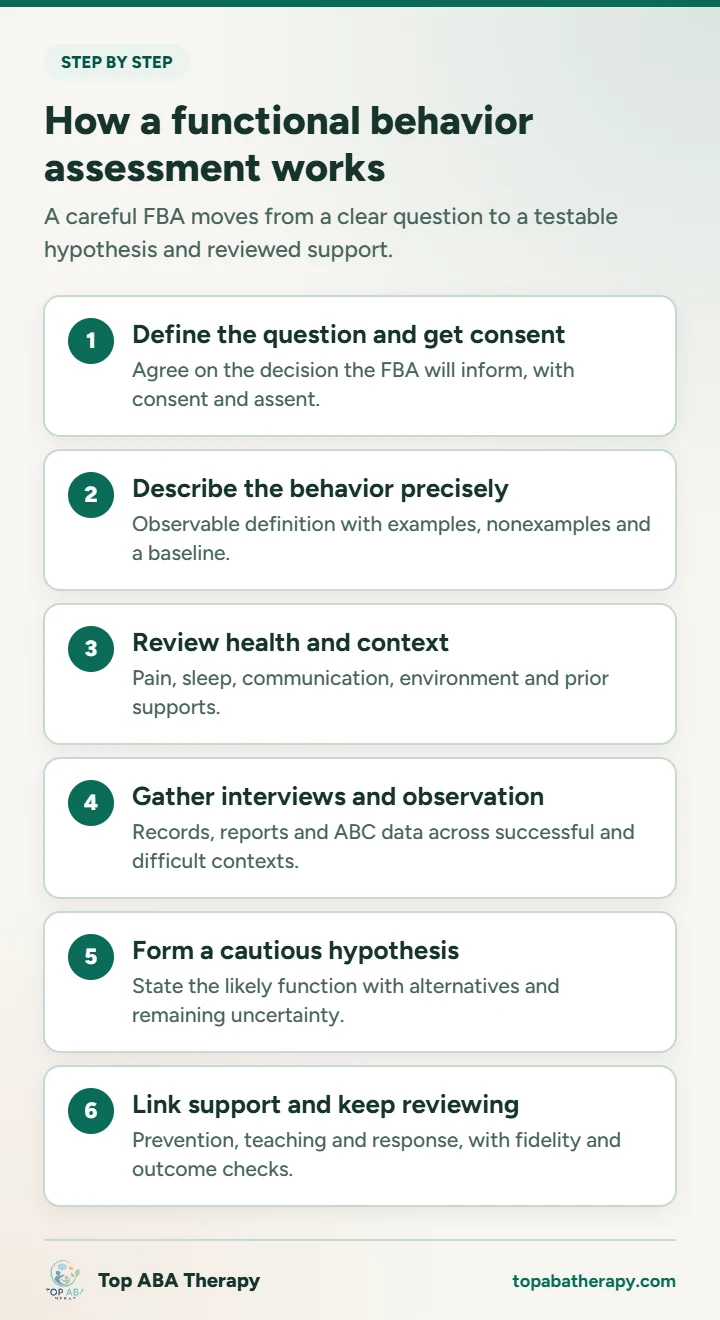
Quick answer: A functional behavior assessment (FBA) examines a defined behavior, its context and conditions that may influence it. It combines relevant records, interviews and observation to develop a cautious hypothesis and guide support. A useful assessment also considers health, communication and environmental barriers; it is not a diagnosis or a permanent explanation.
What should an FBA define and consider before collecting data?
What is the purpose of an FBA?
The purpose is to move beyond labels such as “defiant,” “attention-seeking,” or “noncompliant” and identify conditions that can be changed and skills or supports that may help. Behavior can communicate or be influenced by access, escape or avoidance, attention, sensory consequences, pain, task difficulty, predictability, communication barriers, relationships, or multiple interacting factors.
An FBA is a process, not one form
| Component | Evidence collected | Quality question |
|---|---|---|
| Referral, consent, and scope | Decision, environments, accessible explanation, assent, and roles | Is the question meaningful, and can the person participate or pause? |
| Operational definition | Observable description, examples, nonexamples, and baseline | Could trained observers identify the same event? |
| Health and context review | Medical, communication, education, sleep, schedule, incident, and prior-support information | Were competing explanations considered? |
| Interviews and records | Reports from the person and relevant supporters | Are reports treated as hypotheses, not facts? |
| Direct or experimental observation | Antecedents, behavior, consequences, nonoccurrence, and controlled tests when justified | Are contexts sufficient and risks appropriately governed? |
| Hypothesis, support, and review | Uncertainty, prevention, teaching, response, fidelity, outcomes, and adverse effects | Does support follow the evidence, and does the hypothesis change when predictions fail? |
The depth should match the importance and risk of the decision. A brief interview may inform a low-risk classroom adjustment; it may be inadequate for severe self-injury or a restrictive treatment proposal.
Define behavior without reducing the person to it
An operational definition describes observable events, examples, and nonexamples without moral judgment or assumed intent. The assessment should also describe strengths, successful contexts, communication, preferences, and what the person wants changed. Precision never requires dehumanizing labels.
Start with health, communication, and context
Behavior can change with pain, illness, medication, sleep, hunger, sensory conditions, trauma, communication access, academic mismatch, staffing, relationships, or major events. An FBA cannot rule out medical causes. Urgent symptoms need healthcare evaluation, while speech-language, AAC, occupational, psychological, educational, feeding, or trauma questions may require other qualified professionals. Communication includes more than speech.

Which FBA methods support a cautious function hypothesis?
Indirect assessment
Interviews, tools, records, and checklists can reveal priorities and contexts that observation misses, including the person’s accessible report. Because memory, interpretation, and exposure create bias, indirect results should guide questions and observation, not become a definitive function because a score was generated.
Descriptive assessment and ABC data
Descriptive observation records antecedents, behavior, consequences, broader events, and periods of nonoccurrence in relevant settings. Correlation does not establish function: a demand-break pattern may also reflect difficulty, pain, confusing communication, staff interaction, or fatigue. Sample enough people, times, tasks, and settings to test predictions, and disclose observers, recordings, bystanders, security, and deletion.
Functional analysis is a distinct method
A functional analysis arranges conditions to test whether specified consequences influence behavior. It may strengthen inference but can be unsafe, unnecessary, or impractical. The assessor should disclose design, competence, risk, stop rules, safety planning, consent, assent, staffing, and alternatives. Never copy an online protocol for self-injury, aggression, elopement, feeding, medical risk, or crisis behavior; not every FBA requires this method.
Common function labels are starting points, not boxes
Practitioners may organize hypotheses around access to attention, tangibles or activities, escape or avoidance, and automatic or sensory consequences. These categories can support analysis but may oversimplify.
What does a functional behavior assessment look like in practice?
Consider a simplified classroom example. A student often leaves their seat and pushes materials away during writing tasks, and staff describe it as “avoiding work.”
- Definition: The team describes the behavior observably (leaving the seat or pushing materials away during independent writing) and notes when it does not happen, such as during typed work or partner tasks.
- Context review: Caregivers mention hand fatigue, so the team asks whether an occupational therapy or other evaluation is needed.
- Observation: ABC data across several writing and nonwriting periods shows the behavior is most likely during long handwriting tasks.
- Hypothesis: Escape from effortful handwriting is one explanation, with physical discomfort still open as an alternative.
- Support: Shorter writing segments, a typing option, a taught way to ask for a break, and a review date to check whether the predictions held.
The example is illustrative, not a template. A real FBA depends on the person, setting and risk, and should be led by a qualified professional.
How should FBA findings guide support, school planning, and consent?
From hypothesis to positive support
A support plan should address the findings through prevention, accessible communication, predictability, choice, adjusted demands or materials, health and sensory support, useful alternatives, respectful responses, trained implementers, fidelity checks, benefit and harm measures, generalization, maintenance, review, escalation, and stop criteria. Many of these supports rely on reinforcement-based teaching; see our guide to positive reinforcement in practice.
School-based FBA and clinical FBA differ
The U.S. Department of Education’s 2024 guidance describes FBA as a process for understanding the function or purpose of behavior interfering with learning and factors contributing to occurrence and nonoccurrence. It emphasizes positive, proactive, collaborative supports and notes that FBA can be useful for students with and without disabilities. Our guide to school-based ABA, IEPs and BIPs explains how an FBA connects to a behavior intervention plan.
Consent, assent, and power
Assessment is an intervention into private life. The person and authorized decision-maker should understand why it is proposed, who participates, which settings and records are involved, what may be tested, foreseeable risks, alternatives, data use, and how to withdraw where applicable.
What should a useful FBA report contain?
Scope, evidence, and recommendations
A useful report names the referral question, desired outcome, strengths, communication, health, context, observable definition, baseline, participants, settings, dates, and methods. It separates direct from indirect findings, identifies missing contexts and bias, states a cautious hypothesis with alternatives, and links prevention, communication, response, training, fidelity, safety, generalization, review, and stop rules to the evidence.
Red flags
Red flags include assigning function after one brief contact, dismissing health or communication, ignoring successful contexts, substituting a generic label for a testable hypothesis, recommending support that does not follow the evidence, leading with restriction, coding assent as noncompliance, issuing a plan without training, retaining a failed hypothesis, or withholding understandable findings and data.
Questions to ask before an FBA
Ask what decision the FBA will inform, who is qualified and accountable, how the person participates, which interdisciplinary inputs matter, why each method is proposed, which successful and difficult contexts will be sampled, what privacy and safety rules apply, how uncertainty appears, and who trains implementers, checks fidelity, reviews outcomes, and revises the hypothesis. It also helps to understand the BCBA’s role in assessment when a clinical provider leads the process.
An FBA should remain open to revision
A hypothesis earns confidence by predicting patterns and guiding supports that improve meaningful outcomes. When data contradict it, the team should reexamine definitions, measurement, implementation, context, health, communication, and alternative explanations.
Verify provider claims
Use the Top ABA Therapy directory to move among provider records, place indexes, service settings, insurance guides, comparisons, and education. A profile reporting FBA services cannot prove competence for a particular risk or setting. Confirm the assessor, methods, licensing, supervision, availability, cost, and report process directly.
Frequently asked questions about functional behavior assessment
What is a functional behavior assessment?
An FBA is a process for defining behavior, examining occurrence and nonoccurrence across contexts, considering competing factors, developing cautious function hypotheses, and connecting evidence to positive support.
Is an FBA a medical diagnosis?
No. It cannot diagnose or rule out medical conditions. Pain, illness, sleep, medication, communication, sensory, trauma, and other factors may require qualified interdisciplinary evaluation.
Does every FBA include a functional analysis?
No. Interviews, records, and descriptive observation may be used without an experimental analysis. The method should match the question, risk, feasibility, competence, consent, and needed inference.
What do attention, escape, tangible, and automatic mean?
They are broad hypothesis categories, not permanent boxes. The assessor must identify specific variables, test predictions, document uncertainty, and revise the account when it fails.
Who can conduct a functional behavior assessment?
It depends on the setting and applicable rules. In schools, the educational team arranges it under district and state procedures; in clinical ABA services, a BCBA or another qualified professional usually leads it. Ask who is accountable, what experience they have with this behavior and setting, and who else will contribute.
The bottom line
A functional behavior assessment is a structured way to understand why behavior happens, not a label or a diagnosis. Good FBAs start with a meaningful question and consent, rule in health and communication factors, sample enough contexts to test predictions, and state a cautious hypothesis that stays open to revision. The support plan should follow the evidence and be reviewed against real outcomes. Families and professionals can browse ABA providers near you and ask each one how it conducts and reports FBAs.