

Quick answer: BCBA interviews should examine clinical reasoning, missing evidence, consent and assent, benefit and harm monitoring, supervision and correction of mistakes. Prepare privacy-safe examples that explain your decision and its limits. Also question the employer about workload, staffing and systems that determine whether sound clinical practice is feasible.
Scope note: This guide offers general interview preparation, not individual clinical, employment, billing, contract, or legal advice. Employers must apply the law in their jurisdiction. Candidates must protect client, family, staff, payer, and employer confidentiality.
How should a BCBA prepare interview answers?
| Interview topic | Evidence to discuss |
|---|---|
| Assessment and goals | An anonymized or fictional example connecting assessment to a meaningful goal. |
| Safety and assent | How refusal, distress, risk and clinical uncertainty change decisions. |
| Supervision | Observation, feedback, competence checks and escalation practices. |
| Employer conditions | Caseload, billable expectations, protected indirect time and clinical autonomy. |
Build a small bank of privacy-safe examples
Choose examples that cover an uncertain assessment, a plan changed after new data or feedback, assent affecting care, an adverse effect or safety concern, staff coaching, an ethical disagreement, interdisciplinary work, and a transition or discharge. One example can serve several questions if you explain a different decision each time.
Remove names, initials, exact dates, locations, schools, rare conditions, distinctive incidents, screenshots, graphs, and copied records. Changing a name does not de-identify a recognizable story. If an employer requests a portfolio, use clearly labeled fictional data and original materials. Never open a current employer’s clinical record during an interview.
Explain the reasoning, not a heroic ending
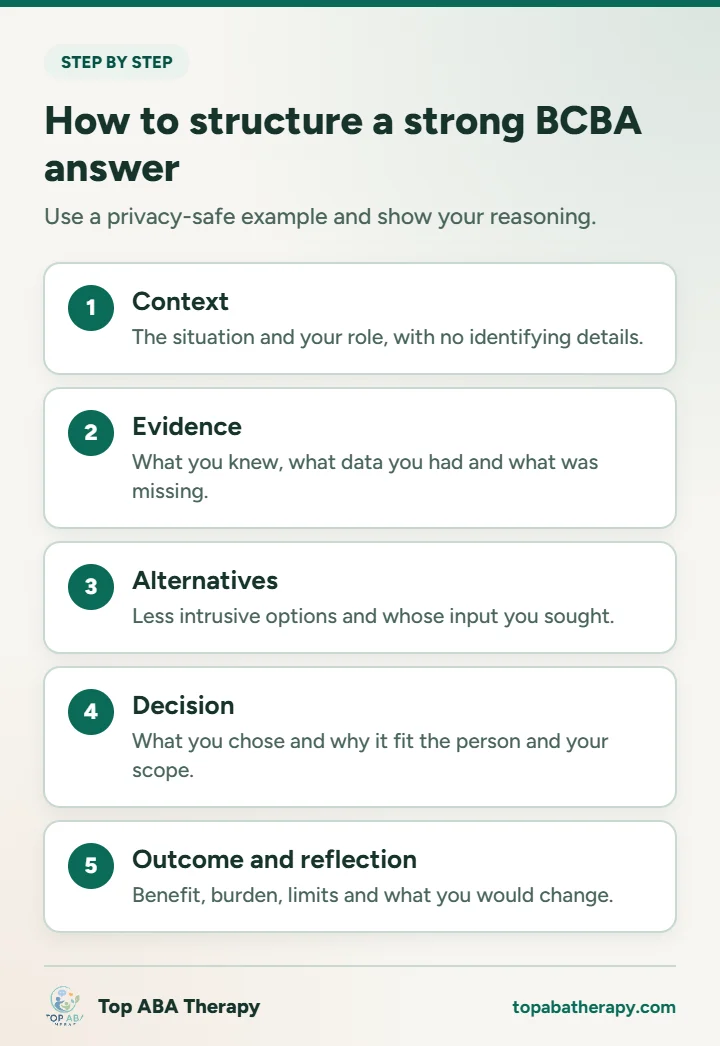
A useful answer has six parts: context, evidence, alternatives, decision, outcome, and reflection. State what you knew, what remained uncertain, whose input mattered, what less-intrusive options were considered, and why the decision fit your actual role. Then identify benefit, burden, adverse effects, generalization, and any limitation in the result.
Review the boundaries attached to the role
Before the call, read the job description, service setting, state requirements, likely payers, travel area, schedule, on-call duties, and supervision expectations. Separate clinical supervision, RBT maintenance requirements, trainee fieldwork, and employee management. They have different purposes and records. Our comparison of BCBA and RBT responsibilities is a useful refresher before the call.
Which clinical interview questions reveal sound judgment?
How do you choose goals and respond to dissent?
Start with the service recipient’s priorities, accessible communication, strengths, autonomy, safety, relationships, participation, and relevant family context. Explain how assessment, evidence, alternatives, consent, burden, feasibility, and exit criteria shape a goal. Harmless autistic traits should not become targets merely because they appear unusual. Environmental accommodation may address the actual barrier.
For dissent, describe how speech, AAC, gesture, moving away, blocking, shutdown, distress, or refusal may communicate information. Explain when you pause, check pain and access barriers, offer choices, protect immediate safety, and review repeated dissent with the person and authorized decision-maker. Do not automatically translate every refusal into escape-maintained behavior. Interviewers may also probe how you use functional behavior assessment in practice.
How do you assess and use evidence?
Describe record review, interview, direct observation, operational definitions, baseline, setting events, communication, medical and sensory considerations, functional hypotheses, risk, and the assessment level justified by the decision. A diagnosis does not identify behavioral function, and every concern does not require an experimental functional analysis.
Connect external research with individualized data, expertise, client values, context, feasibility, burden, and plausible alternatives. Group findings do not predict one person’s outcome with certainty. Name the limits of causal claims and the conditions under which a local result might fail to generalize.
How do you supervise and handle disagreement?
For RBT supervision, discuss client-specific oversight, direct observation, behavioral skills training, feedback, competency checks, accessible escalation, documentation, workload, and current credential rules. A supervisor remains responsible for the conditions in which staff perform. Shame after an error cannot substitute for clear plans, training, observation, and system repair. It helps to be specific about what a BCBA does in your current role versus the one you are applying for.
How do you answer safety and billing scenarios?
A privacy-safe safety example should cover immediate protection, qualified help, emergency and incident procedures, medical attention where indicated, factual documentation, notification, evidence preservation, review, staff support, corrective action, and follow-up. Avoid portraying an incident as inevitable because of a diagnosis.

What should a BCBA candidate ask the employer?
Make workload and authority measurable
Ask for the current caseload range and how acuity, supervisees, sites, travel, assessments, incidents, vacancies, leave, and transitions change capacity. Ask who may pause admissions. Clarify the billable target, its denominator, protected nonbillable work, on-call expectations, and coverage during supervisor absence.
Inspect supervision, safety, and complaint systems
Ask how many RBTs, BCaBAs, and trainees may be assigned to one responsible clinician, how direct observation is protected, and whether fieldwork supervision is optional, paid, and supported. Request plain descriptions of incident review, workplace-violence prevention, restrictive-practice oversight, complaint handling, and nonretaliation.
Verify the offer before accepting
Ask whether a posted range is guaranteed base pay or possible total compensation. Clarify ordinary hours, travel, bonuses, benefits, leave, and repayment terms for tuition, supervision, signing, or relocation support. Request every agreement early enough to review arbitration, noncompete, nonsolicit, moonlighting, notice, repayment, and forfeiture provisions.
Notice which questions receive a number, policy, sample document, or named decision-maker and which receive only reassurance. If the interviewer cannot explain how a clinician pauses admissions after vacancies, corrects a disputed note before billing, reaches leadership during a safety event, or reports pressure without retaliation, request a follow-up from someone who owns that system before treating the claim as verified. Silence is data.
A job listing, on any site, cannot prove ethical practice, a safe workload or a good employment relationship. Compare offers using our BCBA salary guide and treat unanswered questions as part of the offer.

Frequently asked questions about BCBA interviews
How many examples should I prepare?
Six to eight flexible, privacy-safe examples usually cover clinical judgment, supervision, ethics, safety, disagreement, correction, and transition. Depth matters more than inventing a different story for every question.
Should I memorize model answers?
Use a stable reasoning structure, then speak naturally. Memorized language can hide which facts changed the decision and makes follow-up questions harder to answer honestly.
Can I discuss a real client case?
You may discuss experience only when confidentiality is protected. Remove combinations of details that could identify someone. Fictional examples are safer for portfolios, graphs, or demonstrations.
What if I have not used the method they ask about?
State your experience accurately. Explain how you would assess competence, seek training or consultation, obtain supervision, or refer. Pretending expertise creates clinical and employment risk.
The bottom line
Strong answers to BCBA interview questions show careful reasoning, respect for assent and dignity, honest limits and good supervision habits, all told through privacy-safe examples. Use the interview to test the employer just as hard: workload, authority to pause admissions, safety systems and contract terms. Clinicians and families can also browse ABA providers near you to see who operates in your area.