

Quick answer: RBT pay depends on location, employer, role and realistic paid hours. Compare the hourly rate with cancellation policies, paid documentation and training, travel, benefits and required expenses. A national estimate cannot establish a local offer, and multiplying an hourly rate by 40 hours can overstate earnings when those hours are not guaranteed.
Compensation and legal note: This is a comparison method, not a wage promise or legal opinion. Federal, state, and local rules depend on the facts and worker classification. Verify written terms and seek qualified help for a wage, tax, or classification dispute.
How do you turn an RBT rate into realistic compensation?
Start with a source you can interpret
Salary pages may draw from self-reports, employer reports, job advertisements, payroll data, models, or occupational proxies. They can mix years, locations, titles, credentials, settings, employees and contractors, full-time and part-time work, base pay and total pay, or offered and earned wages. Two sites can publish an “average RBT salary” while measuring different groups. If you are still earning the credential, start with the steps to become an RBT so you know which training and supervision costs an employer might cover.
The Bureau of Labor Statistics does not publish a federal occupation that cleanly equals all RBT jobs. Broader psychiatric-technician or aide statistics describe different workers and settings, so they should not be presented as an RBT average.
Convert the advertisement into paid-work scenarios
Separate the client rate from every other rate and hour type. “Up to 40 hours” is not forty guaranteed paid hours. Authorized, available, scheduled, billable, and paid describe different things unless an employer defines them otherwise in writing.
Consider two fictional offers. One advertises $28 for client time but expects 23 paid client hours, pays required notes at a lower disclosed rate, and offers no cancellation floor. Another advertises $24, guarantees 34 paid hours, and includes notes and meetings at the same rate. Before benefits or expenses, the second offer may yield steadier weekly cash despite its lower headline. The numbers are not market estimates; they show why the hour definition can outweigh the displayed rate.
| Compensation input | Evidence to request | How to model it |
|---|---|---|
| Client and nonclient rates | Written rate sheet and activities assigned to each rate | Apply each rate only to the hours it covers |
| Paid-hour stability | Guaranteed-hours terms plus recent scheduled and paid patterns for comparable staff | Run low, expected, and high monthly hours |
| Cancellations and gaps | Cancellation policy, reassignment options, and actual role-relevant frequency | Remove unpaid time and test benefits eligibility |
| Travel and expenses | Service radius, paid travel rules, mileage, parking, tolls, equipment, and phone terms | Add reimbursements and subtract worker costs |
| Benefits and bonuses | Eligibility, employee cost, vesting, earning dates, cliffs, and clawbacks | Value likely usable benefits and probability-weight bonuses |
| Classification and overtime | Employee or contractor terms, timekeeping rules, and overtime policy | Keep taxes, coverage, overtime, and unpaid risk explicit |
Do not hide uncertainty inside one precise total. Record the assumption next to every input. If the employer cannot explain how a required activity is recorded or paid, mark that input unresolved and compare the offer with and without it.

Which job details change RBT pay the most?
Cancellations and nonclient work
Home, clinic, and school schedules can change because of illness, travel, authorization, staffing, weather, school calendars, or a client’s transition out of services. Ask for recent median scheduled and paid hours for comparable workers, not a recruiter’s best week. Clarify cancellation pay, notice rules, reassignment, administrative work, substitute cases, and whether reduced hours jeopardize benefits.
Keep an accurate personal record of actual work time and review it against wage statements. Do not accept instructions to work off the clock, compress notes below the time used, or alter service records to satisfy a productivity target.
Travel, setting, and geography
Home and community assignments may require fuel, maintenance, parking, tolls, added insurance, phone use, and unpaid gaps. Ordinary commuting and travel between job sites may be treated differently, depending on the facts and applicable law. Ask about the service radius, starting location, mileage reimbursement, paid intersite travel, minimum gap rules, and the effect of a cancelled first or last session.
Benefits, bonuses, and classification
A slightly lower rate may be worth more if it comes with dependable hours, affordable health coverage, paid leave, retirement contributions, paid supervision, credential support, mileage, equipment, or a predictable schedule. Use the employee premium, deductible, waiting period, vesting, eligibility threshold, and realistic usage. An employer’s marketing value is not automatically your value.
Employee and contractor offers are not directly comparable. A contractor rate may exclude payroll-tax contributions, unemployment coverage, workers’ compensation, benefits, administrative time, equipment, insurance, and expenses. The working relationship and applicable law control classification, not the label alone. Do not apply one universal percentage to convert between them.
Supervision and safety belong in the comparison
Higher pay does not expand RBT scope. The role remains a supervised paraprofessional credential. Ask who provides oversight, how often direct observation occurs, how quickly someone responds during a difficult session, how many technicians the supervisor supports, and what happens if that person leaves.
How can you compare and negotiate an RBT offer?
Once you have modeled two or three offers, negotiate on the inputs that change real pay, not only the headline rate. Employers often have more flexibility on paid documentation time, cancellation protection, mileage or a guaranteed-hours floor than on the advertised hourly figure.
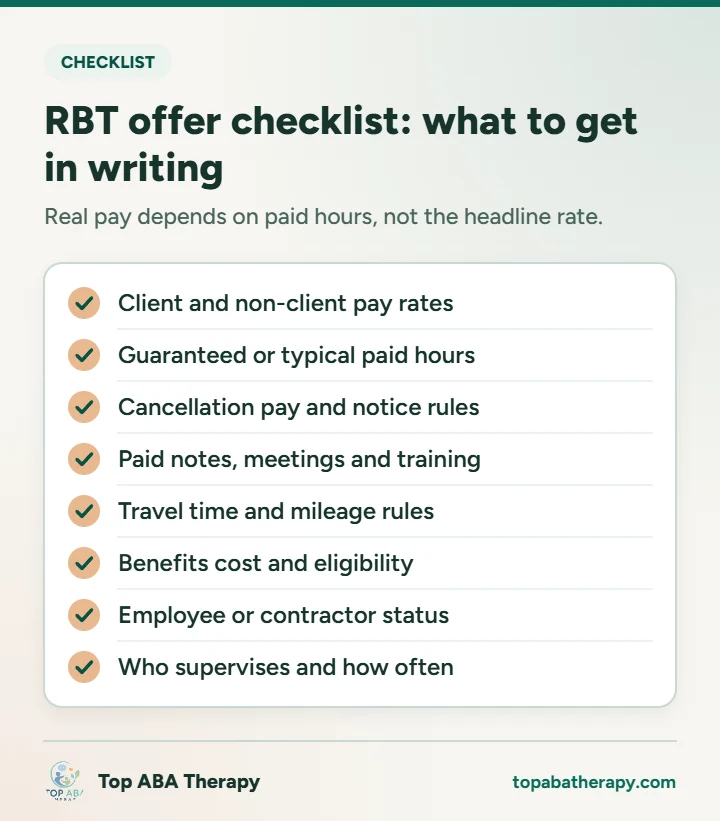
- Ask for the rate sheet, guaranteed-hours terms and cancellation policy in writing before you accept.
- Request recent scheduled and paid hours for technicians in the same setting and region.
- Confirm whether notes, team meetings, supervision and training are paid, and at which rate.
- Clarify travel rules: starting location, paid drive time between clients and mileage reimbursement.
- Check when benefits start, what they cost you, and what happens to eligibility if hours drop.
If you plan to grow into a supervising role later, ask how the employer supports fieldwork and study time; our guide on how to become a BCBA explains what that path involves.

Frequently asked questions about RBT salary
What is the average RBT salary in 2026?
There is no single official figure covering every RBT job. A useful estimate must identify its source, date, geography, title, credential status, setting, pay basis, sample, and limitations.
Is an hourly rate the same as effective hourly pay?
No. Effective cash pay accounts for the wages received across all work hours. Unpaid cancellations, notes, travel, meetings, or gaps can reduce it even when the client-hour rate looks high.
Are scheduled hours guaranteed?
Not unless the employer’s written terms say so. Ask how scheduled, authorized, available, billable, paid, and guaranteed hours differ and request recent patterns for comparable staff.
Should a contractor RBT earn more per hour?
A higher contractor rate may compensate for taxes, coverage, benefits, equipment, expenses, and unpaid time, but there is no universal conversion. Classification and financial effects require fact-specific review.
The bottom line
A realistic RBT salary comes from paid hours, stable scheduling, benefits you will actually use and expenses you will actually pay, not from the highest number in a job ad. Model every offer with low, expected and high hours, get the key terms in writing, and weigh supervision as seriously as pay. Families and professionals alike can browse ABA providers near you to see which organizations operate in your area.