

Quick answer: BCBA salary varies with location, responsibilities, employment arrangement and workload. Compare guaranteed base pay alongside caseload, billable expectations, supervision, documentation, travel, after-hours work and benefits. A high advertised range may describe a different role or pay basis; obtain the complete offer and productivity terms in writing.
Compensation note: This is a comparison framework, not a wage, tax, classification, contract, or employment-law decision. Market data and job terms change. Verify the offer and obtain qualified advice when the facts create legal or financial risk.
How should you compare BCBA compensation?
Interrogate the salary source first
Published estimates may come from self-reports, employers, payroll observations, recruiters, posted ranges, models, or broader occupation codes. They can mix BCBAs, BCBA-D designees, assistant analysts, consultants, clinical directors, researchers, contractors, owners, and unverified titles. They may also combine different locations, years, settings, experience levels, hours, base pay, and bonuses.
Look at the distribution, not only the mean. A range can be widened by directors, owners, very low-hour contractors, or positions in unusually expensive markets. Median and percentile data are more useful when the underlying jobs truly match, but they still cannot account for hidden workload. Treat an estimate as a question generator: which current local roles resemble the job, and what work sits behind their reported pay? It also helps to be clear on what a BCBA does day to day, because titles and duties vary widely between employers.
Rebuild the offer from evidence
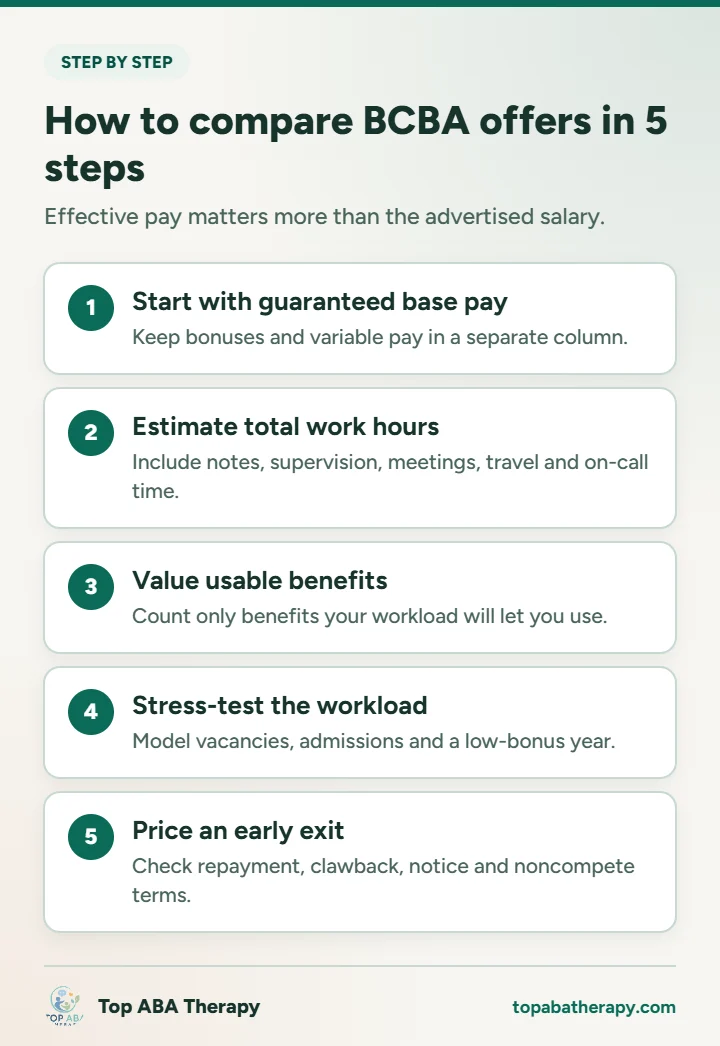
Start with guaranteed cash. Keep probable variable pay separate. Estimate the full time consumed by assessment, analysis, treatment planning, notes, meetings, supervision, caregiver or school coordination, travel, incidents, quality review, training, on-call work, and after-hours follow-up. Then value usable benefits, add reimbursements, and subtract expenses that remain with the worker.
| Offer layer | Evidence to obtain | Stress test to run |
|---|---|---|
| Guaranteed and variable cash | Signed base terms, formula, earning dates, peer attainment, and clawbacks | Treat uncertain incentives as zero and recalculate |
| Workload and time | Caseload method, utilization definition, calendar, supervisees, sites, travel, and on-call schedule | Model vacancies, reassessments, leave, incidents, and admissions |
| Benefits and support | Plan documents, employee cost, eligibility, paid leave, retirement, CE, licensure, insurance, and admin support | Check whether workload permits the benefit to be used |
| Expenses and restrictions | Reimbursement, equipment, travel, repayment, forfeiture, notice, and restrictive terms | Price an early exit and an employer-driven termination |
| Clinical safeguards | Admission authority, documentation time, escalation, incident review, incentive controls, and transition process | Ask what happens when safe capacity is reached |
Calculate expected annual cash across realistic paid weeks, then divide it by expected total work hours to estimate effective cash pay. Run a normal workload, a vacancy-heavy period, and a lower-variable-pay period. Do not force all uncertainty into one annual total; show the assumption next to each input.
Take a fictional comparison. Offer A pays $7,000 more in base salary but assigns two sites, rotating evening coverage, and a bonus tied to utilization. Offer B has one site, protected assessment time, a smaller case-weight ceiling, and paid consultation. The worksheet may show that Offer A still pays more. It may also show that the premium buys hundreds of additional hours and carries a greater ethical burden. The example contains invented terms, not market rates; its purpose is to expose the exchange being proposed.
Which responsibilities and terms change BCBA pay?
Caseload complexity and billable expectations
A case count alone is a poor workload measure. Client need, safety risk, assessment volume, geography, technician experience and turnover, caregiver availability, school collaboration, language access, authorizations, documentation deadlines, admissions, discharges, and staff vacancies all change the work. Ask how the employer weights those factors and who can pause admissions when capacity becomes unsafe.
Supervision, leadership, and on-call work
Supervising technicians, assistant analysts, trainees, or other implementers requires observation, feedback, training, documentation, coordination, and accountability. Count the people, cases, purposes, sites, and credential rules involved. Clinical oversight, RBT requirements, BCaBA supervision, trainee fieldwork, employee performance management, and administrative sign-off may overlap, but one meeting does not automatically satisfy each obligation. Our comparison of BCBA and RBT responsibilities explains why supervision time is real clinical work that should be counted.
Incentives and ethical independence
Bonuses tied to utilization, census, authorization, retention, supervision volume, or margin can influence clinical judgment. Request the exact formula, control owner, audit method, realistic attainment, payment date, leave treatment, and dispute route. Ask what prevents pressure to overprescribe, delay discharge, tolerate an unsafe caseload, underreport harm, or bill unsupported services.
Setting, geography, and professional support
Home services add travel, cancellations, evening sessions, and lone-worker issues. Clinics add census, coverage, space, and staff-turnover pressures. Schools add educational calendars, campus travel, IEP duties, and separate credentials. Residential and hospital work can add high-risk incidents, shift or on-call duties, and institutional rules. Telehealth can add multi-state authorization, privacy, emergency planning, and time-zone coverage.
Classification and exit costs
Contract work may shift taxes, insurance, leave, billing gaps, travel, records, equipment, credentialing, and business risk to the clinician. A higher nominal rate does not establish equivalence with employment. Model the actual arrangement and seek fact-specific tax or legal advice when needed; the contract label alone does not settle classification.
Read tuition or supervision repayment, bonus clawback, notice, arbitration, noncompete, nonsolicit, and forfeiture terms before accepting. Calculate the cost of leaving after three, six, and twelve months. An agreement that makes it expensive to leave unsafe or unethical work belongs in the compensation model.

Which questions should you ask before accepting a BCBA offer?
Use the same short list with every employer so offers can be compared fairly. Ask for answers in writing where possible.
- What is the guaranteed base pay, and how exactly is any bonus calculated and paid?
- How is caseload measured, and who can pause new admissions when it becomes unsafe?
- How many technicians, trainees or assistant analysts would I supervise, and across how many sites?
- How much non-billable time is protected for assessments, treatment plans and notes?
- What are the on-call, evening and travel expectations?
- Which repayment, noncompete or notice terms apply if I leave in the first year?
If you are still working toward certification, our guide on how to become a BCBA covers the degree, fieldwork and exam steps that shape your first offers.

Frequently asked questions about BCBA salary
What is the average BCBA salary in 2026?
No single official figure covers every BCBA role. Any estimate needs a visible source, date, geography, role definition, credential method, pay basis, sample, and limitations before it can be compared with an offer.
How can two jobs with the same salary feel very different?
Caseload complexity, total hours, travel, supervisees, billable expectations, documentation, on-call work, staffing, benefits, and administrative support can make the workloads materially different.
Should bonuses count as salary?
Keep guaranteed base and variable pay separate. Include a bonus only after documenting the formula, conditions, probability, payment date, leave treatment, clawback, and any clinical conflict.
Is contractor BCBA pay directly comparable with employee pay?
No. Taxes, insurance, benefits, expenses, administrative time, payment risk, leave, and legal classification all affect the comparison. Use the actual facts, not a universal conversion percentage.
The bottom line
The best way to judge a BCBA salary is to rebuild each offer from guaranteed pay, realistic hours, caseload, supervision duties, benefits and exit terms, then compare effective pay side by side. Put the key terms in writing and favor roles that protect clinical judgment. Clinicians and families can also browse ABA providers near you to see which organizations operate in your market.