

Quick answer: ABA insurance verification checks the active plan, exact provider and location, network, covered services, authorization requirements and family cost. Keep written answers and reference numbers. A benefits quote records what was reported at a particular time; it does not guarantee authorization, claim payment, staffing or clinical suitability.
What should you verify before ABA services begin?
Identify the plan and the entity making each decision
Start with the member and subscriber information, plan name, product, group number, effective dates, and contacts on the insurance card. Ask whether coverage is fully insured, a self-funded employer plan, Medicaid or managed care, Marketplace or individual coverage, TRICARE, or another arrangement. The company processing claims may not define every benefit or appeal. Medicaid members should also check state rules covered in our Medicaid ABA guide.
Match network status to the exact provider
Do not ask only whether a brand is in network. Give the legal billing entity, exact location, NPI or tax identifier when appropriate, and rendering clinician or credential type. Confirm whether the contract covers this plan product and proposed dates. If you are still deciding whether your plan includes ABA at all, start with our guide to whether insurance covers ABA therapy.
Define the service and coverage rule
Ask how the plan defines ABA or autism-related behavioral treatment, which diagnoses and eligibility rules apply, and which assessment, reassessment, direct treatment, caregiver training, group, protocol-modification, supervision, and telehealth services are covered. Confirm place-of-service rules and exclusions involving education, habilitation, maintenance, experimental treatment, custodial care, or other categories.
Separate each insurance status
| Status | What it may establish | What remains unresolved |
|---|---|---|
| Eligibility | Coverage is active for a member and date | Whether a service is covered, necessary, or payable |
| Benefits verification | Current plan-reported terms for a service category | Authorization, correct coding, documentation, and payment |
| Network verification | A provider may participate under named identifiers | Every location, professional, service, plan product, or date |
| Prior authorization | Approval for specified provider, service, setting, units, and dates | Final payment, continued approval, or clinical fit |
| Claim adjudication | One submitted claim was processed under current rules | How later claims or changed facts will be handled |
| Clinical recommendation | A clinician considers a service appropriate | Coverage, network participation, authorization, or payment |
Prior authorization is its own step with its own paperwork, timelines and renewal rules, so plan for it separately once benefits are confirmed. An approval still does not require a family to accept the proposed service.
Verify member cost and limits
Confirm individual and family deductibles, amounts met, copay, coinsurance, negotiated allowed amount, out-of-pocket maximum, and plan-year reset. Ask which charges bypass the deductible or fail to count toward the maximum, how secondary coverage coordinates, and whether a copay applies per visit, day, service, or another unit.
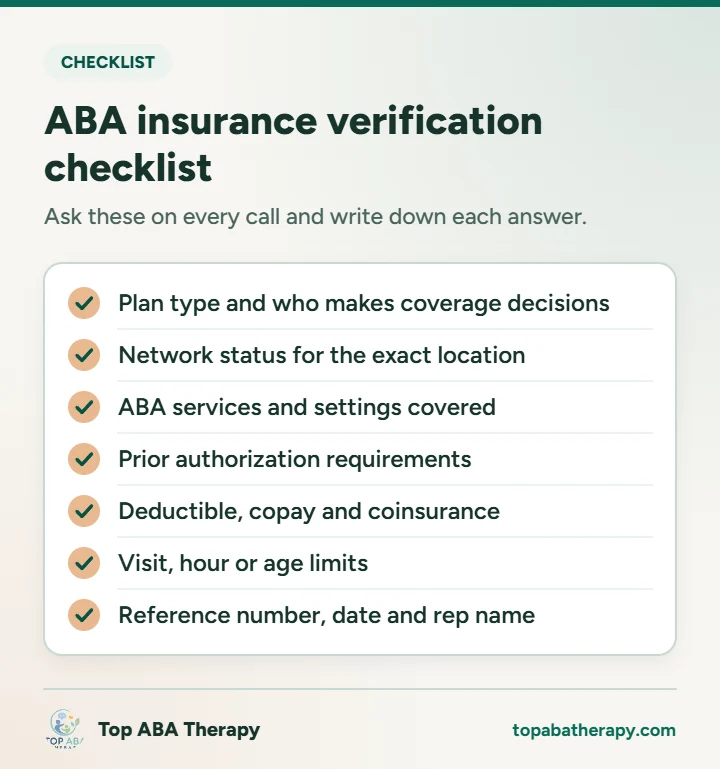
What questions belong in an ABA insurance call script?
- Is the member’s coverage active today, and what type of plan is it?
- Does the plan cover ABA or autism behavioral treatment, and for which diagnoses and ages?
- Is this provider, at this exact location and tax ID, in network for this plan product?
- Which ABA services are covered: assessment, direct treatment, caregiver training, supervision, group and telehealth?
- Is prior authorization required, who submits it, and how long does a decision usually take?
- What are the deductible, amount met, copay or coinsurance, and out-of-pocket maximum?
- Are there hour, visit, age or setting limits?
- Can I have a reference number and the name of the policy that applies?
Read each answer back to the representative, note any conditions, and ask where the rule is written so you can check it later.

How should you make the call, document it, and resolve conflicts?
Use a scoped call script
Open with the boundary: “I am verifying benefits only. I understand this is not a guarantee of authorization or payment, but I need today’s plan-reported answers and a reference number.” Then work through the call script questions above, in order, and read each answer back.
Record scoped facts, not just a reference number
For every call or portal response, record the date and time, representative, reference number, exact question, exact answer, provider identifiers, service and setting, relevant dates, policy source, conditions, uncertainties, and next owner. Save the SBC, SPD when applicable, medical policy, directory evidence, authorization, denial notice, estimate, and correspondence.
Compare the payer response with the provider’s written estimate. A rough calculation may need service units, allowed amounts, remaining deductible, copay or coinsurance, out-of-pocket accumulation, authorization dates, noncovered charges, secondary coverage, and the plan-year reset. Multiplying a public cash rate by recommended hours does not estimate insured cost. Our ABA therapy cost guide shows how to turn these numbers into a monthly budget.
Resolve contradictory answers without guessing
When payer and provider disagree, recheck the plan product, legal entity, identifiers, service, code description, setting, and dates. Ask each side for its source and effective version. Request a contracting or network escalation, supervisor, case manager, or written pre-service decision when available.
Keep the item marked unresolved until authoritative evidence aligns. If the decision is adverse, use the actual notice to identify the reason, evidence, deadline, standard or expedited process, continuation rules, and external review information. A generic call script cannot replace plan-specific appeal instructions or legal advice.
Reverify whenever a material fact changes
Repeat the check after plan renewal, employer change, plan-year reset, provider or site change, a new rendering clinician, authorization renewal, setting or modality change, a major service change, secondary-coverage change, denial, unexpected bill, or transition to another eligibility category.
Directory listings, including ours, can show dated, provider-reported insurance information, but they cannot see your plan contract or guarantee payment. Always confirm network status and benefits directly with your plan before intake.

Frequently asked questions about ABA insurance verification
Is benefits verification the same as prior authorization?
No. Benefits verification reports plan terms. Prior authorization is a separate decision about specified services, provider, setting, units, and dates. Neither guarantees final claim payment.
Does in-network status cover every location and BCBA?
Not necessarily. Contracts can vary by plan product, legal entity, location, professional, credential, service, and effective date. Match the identifiers to the proposed claim.
Should I ask about CPT codes?
Codes can clarify what the provider expects to bill, but they do not create coverage. Ask the provider for expected codes and the payer for current handling without treating either answer as individual coding advice.
How often should ABA benefits be reverified?
Reverify at material change points and before relying on a new service period. Plan renewal, authorization, clinician, location, setting, employer, secondary coverage, denial, or an unexpected bill can change the answer.
The bottom line
Good ABA therapy insurance verification is about precision: the exact plan, the exact provider location, the exact services and settings, and written answers with reference numbers. Reverify whenever something changes, keep authorization as a separate step, and do not treat a benefits quote as a payment guarantee. Once your benefits are clear, search ABA providers in your area and confirm each one’s network status directly.