

Quick answer: BCBA is a graduate-level BACB certification that permits independent behavior-analytic practice within applicable rules and competence. BCaBA is an undergraduate-level certification requiring BCBA supervision. Compare education, responsibilities and supervision separately from job titles, then check state authorization, employer requirements and payer recognition for the work you intend to do.
Credential note: This comparison uses BACB sources checked August 16, 2026, including published transition resources for upcoming requirement changes. Confirm the current handbook, application-date rules, state authority, payer terms, and employer structure before enrolling, counting fieldwork, applying, supervising, or accepting work.
What are the core BCBA and BCaBA differences?
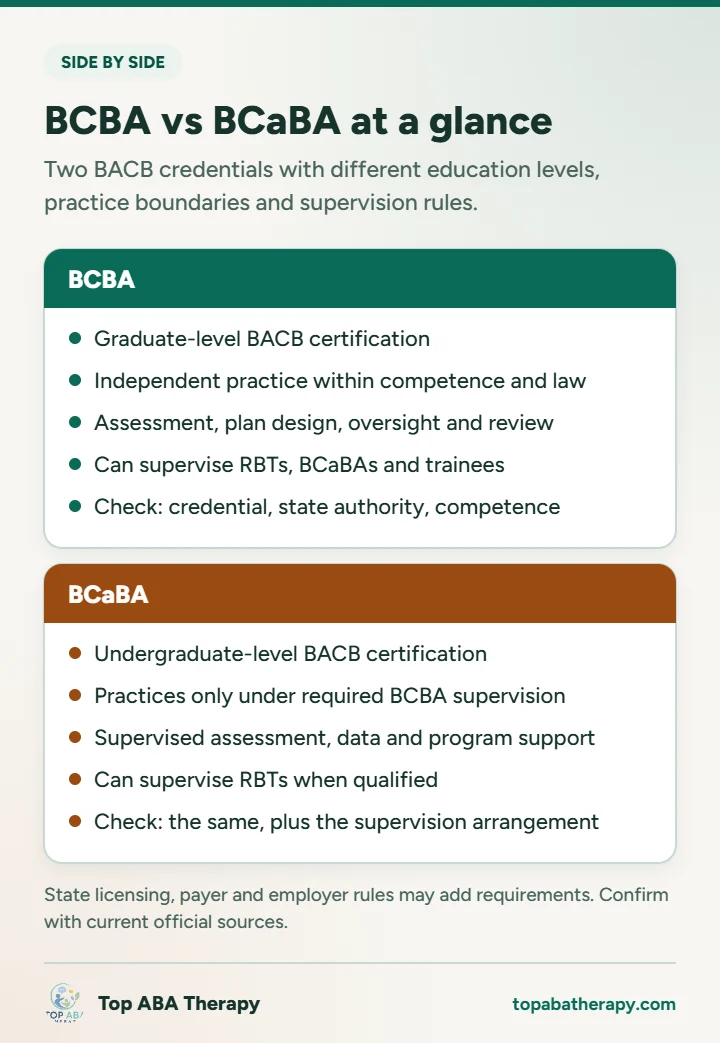
| Comparison | BCBA | BCaBA |
|---|---|---|
| Credential level | Graduate-level | Undergraduate-level assistant |
| Practice boundary | Independent within competence and applicable law | Requires qualified BCBA supervision |
| Core work | Assessment, plan design, implementation oversight and review | Behavior-analytic work within supervised scope |
| What to check | Current credential, state authorization and relevant competence | The same checks plus the supervision arrangement |
BCBA is the graduate-level independent-practitioner credential
The BACB describes the BCBA as a graduate-level certification. Within its certification framework, a BCBA may practice behavior analysis independently and may supervise RBTs, BCaBAs, trainees, and other implementers when qualified. The person can hold accountable responsibility for assessment, analysis, plan design, review, supervision, and transition within the actual job and competence. Our guide to a BCBA’s daily responsibilities shows what that looks like in practice.
BCaBA is an undergraduate-level supervised credential
The BACB describes the BCaBA as an undergraduate-level certification. A BCaBA may provide behavior-analytic services only under required BCBA supervision. Duties may include assigned assessment work, data analysis, program support, caregiver or staff teaching, implementation review, coordination, and RBT supervision when the person and structure meet every applicable requirement.
The credential does not turn the assistant analyst into the independent clinician for a case. Ask who holds responsibility, approves changes, reviews data, provides urgent support, and decides whether the work remains within competence. An employer title such as “behavior analyst” or “case manager” cannot remove the supervision requirement.
Both credentials remain bounded by evidence and ethics
Both levels must protect clients, practice within competence, document accurately, handle conflicts, maintain confidentiality, and satisfy applicable ethics and maintenance obligations. Neither certification proves specialty skill, employer quality, lawful state practice, payer recognition, compensation, or safe caseload design.
Job titles add another source of confusion. “Assistant behavior analyst,” “behavior specialist,” “consultant,” and “clinical supervisor” may be defined by a state, school system, payer, or employer in ways that do not map neatly to BACB credentials. Read the required credential and authority fields instead of inferring scope from the title printed on a badge.
BCBAs and BCaBAs can both be listed as RBT supervisors when current qualifications and conditions are met, but the accountable structures differ. A BCaBA supervising an RBT still receives the BCBA supervision required for BCaBA practice. The organization needs enough capacity for observation, feedback, documentation, backup, and coordination; a name in a registry cannot establish daily supervision quality. For how RBTs fit into this structure, see our comparison of BCBA and RBT roles.
How do education, supervision, and practice authority compare?
Education and fieldwork follow separate handbooks
BCBA eligibility operates at the graduate level, while BCaBA eligibility operates at the undergraduate level. Each path has its own degree or education conditions, fieldwork, documentation, application, examination, maintenance, and transition rules. A course, activity, form, or hour accepted for one path is not automatically transferable to the other.
Required supervision must be operational
For BCaBA practice, supervision should identify the responsible BCBA, assigned clients or work, decision authority, observation, feedback, records, urgent access, multiple-supervisor coordination, and contingency when the supervisor is unavailable. A distant signature arrangement cannot substitute for active professional oversight.
State and payer recognition can alter the practical choice
Certification and permission to practice are separate. States vary in whether and how they recognize assistant behavior analysts, titles, exemptions, supervisors, applications, settings, and telehealth. Verify the official authority for the location where the client is and the service occurs. A national credential alone cannot answer that jurisdictional question.

Which credential fits your career plan?
BCaBA may fit a verified supervised market
Consider BCaBA when you want an undergraduate-level behavior-analyst credential, local authorities and employers recognize a substantive supervised role, reliable BCBA supervision exists, and the complete education and fieldwork plan is feasible. The role should still make sense if you never continue to BCBA.
BCBA may fit independent clinical responsibility
Consider BCBA when target roles require the graduate credential or associated state authority, you want accountable responsibility for clinical decisions and supervision, and you can complete eligible education and fieldwork without relying on guaranteed salary or exam outcomes. The path should include mentorship for the populations and methods you intend to serve. Our step-by-step BCBA pathway guide covers the degree, fieldwork and exam.
Pause when the pathway rests on assumptions
Delay commitment when the program cannot identify the exact eligibility route, fieldwork is promised without operational capacity, local practice authority is unclear, BCaBA roles are absent from the target market, supervision records are weak, or debt depends on a salary and timeline nobody can guarantee.
Questions to ask an employer about a BCaBA or BCBA role
- Which credential and state authorization does this role require?
- Who is the supervising BCBA, and how often will supervision happen?
- Which decisions can I make, and which need approval?
- What is the expected caseload, and how much time is protected for supervision and documentation?
- Does the organization support fieldwork or continuing education, and on what terms?
Before taking on education debt, compare realistic pay and caseloads in our BCBA salary and caseload guide.

Frequently asked questions about BCBA and BCaBA credentials
Can a BCaBA practice independently?
No. BACB materials describe the BCaBA as an undergraduate-level certification whose holders provide behavior-analytic services under BCBA supervision.
Can a BCaBA supervise RBTs?
Yes, when the BCaBA meets current supervision qualifications and all credential, state, payer, employer, competence, and service conditions. The BCaBA’s own required BCBA supervision still applies.
Can a BCaBA design treatment?
A BCaBA may perform allowed behavior-analytic work within competence and the accountable BCBA supervision structure. The credential does not authorize independent practice, so ask who assesses, approves, changes, and remains responsible for the plan.
Does BCBA certification permit practice in every state?
No. A state may require a separate license, registration, title condition, or other authority. Check the controlling state source for the service location, including telehealth.
Is it worth getting a BCaBA before a BCBA?
It can be, if local employers recognize the role and reliable supervision exists, but the BCaBA is not a required step toward BCBA certification. Coursework or fieldwork for one path does not automatically transfer to the other, so compare both plans against current BACB handbooks and the jobs available where you want to work.
The bottom line
The BCBA vs BCaBA decision comes down to education level, practice authority and supervision. A BCBA is a graduate-level credential for independent practice within competence and law; a BCaBA is an undergraduate-level credential that always works under BCBA supervision. Before choosing, verify state recognition, local demand and the real supervision structure, and map the requirements against current BACB handbooks. Families and professionals can browse ABA providers near you to see how local teams structure their clinical roles.