
Quick answer: ABA can take place at home, in a center, at school, in the community or through selected telehealth activities. Choose the setting that can address an agreed goal safely with manageable burden. Compare access, privacy, staffing, travel, daily routines and generalization; the same person may need different settings for different goals.
Clinical note: Setting choice is an individualized clinical and personal decision. Provider staffing, insurance, state rules, school authority, transport, and telehealth conditions may limit options. This guide does not recommend a setting for one person.
How should you compare ABA therapy settings?
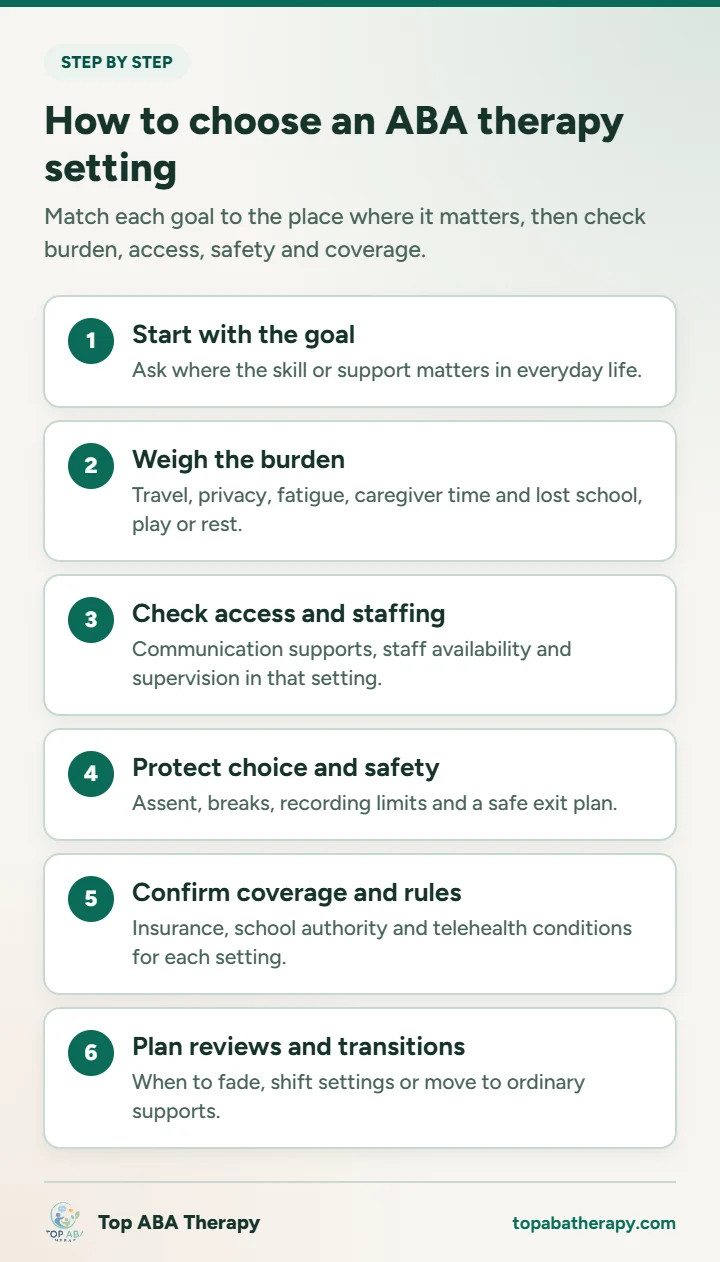
Start with a person-valued goal
Ask where the skill or support matters in ordinary life. A morning routine may call for home observation. Classroom participation belongs in an educational context. Buying an item may require community access. An early teaching step might be easier in a quiet room. Caregiver problem-solving may work through telehealth when the activity and technology fit.
| Planning question | Evidence to write down |
|---|---|
| Why is this place relevant? | Person-defined outcome and the natural context where it matters |
| What burden does it add? | Travel, privacy, fatigue, caregiver time, lost school, work, play, rest, or relationships |
| Who must participate? | Service recipient, clinician, technician, caregiver, teacher, peer, interpreter, or support person |
| What access is required? | Communication, AAC, sensory, mobility, language, cultural, technology, and environmental support |
| How will choice be protected? | Consent, assent, dissent, breaks, recording limits, withdrawal, complaint, and safe exit |
| How will benefit and harm be reviewed? | Baseline, outcome, quality of life, generalization, adverse effects, and implementation evidence |
| When will the setting change? | Fade, transfer, pause, hybrid shift, discharge, or ordinary-support criteria |

How do home and center-based ABA differ?
Home service uses natural routines but enters private space
In-home ABA may support communication, daily living, play, transitions, and caregiver coaching with familiar materials. Clinicians can see barriers that a controlled room may hide, and the family may avoid a commute.
A center offers resources but can narrow context
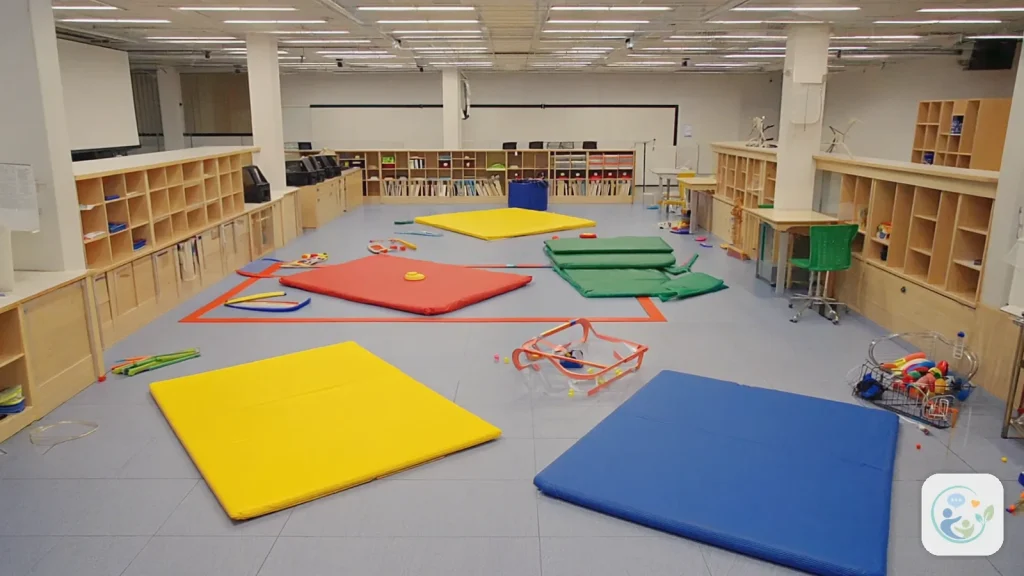
A center may provide materials, predictable teaching space, supervisor proximity, team training, peers, and dense scheduling. It may help when home service is not feasible or an arranged environment supports learning.
Questions that separate home and center care
Each setting trades one advantage for another. Home sessions can fit family routines but may be affected by siblings, visitors, space and privacy, and staff travel can disrupt the schedule. Centers offer a predictable space and nearby supervisors but add transport, drop-off routines and a context that may differ from daily life.
- Where will target skills be practiced outside the room where they are taught?
- How will a center-learned skill be tested at home, or a home skill tested in the community?
- Who is present during home sessions, and what privacy and recording rules apply?
- How often does the supervising clinician observe in person in this setting?
- What happens to sessions when staff are sick or travel is disrupted?
Our side-by-side guide to comparing in-home and center-based ABA covers these trade-offs in more depth.
How do school and community ABA differ?
School service has an educational purpose and authority
School is where instruction, peers, routines, and educational participation occur. Behavior-analytic professionals may contribute to assessment, positive behavioral supports, communication, data review, staff coaching, or IEP implementation. Whether an outside ABA provider can work in a classroom depends on school policy and the IEP team, so ask early; our guide to school-based ABA, IEPs and behavior plans explains how those decisions are made.
Community practice should support chosen participation
Community service can take place in stores, parks, libraries, transit, workplaces, recreation, or healthcare settings. It may support navigation, communication, safety, leisure, vocational participation, and self-advocacy under real variation.
Never stage embarrassment or provoke danger for assessment. Plan transportation, weather, bathrooms, food, crowds, mobility, communication, and exit. A goal that only makes the person appear socially typical is not automatically meaningful; chosen interaction, parallel participation, friendship, or self-advocacy may matter more.
When do telehealth and hybrid ABA make sense?
Telehealth fits selected tasks, not every service
Telehealth may support interviews, caregiver consultation, team meetings, observation, supervision, selected assessment components, or some direct service when clinically appropriate and permitted. It can extend reach and reduce travel. Before agreeing to it, ask about the device and connection needed, privacy at both ends, the caregiver’s role and the emergency plan; our guide to how online ABA sessions work covers each of these.
Hybrid care needs one accountable integrator
A hybrid plan might use a center for an initial teaching step, home for a routine, school consultation for educational coordination, community practice for access, and telehealth for review. More settings also mean more handoffs, travel, privacy exposure, conflicting instructions, duplicated goals, and data complexity.
Hybrid care works best with one lead clinician, one shared goal list, one data system and a regular communication schedule across settings. Ask how each location will know what the others are working on, and how conflicting instructions will be resolved before they reach the person.
What are the red flags in any ABA therapy setting?
Whatever the location, watch for signs that the setting is serving the schedule rather than the person:
- The setting was chosen for staffing convenience, with no goal-based rationale.
- There is no plan to test whether skills transfer to everyday places and people.
- Home or telehealth sessions have no clear privacy, recording or visitor rules.
- Community sessions risk embarrassment or danger instead of supporting chosen participation.
- Telehealth is offered without a technology check or emergency plan.
- Nobody can say when or why the setting would change, fade or end.
If you see several of these, ask the supervising clinician to explain the setting choice in writing and to propose criteria for reviewing it.
Frequently asked questions about ABA therapy settings
Is center-based ABA better than in-home ABA?
Not universally. Compare the person’s goals, preferences, access, privacy, travel, staffing, natural context, burden, and evidence that learning transfers.
Does telehealth work for every ABA service?
No. Suitability depends on the activity, person, locations, technology, privacy, emergency planning, provider authority, and payer conditions.
Should caregivers attend every home session?
Not automatically. Participation should be purposeful, consented, taught accessibly, and sustainable. The provider remains responsible for clinical service.
Can a child receive ABA in more than one setting?
Often, yes. A plan may combine home, center, school consultation, community practice or telehealth, depending on goals, provider capacity, school policy and payer rules. Ask who leads the overall plan, how goals and data are shared across settings, and whether each setting is covered under your benefits.
Can ABA sessions happen in the community?
Yes. Community sessions at stores, parks, or appointments teach skills where they are actually needed. They require planning for safety, privacy, and transportation, and some insurance plans limit the locations they will pay for, so confirm the setting is authorized before sessions start.
The bottom line
The right ABA therapy settings depend on the goal, not on a general rule that one location is better. Home, center, school, community and telehealth each offer different access, privacy, staffing and generalization trade-offs, and many people benefit from a mix with one accountable clinician. Write down why each setting is relevant, what burden it adds and when it will change. When you are ready to compare options, browse verified ABA providers near you and ask which settings each one can actually staff.