

Quick answer: Neither in-home nor center-based ABA is best for everyone. Home services connect practice to household routines; centers may offer equipment, staff access and peer opportunities. Choose the setting that fits the assessed goal, then compare provider quality, privacy, travel, family workload, cost and real-life skill use.
How do in-home and center-based ABA differ?
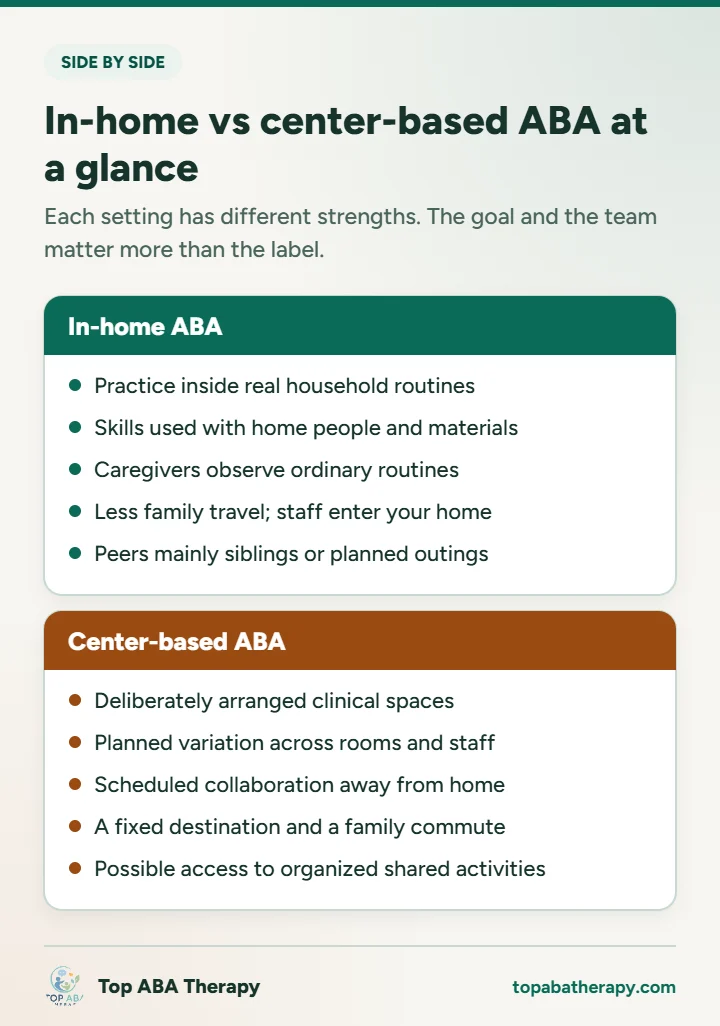
| Factor | In-home possibility | Center-based possibility |
|---|---|---|
| Context | Direct practice in household routines | Deliberately arranged clinical spaces |
| Generalization | Use with home people and materials | Planned variation across rooms, staff, and materials |
| Caregiver access | Observation within ordinary routines | Scheduled collaboration away from household demands |
| Peer opportunities | Siblings or planned community activities | Potential access to organized shared activities |
| Supervision | Observation in the natural environment | Supervisors may work near several teams |
| Privacy | Professionals enter the household | Treatment remains outside the home but uses shared spaces |
| Logistics | Less family travel within provider service areas | One destination with a family commute |
| Resources | Everyday objects and routines | Specialized rooms, materials, or equipment |
A provider’s actual practice can differ sharply from the setting label.
Start with goals, not a preferred building
A qualified clinician should assess strengths, needs, preferences, communication, health and safety factors, relevant environments, and outcomes valued by the person and family. The treatment plan should then connect each goal to a setting rationale.
How do you compare real providers and hybrid plans?
Setting discussions can obscure the strongest source of variation: the organization and team. Verify who performs the assessment, who owns clinical decisions, who provides direct services, which credentials and licenses apply, how staff are trained, and what happens during absences or turnover.
Supervision matters in both models
A supervisor being in the same clinic does not prove meaningful observation. A supervisor traveling to a home does not prove insufficient oversight. Ask for the expected frequency, duration, and format of direct supervision; how data and treatment integrity are reviewed; how technician competence is assessed; and how the family can reach the accountable clinician. If the roles are unclear, review what BCBAs and RBTs each do before comparing supervision plans.
Continuity can outweigh theoretical advantages
A preferred setting may be a poor choice when the provider cannot staff it consistently. Compare waitlists, cancellations, substitutions, supervisor caseloads, retention, and continuity plans. Ask whether a setting change would require a new authorization or place on another waiting list.
Evaluate generalization and real-life usefulness
Generalization means a useful skill occurs with relevant people, materials, settings, or situations beyond the original teaching conditions. Maintenance means it persists over time. Both need deliberate planning and measurement.
Compare social and peer opportunities carefully
A center may have other clients nearby, but proximity is not the same as appropriate peer interaction. Ask whether shared activities are actually offered, how participants are grouped, whether involvement is voluntary, how privacy is protected, and what individualized purpose the activity serves.
Privacy and family-life tradeoffs
Home-based services bring staff, records, and clinical activity into a private environment. Clarify permitted spaces, visitor and sibling boundaries, photography, audio or video, electronic documentation, staff communication, and what happens when the person or family needs privacy.
Safety questions differ by environment
At home, plans may need to address household layout, pets, pools, firearms, visitors, food, community exits, and emergency roles. In a center, examine secured entry and pickup, room visibility, evacuation, shared-space risks, personal care, infection controls, transportation, and incident reporting.
Do not assume locked doors, cameras, or restrictive procedures equal safety. Ask what risk each control addresses, what less intrusive options were considered, who approves it, how it is monitored, and when it will be faded. Any emergency or crisis practice must remain within law, professional scope, payer rules, and organizational policy.
Logistics can determine whether a plan is sustainable
Schedule and travel
Home-based care can reduce family driving but may depend on provider travel zones, traffic, weather, and staff willingness to commute. Center-based care creates a fixed destination but can add daily travel and transportation coordination. Compare the whole door-to-door burden, not only session hours.
Household and caregiver capacity
Ask what adult presence, caregiver training, space, technology, and between-session activity the provider expects. Participation should be clinically justified and adapted to language, disability, employment, other children, and family resources. A plan that cannot be sustained is not rescued by its setting label.
Availability and authorization
Confirm that the payer authorizes the proposed service, provider, dates, units, and setting. Verify whether assessment, direct treatment, caregiver training, group services, telehealth, travel, and community work are treated separately. The ABA insurance coverage guide explains how to obtain plan-specific answers.
When a hybrid ABA plan may make sense
A hybrid plan uses more than one setting. It may be reasonable when distinct goals require distinct environments, when generalization must be observed directly, or when a planned transition shifts services from one setting to another.
- which goals belong in each setting and why;
- who is accountable for the integrated treatment plan;
- how information is shared with informed permission;
- how conflicting recommendations are resolved;
- how travel and transitions affect the person;
- how outcomes and unwanted effects are compared across settings;
- when a setting will be added, reduced, or discontinued.
Build a provider-by-provider evidence record
Rate evidence only after interviews, document review, benefits verification, and a tour or observation where possible. “Unknown” is more honest than assigning a high score from marketing copy. For each candidate, record the setting rationale, meaningful goals, consent and assent practices, qualified leadership, staff competence, direct supervision, continuity, generalization measures, safety controls, privacy terms, incident accountability, schedule, travel, financial terms, and transition criteria. Our full list of ABA warning signs can help you decide which answers should pause an intake.
Red flags in either setting
- a guaranteed outcome, fixed timeline, or universal intensity before assessment;
- goals chosen primarily for compliance or appearance without meaningful benefit;
- pressure to start before credentials, costs, policies, or authorization are clear;
- refusal to explain data, supervision, incidents, or complaint pathways;
- routine exclusion of the person or family from decisions;
- high staff turnover presented as irrelevant;
- no plan for generalization, transition, step-down, or discharge;
- a claim that one setting is best for every autistic person.
Make a reversible, reviewable decision
Document why the selected provider and setting fit the current goals, what evidence will indicate benefit, which adverse effects or practical problems will trigger review, and when the decision will be reconsidered. Preferences, needs, staff, availability, and coverage can change.
Do not average away a threshold failure: convenient hours or a short commute cannot compensate for unsafe practice, weak clinical accountability, inaccessible communication, disregard for refusal, or an unexplained setting rationale.


Frequently asked questions about ABA settings
Is in-home ABA more natural than center-based ABA?
It is closer to some household routines, but “natural” does not automatically mean useful, preferred, or effective. Ask whether the goal belongs in that environment and whether the result transfers to other people and places that matter.
Is center-based ABA better for social skills?
Not by default. Other clients in a building do not create meaningful interaction without appropriate grouping, consent, purpose, and skilled support. Community, school, family, or chosen social environments may be more relevant for some goals.
Which setting offers better BCBA supervision?
The label cannot answer that. Compare the accountable clinician, direct observation frequency, feedback process, caseload, staff competence checks, availability during concerns, and evidence that supervision changes treatment decisions.
Can insurance decide between home and center ABA?
A plan may authorize particular providers, services, units, and settings, but coverage does not establish clinical fit. Ask the clinician to document the setting rationale and ask the payer for the written rule governing the request.
Can ABA therapy happen at school?
Some providers deliver services in schools or coordinate with school teams, depending on district policy, payer rules, and consent. Supports under an IEP are governed by education law and are separate from health coverage. Ask both the provider and the school how services, goals, and communication would be coordinated.
The bottom line
The in-home vs center-based ABA decision is less about which setting is better and more about which one serves your child’s current goals with a team that can deliver consistently. Compare supervision, continuity, safety, privacy, and the real weekly burden on your family, and consider a hybrid plan when different goals need different places. Write down why you chose, then revisit the decision at each review. When you are ready, find in-home and center-based ABA providers near you.