

Quick answer: Choose an ABA provider by checking the responsible clinician, credentials, applicable state license, supervision and actual service location. Then compare goals, consent and assent practices, safety, progress reporting, staffing and written costs. Interview the team that would deliver care; a brand name or directory listing cannot establish clinical fit.
Which ABA provider facts can you verify?
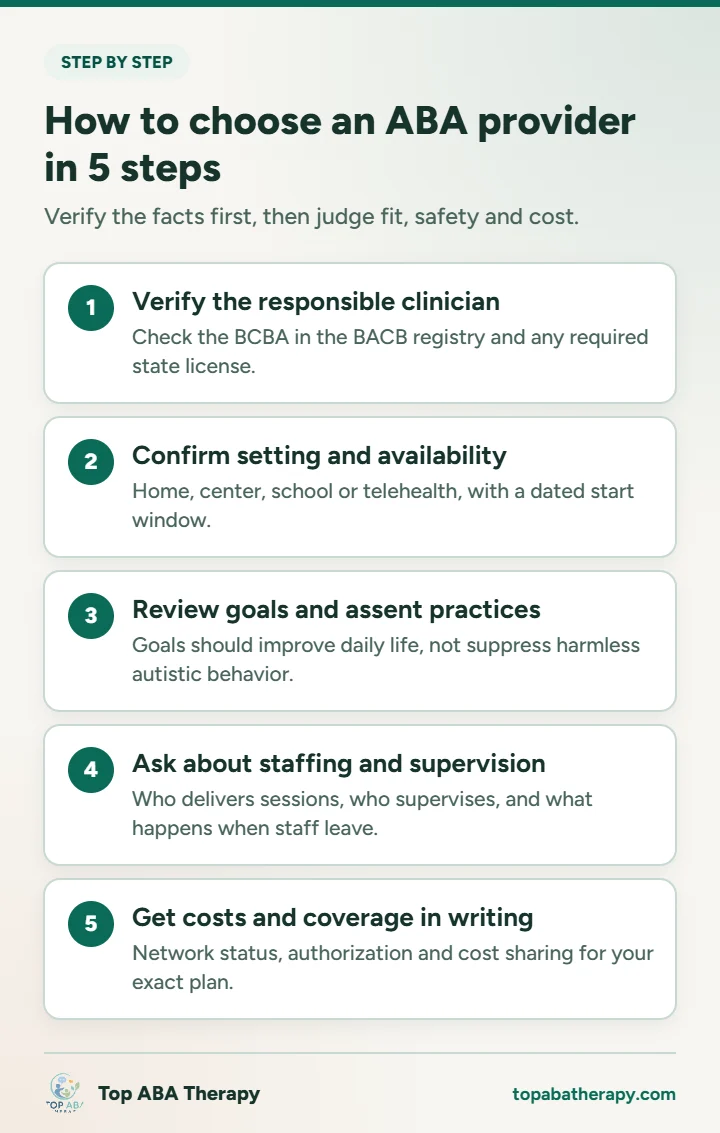
Ask for the full name and role of the professional responsible for assessment and the treatment plan. The Behavior Analyst Certification Board’s Certificant Registry can show credential type, current status, and reportable disciplinary information. BACB materials describe BCBAs as graduate-level certified practitioners who can work independently when their competence and applicable law allow it. RBTs are paraprofessionals whose services require ongoing supervision.
Confirm the organization’s legal name, service address, contact details, and the location where care would occur. If federal healthcare programs are involved, the HHS Office of Inspector General maintains a public exclusion database. Families do not need to conduct a corporate audit, but a provider should be able to identify its responsible people and explain its own screening process.
| Provider claim | Evidence to request | What the evidence cannot prove |
|---|---|---|
| Our clinicians are certified | Current individual BACB record and named case supervisor | Relevant competence, availability, or quality |
| We accept your insurance | Written network and benefit verification for the exact plan and location | Authorization, cost sharing, or future claim payment |
| We have immediate openings | Dated confirmation for the requested setting and schedule | Whether staffing and authorization will align |
| We provide evidence-based care | Individual assessment, justified methods, supervision, and meaningful measures | Whether this plan will help this person |

How should you evaluate goals and the care process?
The best-sounding method cannot rescue a poor goal. Ask how each proposed outcome improves communication, safety, autonomy, daily living, participation, access, or another priority meaningful to the client. Eye contact, quiet hands, obedience, indistinguishable appearance, and suppression of harmless autistic behavior should not be treated as universal goals.
Ask to see a de-identified sample treatment plan and progress report. Strong plans connect each goal to a real situation, explain how the person’s preferences and assent are respected, and show how progress will be measured and shared with you. If a provider cannot explain how it will know a goal is working, or when a goal should be changed, keep looking.
Also ask how caregivers are involved. Good programs coach families in everyday routines and adjust recommendations to your schedule, culture and energy, rather than handing over a fixed list of hours and rules.
What should you ask about staffing, safety, and cost?
Provider brands can conceal very different staffing models. Ask who conducts the assessment, writes the plan, delivers most sessions, observes implementation, reviews data, trains staff, communicates with the family, and responds to an urgent concern. Also ask what happens when the assigned technician leaves, is absent, or needs additional training. Organization-level marketing cannot replace person-level checks: identify who signs the plan, who delivers each service, and whether every role’s current credential and scope match the work described.
Safety note: A provider should investigate sudden distress, pain, sleep changes, medication effects, or other health factors within appropriate professional boundaries. Treating every difficult moment as noncompliance can delay needed medical, communication, environmental, or sensory support.
How can you compare providers and spot red flags?
Use the same questions for every organization. Record the evidence date and write “unknown” when a claim is not confirmed. Compare the responsible clinician, supervision model, requested setting, availability, goal-selection process, assent approach, progress measures, coordination, cost verification, transition, and complaint route.
Do not force a false winner. One provider may have stronger supervision but no suitable schedule; another may have current availability but an unresolved network question. Mark each issue as verified, provider-reported, contradicted, or unknown. Decide which unknowns must be resolved before intake and which can be monitored after care begins. Treat it as a red flag when a provider:
- guarantees outcomes, coverage, a start date, or a fixed timeline before assessment;
- will not identify the responsible clinician or explain supervision;
- proposes generic intensity without discussing the person’s total service burden;
- dismisses communication, refusal, distress, sensory needs, or autistic perspectives;
- treats every refusal as behavior to eliminate;
- cannot explain how goals improve the client’s life;
- discourages coordination or reasonable access to records;
- pressures enrollment before benefits, costs, policies, and alternatives are clear;
- lacks an understandable complaint, transition, or discharge process.

What should you ask on the first call?
The first call is a screening step, not a commitment. Keep it short and focused on facts you can check later. Note who you spoke with and the date, because availability and network status change quickly.
- Do you currently have openings for our setting, location and preferred schedule?
- Who would be the supervising BCBA, and how often would they observe sessions?
- Are you in network with our exact insurance plan at this service location?
- What does your assessment include, and how long until a treatment plan is ready?
- How do you involve caregivers, and how often will we receive progress updates?
- What is your process if we have a concern or want to change staff?
Before the call, confirm your benefits with our guide to whether insurance covers ABA therapy, so you can compare answers instead of relying on a provider’s summary.
Frequently asked questions about choosing ABA care
Is a BCBA credential enough to choose a provider?
No. A current credential confirms a defined professional status, not availability, relevant competence, staffing stability, ethics in practice, or fit for one person. Verify any required state license and ask who will supervise the actual case.
Does Top ABA Therapy vet provider quality?
Top ABA Therapy verifies bounded public facts from dated sources and holds unsupported fields blank. It does not endorse providers, certify clinical quality, or rank organizations by suitability for an individual.
How many providers should a family compare?
Compare enough providers to see meaningful differences in access, staffing, goals, safeguards, and cost. In a thin market, that may mean documenting why only one or two options are realistically available.
What should happen during an ABA consultation?
The provider should learn about the person’s strengths, communication, priorities, context, and support needs while explaining its process and limits. A consultation should not produce a guaranteed outcome or generic treatment intensity before assessment.
The bottom line
Knowing how to choose an ABA provider comes down to evidence over promises: verify the people and the paperwork, then judge whether the goals, supervision and schedule fit your child and your family. Compare at least two options with the same questions, write down what is confirmed and what is still unknown, and only start intake once the essentials are clear. When you are ready, find ABA therapy providers near you and use this checklist on every call.