

Quick answer: Discrete trial training (DTT) organizes teaching into brief opportunities with a cue, response, planned consequence and data. It can support focused practice, but correct responses in a lesson do not establish everyday independence. Ask how the provider checks assent, fades prompts and tests generalization and maintenance.
How does discrete trial training work, and what can it teach?
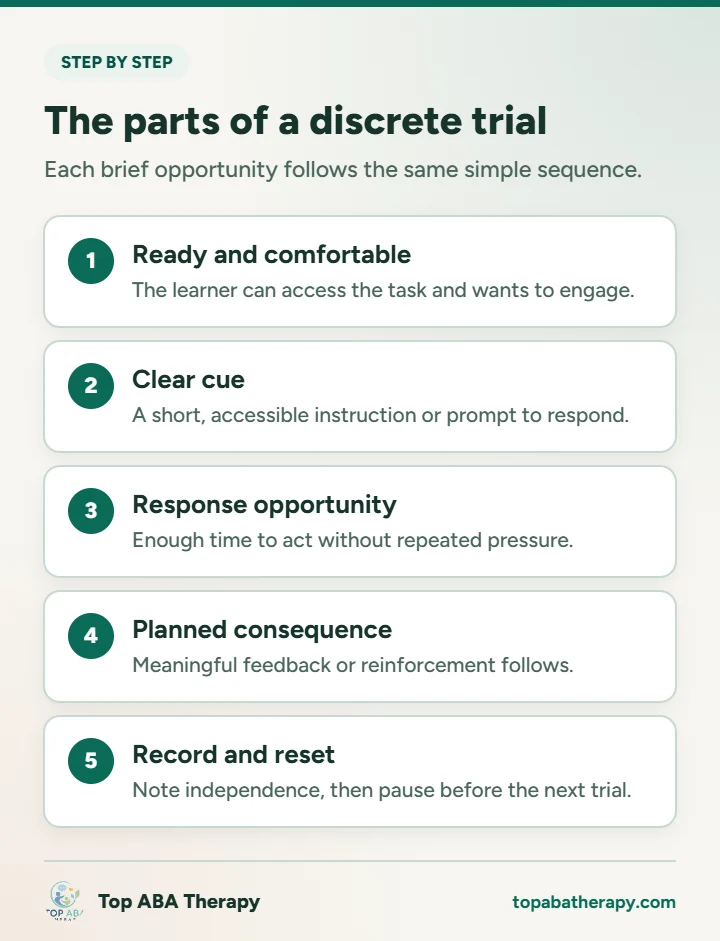
The parts of a discrete trial
| Component | What it means | What to verify |
|---|---|---|
| Context or motivating condition | The situation in which teaching occurs | Is the learner ready, comfortable, and able to access the task? |
| Antecedent | A cue, instruction, material, or event before the response | Is it clear, accessible, and relevant to the eventual natural cue? |
| Response opportunity | Time and conditions for the learner to act | Is enough processing time provided without repeated pressure? |
| Prompt | Added assistance when planned | Is it least intrusive, consented to, measured, and faded? |
| Consequence | What follows the response | Is feedback or reinforcement ethical, meaningful, and connected to learning? |
| Intertrial interval | Brief transition before another opportunity | Is pacing appropriate and are pauses genuinely available? |
| Data | Record of response, independence, prompt, or other measure | Does measurement distinguish true learning from prompted performance? |
The exact format varies. A provider should explain its terminology in plain language without implying that every DTT program follows one standardized protocol.
A conceptual DTT example
Suppose a learner and team select a meaningful goal of identifying a preferred communication symbol among several options. A teacher may present the materials and a clear cue, allow time to respond, provide a planned prompt if needed, honor the selected communication outcome, record the level of independence, and reset for another brief opportunity.
Why providers use DTT
Potential advantages include:
- clear teaching opportunities and response definitions;
- repeated practice of a narrowly defined skill;
- systematic manipulation of prompts, examples, or consequences;
- relatively direct measurement of accuracy and independence;
- easier detection of specific error patterns;
- predictable routines that some learners may prefer;
- controlled practice before a skill is tested in more complex settings.
These capabilities do not prove benefit. The outcome must be useful outside trials, and the learner’s experience and preferences matter.
DTT is not all of ABA
ABA includes assessment, environmental strategies, communication interventions, naturalistic teaching, caregiver coaching, workplace or organizational applications, and many focused practices. DTT is one instructional format. Our overview of ABA therapy techniques shows where it fits among the others.
Prompting and prompt fading
Prompts may be visual, gestural, modeled, verbal, positional, or physical. The provider should select prompts based on the task, communication, accessibility, intrusiveness, bodily autonomy, and error risk, not staff convenience.
Errorless learning and error correction
Some DTT arrangements use prompts early to reduce errors. Others allow an independent opportunity and then provide a defined correction. Neither label is automatically better. Ask the provider:
- Does the learner understand the cue and response format?
- Does the prompt produce learning or only short-term accuracy?
- What happens emotionally and behaviorally after errors?
- Does correction become repetitive, aversive, or coercive?
- Are data capturing first-response independence instead of corrected performance alone?
- How will the procedure change if errors persist?
Reinforcement in DTT
Reinforcement may be arranged after defined responses, but measured effect, not provider intent, identifies it. Preferences shift, and a consequence can lose value or become burdensome. See positive reinforcement in ABA for the ethics of choosing and fading reinforcers.
Data can misrepresent learning
A high percentage correct may reflect memorized order, unintentional cues, narrow materials, prompt dependence, repeated corrected responses, or a definition that omits meaningful errors. Trial totals can also obscure fatigue and loss of assent. Good DTT data keep these apart:
- independent, prompted, incorrect, and no responses;
- first opportunity from correction trials;
- acquisition from generalization and maintenance;
- performance with familiar versus unfamiliar people and materials;
- skill accuracy from speed where speed matters;
- benefit from distress, avoidance, burden, or adverse effects.
Generalization must be planned
DTT often simplifies learning by controlling materials, language, timing, and distractions. Those supports can become limitations if the skill never transfers.
DTT and naturalistic teaching can coexist
Structured and naturalistic teaching are not mutually exclusive. A team might introduce a component through brief trials and practice it during play or routines, or begin naturally and use structured practice for a specific discrimination.
Which DTT limitations and provider safeguards matter?
Assent, pacing, and breaks
A compliant seated posture is not proof of assent. Providers should monitor approach, engagement, choice, avoidance, distress, shutdown, communication, and withdrawal throughout instruction.
Limitations and risks
Key risks are rote performance, prompt dependence, weak generalization, compliance goals, fatigue, coercive reinforcement, narrow data, and staff drift. Safeguards include varied examples, separate independence measures, real-life tests, person-valued outcomes, accessible breaks, ordinary access to essentials, adverse-effect review, direct observation, competency checks, and feedback.

Questions to ask a provider
Rationale
- Which goals will use DTT and why is the format appropriate?
- Which alternatives or environmental changes were considered?
- How did the person and family participate in selecting goals?
- What percentage of service time is structured trial teaching?
Implementation
- Who designs the trials and who implements them?
- How are staff trained and directly observed?
- What prompts, physical contact, correction, reinforcement, and break procedures apply?
- How are assent and withdrawal recognized?
Outcomes
- Are independent responses separated from prompted and corrected responses?
- How are generalization, maintenance, quality of life, and adverse effects measured?
- What triggers a method change, reduction in trials, referral, pause, or stop?
- How will arranged consequences and adult prompts fade?
For broader due diligence on credentials, supervision, safety, data, communication, and transition, open the provider-selection framework.
DTT should not be copied from an article
A readable example cannot supply individualized assessment, material design, response definitions, prompt selection, reinforcement evaluation, risk analysis, consent, or staff competence. Poorly designed trials can teach errors, create prompt dependence, strengthen avoidance, or suppress communication.
Verify real practice, not a technique label
A provider profile that mentions DTT does not tell you which goals, staff, safeguards or availability apply to your child. Confirm the actual plan directly and, where possible, observe a session.

Frequently asked questions about discrete trial training
What does DTT mean in ABA?
DTT means discrete trial training, a structured format using defined teaching opportunities with a cue, response opportunity, consequence, data, and planned prompting when needed.
Is DTT the same as ABA?
No. DTT is one teaching format within a much wider field that includes assessment, environmental strategies, naturalistic teaching, communication intervention, consultation, and other focused practices.
Does a correct response prove learning?
Not by itself. The response may depend on prompts, memorized order, familiar materials, or correction trials. Providers should report first-response independence, transfer, maintenance, and functional use.
Can DTT and naturalistic teaching be combined?
Yes. Structured practice may introduce or clarify a component, while routines and play test flexible use. The mix should follow the person’s goal, preference, progress, and burden.
The bottom line
Discrete trial training is a useful teaching format when it targets meaningful skills, respects assent and breaks, separates independent from prompted responses, and plans from day one for generalization into real life. It should be one tool among several, not the whole program. When you are comparing programs, find ABA therapy providers near you and ask how much of their teaching is structured versus naturalistic.