

Quick answer: Extinction occurs when a response no longer produces the reinforcer that maintained it and then decreases over time. The examples explain a process, not a home procedure. Risks, verified function, communication alternatives, consent and monitoring require qualified evaluation; extinction is not a general instruction to ignore distress.
What does extinction mean, and which risks follow?
Reinforcement describes a consequence that increases future responding in similar conditions. Extinction changes that function-specific relation: the identified reinforcer no longer follows the target response. Response reduction may occur slowly, unevenly, in some contexts only, or with later relapse. (Our guide to positive reinforcement in ABA explains this in more depth.)
The technical definition does not mean ignoring all behavior, removing attention without evidence of an attention function, punishing a response, blocking movement, forcing compliance, or waiting for a skill to disappear. It never authorizes withholding food, water, toileting, pain care, communication, sensory access, comfort, relationships, or a safe exit.
Extinction is function-specific
If attention maintained a response, stopping attention for that defined response may meet the technical relation. If escape from pain, access to help, sensory change, or another outcome maintained it, ignoring the response does not implement the matching contingency. The same visible behavior can serve different functions across people, settings, and time. That is why a careful functional behavior assessment comes before any extinction decision.
Bursts and variability are possible, not guaranteed
An extinction burst is commonly described as a temporary increase in rate, duration, intensity, or variability after extinction begins. Shahan and colleagues examine definition and prevalence limits. Ordinary variability, measurement choices, and other plan changes can be misclassified as a burst.
Never use “it gets worse before it gets better” to wave away injury, severe distress, new topographies, withdrawal of assent, sleep disruption, relationship damage, or implementation error. Follow predetermined review and stop criteria. Reassess function, access to the alternative, reinforcer quality, and whether the plan remains acceptable.
Relapse needs a realistic response plan
Behavior reduced during extinction can return after time, a context change, renewed contact with reinforcement, or worsening reinforcement for a newer response. Relevant labels include spontaneous recovery, renewal, reinstatement, resurgence, and rapid reacquisition.

What do function-matched extinction examples reveal?
Each example below is synthetic and incomplete. It shows the relation a qualified team would have to verify, plus the support that prevents extinction from standing alone.
| Proposed situation | What a defensible plan must clarify and protect |
|---|---|
| Unsafe behavior previously produced routine adult help during software errors | Repair accessibility; teach a one-tap, gesture, or spoken help request; make help rapid; define urgent safety response; record error opportunities, help latency, distress, and staff fidelity. |
| Unsafe behavior previously ended difficult work | Review pain, fatigue, communication, sensory conditions, task value, duration, and choice; redesign work and make an accessible break or modification request effective. Escape blocking and forced compliance are not default safeguards. |
| A low-risk response previously produced a particular form of social attention | Provide abundant appropriate attention, teach an accessible bid, specify which attention relation changes, and continue responding to pain, distress, communication, bullying, illness, and safety. |
| A vending-machine button no longer produces a snack because the machine is broken | This everyday example illustrates a response-consequence relation; it is not a clinical plan and the person can choose another machine or ask for help. |
Help should remain easy to obtain
A student encounters a software error and throws a tablet after years of receiving immediate troubleshooting that way. Before any consequence change, the team repairs interface barriers, teaches a one-tap help message during calm practice, and confirms that adults respond quickly.
Compare response effort, delay, reliability, quality, and magnitude. A tiny icon hidden across several device screens cannot compete with an established response that produces immediate help. Train partners to recognize all accepted forms, deliver the outcome promptly, and repair missed communication. Thin reinforcement only when the person continues to succeed and the resulting schedule remains humane in ordinary life.
Task-break plans can become coercive
When an unsafe response has ended work, begin with whether the work should occur in its current form. Shorten or adapt it, offer genuine choice, make breaks predictable, provide communication, and address pain or overload. An accessible break request should work quickly.
Natural escape may make extinction infeasible, and immediate interruption may be necessary for danger. Caregivers and teachers also cannot implement brittle plans across every moment. Antecedent changes, noncontingent reinforcement, enriched environments, differential reinforcement, choice, and concurrent options may be safer and more usable.
Attention plans must retain human responsiveness
If assessment supports a specific attention-maintained relation, the plan can provide frequent attention independently and reinforce a clear bid. It should name which response no longer produces the identified attention and which compassionate, safety, health, and communication responses continue.
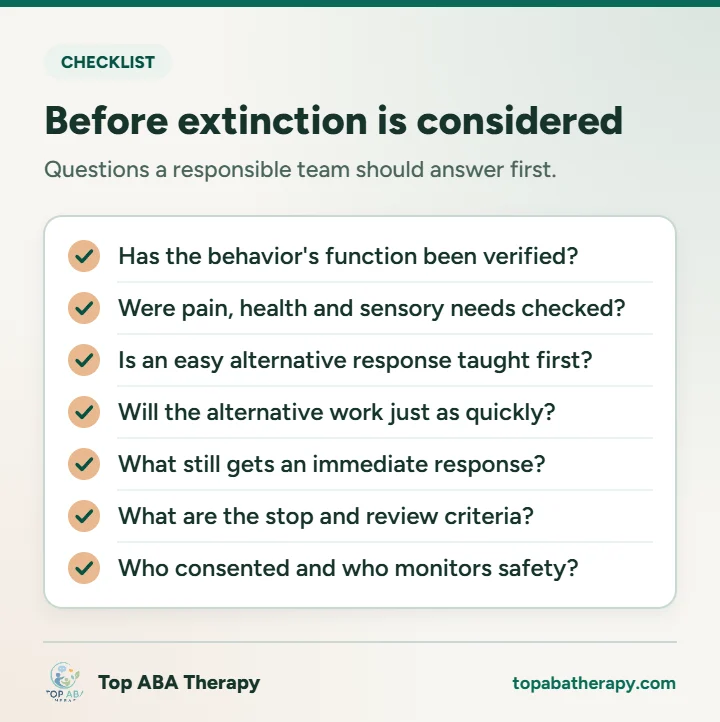
How should teams decide whether extinction belongs in a plan?
First define behavior neutrally and identify outcomes the person values, such as easier communication, less pain, safer access, greater choice, or fuller participation. Then assess function, health, environment, communication, and learning history with procedures proportionate to risk.
Improve antecedent conditions first
Change unclear instructions, long waits, unavailable attention, unpredictable transitions, excessive difficulty, sensory barriers, inaccessible communication, and unsafe design. Kincaid and colleagues discuss positive behavior support through proactive environmental changes, choice, and skills teaching. Those changes may remove the reason to consider extinction.
Teach an alternative through the person’s reliable modalities, including AAC, sign, gesture, writing, or speech. It should produce the same relevant outcome at least as efficiently as the established response during early teaching. Do not require eye contact, a full sentence, or calm appearance as an extra price.
Compare feasible alternatives explicitly
Lattal and colleagues review the state of knowledge for extinction and punishment, including risks, feasibility, and concurrent alternatives. Ask why differential reinforcement without extinction, noncontingent reinforcement, environmental redesign, skills teaching, or another arrangement is insufficient.
Put safety and assent in the operational plan
Write what staff do during pain, distress, danger, withdrawal, urgent communication, and implementation error. Name pause, stop, emergency, reporting, and review routes. Restrictive components require relevant competence, legal and ethical review, consent, risk analysis, alternatives, oversight, and a real exit. Families weighing these questions may find our overview of ABA criticism, evidence and safety useful.
Frequently asked questions about extinction in ABA
Is extinction the same as punishment?
No. Extinction changes the maintaining reinforcement relation. Punishment reduces future behavior through a consequence; either procedure can still create ethical and safety concerns.
Is planned ignoring always extinction?
No. It fits only a defined attention-maintained relation and must not override pain, communication, safety, distress, bullying, illness, or humane support.
Must a behavior plan include extinction?
No. Environmental redesign, differential or noncontingent reinforcement, skills teaching, choice, and other function-based arrangements may work without it.
Should families try extinction at home?
Not from an online example. Incorrect function, weak alternatives, inconsistent delivery, and absent safety controls can increase risk and damage trust.
The bottom line
Extinction ABA examples are useful for understanding a behavioral process, not for copying at home. Extinction only applies when the maintaining reinforcer is verified, must never mean ignoring distress or needs, and should come after better environments and easy, effective alternatives. If you are reviewing a behavior plan, ask the hard questions and compare ABA therapy providers near you on how they answer them.