

Quick answer: ABA waitlists vary by location, age, setting, schedule, staffing, clinical fit and payer. Submitting a form may create an inquiry rather than a confirmed queue position. Ask which stage you have reached, what is missing, who will update you and what must happen before a realistic start date can be confirmed.
How do ABA therapy waitlists actually work?
One provider can have several queues
Capacity is multidimensional. A center may advertise an opening while lacking staff for the requested hours, language, age, payer, communication profile, service type, or clinical risk. Home-based availability may depend on travel zones and traffic. School and community services require access agreements. Telehealth depends on jurisdiction, modality, and fit.
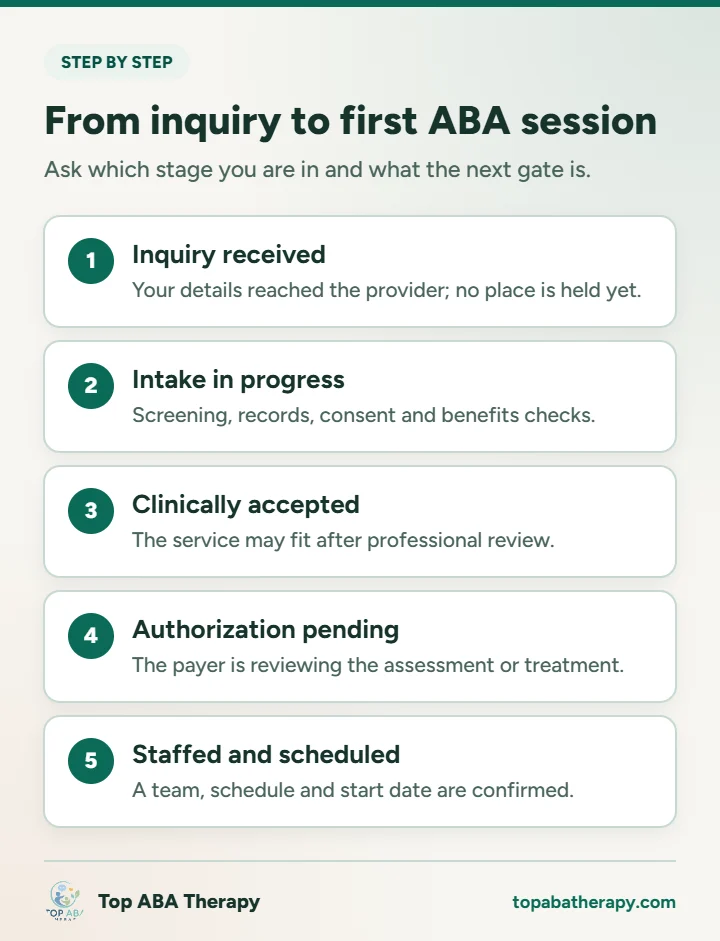
| Status | What it may establish | What remains uncertain |
|---|---|---|
| Website inquiry or interest record | Contact details reached the organization | Eligibility, response, clinical fit, priority, or queue position |
| Intake pending | Screening, referral, records, consent, or benefits work has started | Acceptance, payer approval, staffing, or schedule |
| Clinically accepted | The service may fit after professional review | Authorization, staff match, and start date |
| Authorization pending | A request reached a payer or funder | Approval and capacity after approval |
| Staffing queue | Clinical and financial prerequisites may be complete | Stable assignment, offered hours, and exact timing |
| Start scheduled | A proposed team, schedule, and date exist | Protection from turnover, cancellation, or a final eligibility change |
Ask the provider to name your status. “You are on our list” cannot support planning unless it identifies the legal entity, location, service, entry date, and next gate.
Questions that expose how the queue operates
Confirm whether priority is chronological, needs-based, geographic, payer-specific, schedule-based, or mixed. Ask what proves the entry timestamp, how estimated waits are calculated, when that estimate was refreshed, and which documents remain outstanding. Learn how often you must reconfirm interest, which contact attempts count, how much response time you get, and what causes removal. For each list you join, keep a record of:
- brand and legal billing entity;
- exact site, travel area, or telehealth state;
- service, setting, age range, payer, and requested schedule;
- queue status, entry timestamp, and confirmation evidence;
- documents, benefits checks, and authorization still pending;
- update date, response window, removal rule, and next contact;
- final decision and reason: active, hold, declined, removed, started, or closed.
Coverage and privacy are separate gates
Provider availability does not prove insurance coverage, and authorization does not create a staff opening. Ask the payer whether the exact organization, location, clinicians, setting, and service are in network; which referrals and medical-necessity records apply; whether assessment or treatment needs prior authorization; and which units, dates, and service sites are covered. Use our ABA insurance verification call script while you wait, so coverage is not the final hold-up.
How can families reduce delays and evaluate an opening?
Search in parallel without treating every list as useful
Families can often join several appropriate lists, subject to provider and payer rules. Each option should still pass basic checks for setting, methods, schedule, travel, communication access, credentials, supervision, coverage, and family priorities. Sending sensitive records to an implausible match only creates privacy and administrative burden. Our guide to finding ABA therapy and questions to ask an ABA provider help you shortlist quickly.
Do not authorize overlapping assessments or billing without understanding coordination and payer rules. Tell providers when you no longer want a place so limited intake capacity is not held. Keep your phone, email, address, payer, schedule, language, accessibility needs, and service preference current, using secure channels for clinical changes.
Prepare for intake, but do not let speed replace fit
Possible intake requests include a referral, diagnostic report, insurance card, prior evaluations, school or treatment records, consent forms, and availability. Ask which of these stages is holding things up: pre-screening, benefits, consent, assessment, authorization, plan approval, staffing or scheduling. Knowing the real bottleneck tells you what you can speed up yourself.
Then confirm days, times, location, travel, caregiver role, cancellations, network status, authorization, written estimate, transition, and discharge. Ask what happens if the assigned technician leaves before or after the start. The fastest opening is not useful when the plan, staffing, burden, or financial terms do not fit.
Keep other support and safety routes active
A directory cannot prescribe interim care. Depending on needs and eligibility, ask qualified professionals or agencies about medical or mental-health evaluation, IDEA Part C for an eligible infant or toddler, school evaluation and positive behavioral supports, speech-language or AAC services, occupational or other relevant care, respite, disability supports, family navigation, and payer case management.
A waitlist is never a crisis plan. For immediate risk, injury, suspected abuse, acute medical change, or crisis, use appropriate healthcare, emergency, or protective resources. Tell the provider securely about changes affecting clinical fit, risk, setting, or competence, but do not assume greater need guarantees priority. Transparent systems explain any expedited-review criteria without encouraging exaggerated risk.
Audit availability claims
Useful availability information is scoped to a service, location, age, payer, schedule, and setting, with a source and last-checked date. “Accepting clients” without that context can waste months. Trustworthy systems define status vocabulary, transitions, priority rules, nondiscrimination safeguards, timestamps, update frequency, removal policy, correction history, accessible communication, and retention limits.
When a listing says a provider is accepting clients, check the date and confirm directly for your location, age, payer and schedule. No directory can promise a real-time opening, so treat availability claims as leads to verify.


Frequently asked questions about ABA therapy waitlists
Can I join more than one ABA waitlist?
Often yes, but provider and payer rules differ. Join only plausible options, avoid authorizing duplicate billable work without clarification, protect sensitive records, and close entries you no longer want.
Does a waitlist position guarantee a start date?
No. Intake, clinical acceptance, payer approval, staffing, schedule, and final eligibility can remain unresolved. Even a scheduled date can change after turnover or an authorization issue.
How often should I check my ABA waitlist status?
Use the provider’s stated cadence and reconfirmation policy. Follow up sooner after a material contact, deadline, payer change, or safety-relevant update. Repeated daily calls rarely create capacity and may obscure the official record.
What if insurance authorization expires while I wait?
Ask the provider and payer who owns renewal, when action can begin, and whether a network-access or appeal route applies. Obtain plan-specific answers and reference numbers; do not assume approval will remain active indefinitely.
The bottom line
ABA therapy waitlists are easier to manage when you know your exact stage, the next gate and who will update you. Join a few well-matched lists, keep paperwork and coverage ready, keep other supports active while you wait, and evaluate any opening for fit, not just speed. To widen your options, search ABA providers in your area and ask each one about current availability.