

Quick answer: ABA supervision can mean clinical oversight, RBT or BCaBA ongoing supervision, supervised fieldwork or employee management. These are different responsibilities with different rules. Identify the purpose and applicable requirements first, then check direct observation, feedback, records, backup coverage and a safe way to report supervision problems.
Credential note: Requirements change and arrangements vary. Use the current BACB handbook, transition materials, state authority, payer and employer rules, and signed agreements. This article cannot validate a person’s monthly supervision or fieldwork.
Which ABA supervision system applies?
The word “supervision” can refer to different relationships. Mixing them produces false assurances and broken records. Begin by writing a purpose statement for each meeting or observation.
| Supervision system | Question its evidence must answer |
|---|---|
| Client clinical oversight | Who knows the client, authorizes and reviews the work, monitors benefit and harm, and owns transition decisions? |
| RBT ongoing supervision | Did each organization provide the current amount, contacts, observation, individual structure, qualified relationship, and monthly records? |
| BCaBA ongoing supervision | How does the responsible BCBA actively oversee assistant-analyst decisions, scope, clients, RBT supervision, and urgent concerns? |
| Trainee fieldwork | Did eligible experience, observation, feedback, activity mix, forms, and documentation meet the target credential’s ruleset and period? |
| Employee management | What job expectations, scheduling, pay, evaluation, discipline, accommodation, and development terms apply? |
| Mentoring or professional development | Which capabilities are being developed beyond mandatory credential or employment controls? |
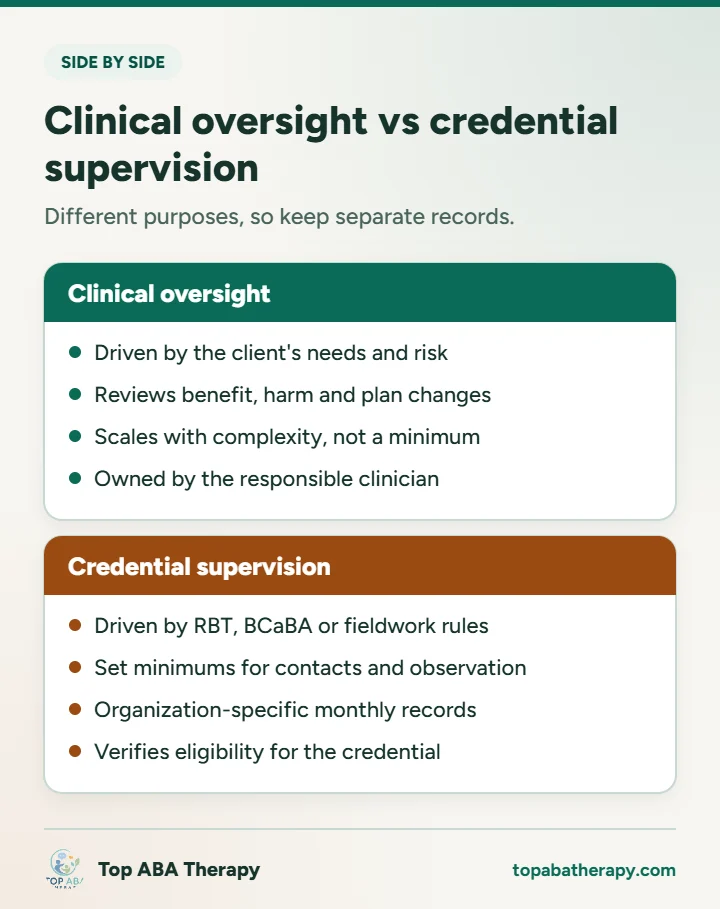
A staff performance review does not automatically satisfy credential supervision. A fieldwork meeting does not necessarily provide enough client-specific oversight. An RBT observation cannot be credited to a different organization merely because the same person works there. Keep the purposes distinct, then document any legitimate overlap. Our comparison of BCBA vs BCaBA roles and BCBA vs RBT roles explains who supervises whom.
What do RBT and BCaBA supervision require?
RBT supervision is organization-specific and ongoing
The RBT is a supervised paraprofessional. Under the June 2026 RBT Handbook, supervision at each organization must equal at least 5% of the RBT’s monthly behavior-analytic service hours there. The month also needs at least two real-time, face-to-face contacts, at least one observation of service delivery, and at least one individual session, plus the complete qualification, group, record, and relationship conditions in the handbook.
Apply the entire current rule, not only the percentage. If an RBT provides 92 service hours at one organization, 5% is 4.6 supervision hours, but arithmetic alone says nothing about required contacts, observation, individual or group format, supervisor eligibility, client responsibility, feedback, or documentation. Hours across organizations cannot be combined to repair a shortfall at either one.
BCaBA supervision is not RBT supervision
BCaBAs do not practice independently. Their ongoing BCBA supervision should define client responsibility, scope, frequency, observation, data and record review, decision authority, urgent access, fees, multiple relationships, transition, and oversight of any RBT supervision they provide.

How do fieldwork and client clinical supervision differ?
Fieldwork develops and verifies trainee competence
BCBA or BCaBA fieldwork follows the target credential, expected application date, ruleset, fieldwork type, activity definitions, supervision conditions, observations, documentation, and forms. Before hours begin, verify supervisor qualification, complete required training and a written contract, define qualifying work and records, and plan for a supervisor or job change.
Keep monthly evidence while it can be reconciled. Never backdate a contract, invent observation, sell a signature, or assume all paid work counts. Employer-offered fieldwork may fail to qualify if the conditions and records are not met. For the full certification path, see how to become a BCBA.
Clinical oversight responds to the client and service
Credential minimums do not tell a provider how much oversight a particular client needs. Service intensity, risk, staff experience, plan changes, communication access, data stability, setting, caregiver concerns, incidents, and observed implementation can require more direct involvement. Minimum hours should not become either a ceiling or a reason to generate unnecessary billable work.
How do you audit supervision quality and records?
Observe performance and close the feedback loop
A useful observation has a stated purpose, relevant sample, operational criteria, privacy control, feedback, practice, and follow-up. Record the context and time, what was observed, the expected behavior, strengths, correction, rehearsal or modeling, outcome, and responsible next step. Watching silently or reviewing completed notes later may miss how the service was actually delivered.
Reconcile monthly evidence before deadlines
Keep separate, reconcilable ledgers for client oversight, RBT maintenance, BCaBA supervision, fieldwork, and employment. Verify identities and statuses, organization and client scope, handbook version, service or experience hours, supervision amount, contacts, observations, individual and group format, feedback, signatures, corrections, and required portal relationships.
Store records securely with clear ownership, access, retention, and backups outside a system one party can abruptly lose. Correct discrepancies transparently. A missed requirement should trigger prompt review and an honest plan, never a fabricated date or retroactive meeting.
Audit capacity and escalation
Count the combined load across clients, technicians, assistant analysts, trainees, sites, travel, time zones, assessments, incidents, authorizations, meetings, and documentation. No universal caseload number proves adequacy. Supervisors need authority to decline assignments, protect observation time, obtain backup, and pause unsafe work. Candidates can test these systems with our BCBA interview questions.

Frequently asked questions about ABA supervision
Is 5% supervision enough for every RBT situation?
It is a current monthly minimum described in the cited June 2026 RBT Handbook, not proof of adequate clinical support. Client needs, staff competence, risk, change, and setting may require more.
Can one meeting count for RBT supervision and fieldwork?
Potentially, but only if the meeting independently satisfies every applicable purpose, qualification, activity, format, observation, feedback, and documentation condition. Never assume dual credit from the calendar title.
Can RBT supervision hours be combined across employers?
Not to cure a shortfall. The cited handbook applies the monthly supervision requirements to each organization where the RBT provides behavior-analytic services.
Does remote supervision count?
It may under the applicable credential rules, law, consent, privacy, technology, interaction, and observation conditions. A connected camera or recording alone does not prove a qualifying or clinically useful session.
The bottom line
Good ABA supervision starts by naming which system applies: client oversight, RBT or BCaBA supervision, fieldwork or employee management. Meet the current rules in full, observe real sessions and close the feedback loop, reconcile records monthly and scale oversight to client needs rather than minimums. Professionals and families can browse ABA providers near you and ask how supervision works in practice.