

Quick answer: Medicare payment for ABA-related services depends on the beneficiary, covered service, eligible billing pathway, provider and applicable policy. The presence of adaptive-behavior codes in a Medicare guide does not guarantee payment. Confirm Original Medicare or the exact Medicare Advantage benefit and any Medicaid coordination before scheduling on that assumption.
Medicare boundary: This guide is general education, not individual coverage, coding, billing, medical, benefit, appeal, or legal advice. Medicare rules and plan materials change. Verify the date of service, jurisdiction, beneficiary, provider, and product with official sources.
What do Medicare’s 2026 materials actually show?
| Coverage route | Question to resolve |
|---|---|
| Original Medicare | Is the specific service covered for this beneficiary, diagnosis and clinician? |
| Medicare Advantage | What does the exact plan cover, and which network and authorization rules apply? |
| Medicaid alongside Medicare | Does a separate state Medicaid benefit apply, and how are benefits coordinated? |
| Other insurance or self-pay | What remains payable after the applicable benefits are confirmed? |
CMS recognizes service categories, not every use
The CMS Medicare Learning Network guide dated March 2026 lists behavior identification assessment, behavior identification-supporting assessment, adaptive behavior treatment by protocol, adaptive behavior treatment with protocol modification, and adaptive behavior treatment guidance among commonly used mental-health-related HCPCS/CPT code categories. That is meaningful evidence that the categories appear in Medicare billing education.
Find the geographically applicable policy
Use the Medicare Coverage Database to search current national and local coverage documents. Local coverage can depend on the Medicare Administrative Contractor and geographic jurisdiction. Check status, effective date, revision history, covered indication, documentation, provider, setting, and coding articles. An archived item or policy from another jurisdiction cannot control a current claim merely because a search engine surfaced it.
Identify who performs and who bills
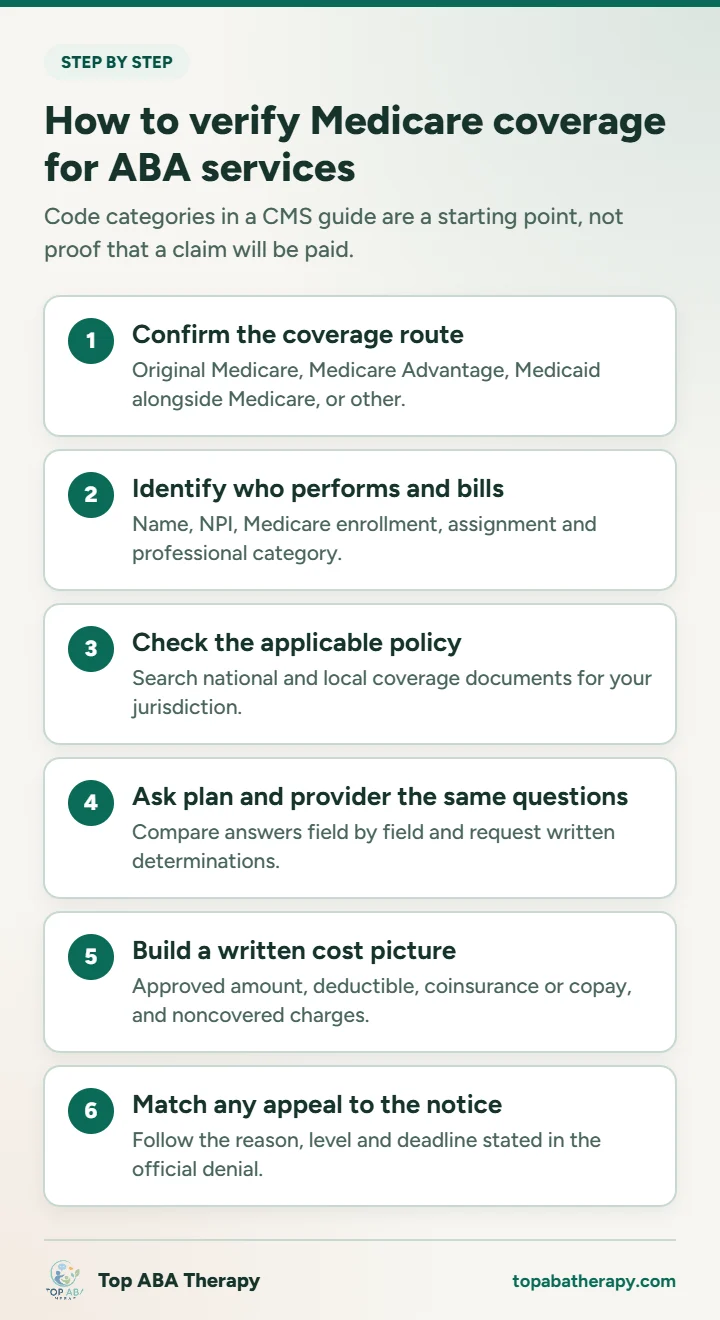
Medicare recognizes defined provider and supplier categories under statutory and regulatory conditions. The professional performing an activity may differ from the professional or entity permitted to bill it. Ask for the legal name, national provider identifier, Medicare enrollment status, assignment status, professional category, role in the service, supervisor where applicable, and the rule supporting the proposed claim.
Do not infer that every BCBA, BCaBA, RBT, behavior technician, autism clinic, or multidisciplinary practice can enroll or bill independently. A provider should be able to explain who is clinically responsible, who appears as rendering and billing professional, how supervision is documented, and which source permits that configuration.

How should beneficiaries verify Original Medicare or Medicare Advantage?
Start with the actual coverage route
For Original Medicare, ask the provider and 1-800-MEDICARE or the official beneficiary account about the proposed service, medical purpose, current code, quantity, diagnosis linkage, place of service, performing professional, billing professional or supplier, enrollment, assignment, applicable national or local policy, documentation, expected approved amount, and beneficiary share.
Medicare.gov explains that Part B covers medically necessary services from specified provider categories and often leaves 20 percent of the Medicare-approved amount after the deductible for many covered services. That general cost framework cannot establish the price, approved amount, or coverage of one adaptive behavior claim. Supplemental coverage and assignment status may also affect exposure.
Treat Medicare Advantage as plan specific
Medicare Advantage plans provide covered Part A and Part B benefits and may include certain additional benefits. They can operate networks, referrals, prior authorization, and utilization management within governing rules. Call the number on the current member card and request the evidence of coverage.
Confirm full plan name, county, network, organization, service location, performing and billing professionals, proposed service, code, criteria, referral, authorization, setting, approved quantity, effective dates, cost sharing, and appeal route. An insurer may sell commercial autism coverage and Medicare Advantage products. A commercial ABA policy cannot establish the Medicare Advantage benefit.
Use the same written question with the plan and provider so their answers can be compared field by field. Include the member’s product, proposed service and code, clinical purpose, performing professional, billing professional or supplier, site, expected dates and quantity, supervision, authorization, and source policy; then ask each party to mark what it confirmed, what it inferred, and what it cannot decide. When the replies differ, request a named escalation and a written determination instead of relying on whichever verbal answer sounds more favorable. Our ABA benefits call script can help you structure those questions.
Coordinate Medicare and Medicaid carefully
Medicare.gov notes that people with both Medicare and Medicaid may receive added coverage or help with costs. Medicaid is state-administered, and benefits, provider enrollment, managed-care responsibility, authorization, and cost sharing vary. For the Medicaid side, see our guide to checking Medicaid ABA coverage in your state.
Keep notices from both programs. When answers conflict, ask each payer to identify coordination rules and claim order. Do not let a provider bill the beneficiary as the default while payer responsibility remains unresolved.
How should beneficiaries handle cost, notices, and denials?
Build a written cost picture
Request the proposed charge, Medicare-approved amount if available, deductible status, coinsurance or Medicare Advantage copayment, assignment status, supplemental plan response, Medicaid coordination, and potentially noncovered charges. Separate each service and date. An estimate should identify which values are known, quoted, assumed, or pending.
Track the cash timing separately. A provider may request payment before Medicare or a plan adjudicates, a supplemental claim may lag, and an appeal can outlast several billing cycles. Ask what the provider collects up front, whether collection pauses during a documented dispute, when refunds issue after later payment, and which written policy governs balances. Never assume that a pending appeal suspends a deadline or makes a charge disappear.
Read an ABN before choosing an option
Medicare.gov explains that an Advance Beneficiary Notice of Noncoverage is not an official Medicare denial. It may give an Original Medicare beneficiary choices about receiving a service and claim submission when the provider expects noncoverage. Read the exact reason, service, estimated cost, and selection.
If the beneficiary asks that no claim be submitted, an appeal of that claim decision may not be available because Medicare did not decide it. An ABN does not prove the service is never covered and does not permit any charge without applicable notice and billing rules. Ask questions before signing and retain a complete copy.
Match the response to the official denial
Original Medicare and Medicare Advantage use different appeal paths. Read the official notice for reason, level, deadline, destination, representative rights, and any expedited process. Preserve the claim, medical records, coverage material, policy, provider eligibility evidence, medical-necessity explanation, communications, estimate, and notice.
Classify the issue: benefit, provider eligibility, enrollment, medical necessity, code, duplicate, setting, documentation, authorization, quantity, coordination, or another claim rule. A corrected claim cannot solve an excluded benefit. A clinical appeal cannot cure a provider who lacked the required billing status. Ask qualified billing, clinical, or legal reviewers when the route is unclear. Our step-by-step ABA appeal guide shows how to map each denial reason to evidence.

Frequently asked questions about Medicare and ABA
Does Medicare always pay when an adaptive behavior code appears in a CMS guide?
No. Code-category recognition does not settle benefit, medical necessity, provider eligibility, setting, documentation, policy, or claim requirements.
Can every BCBA bill Medicare independently?
Do not assume that. Verify the professional category, Medicare enrollment, billing route, supervision, setting, and authority for the exact service.
Is Medicare Advantage coverage identical to Original Medicare?
No. Medicare Advantage plans can use plan-specific networks, authorization, referrals, cost sharing, and review processes within applicable rules.
Will Medicaid automatically pay after Medicare denies?
No. State Medicaid benefits, enrolled providers, authorization, managed care, coordination, and claim rules still apply.
Who should I call to check Medicare coverage for ABA services?
For Original Medicare, use 1-800-MEDICARE or your official Medicare account, and ask the provider the same questions. For Medicare Advantage, call the number on your current member card and request the evidence of coverage. If you also have Medicaid, contact the state program or Medicaid plan about coordination.
The bottom line
Does Medicare pay for ABA therapy? Sometimes, but never automatically. Adaptive behavior code categories appear in Medicare billing education, yet payment depends on the beneficiary, the exact service, an eligible billing professional, the applicable policy and whether coverage comes through Original Medicare, Medicare Advantage or Medicaid coordination. Get each answer in writing, build a cost picture before services start, and read any notice carefully before signing. Once coverage is clearer, start your search for ABA therapy near you and ask each provider how it bills Medicare.