

Quick answer: Natural environment teaching (NET) places planned learning opportunities inside activities, interests and daily routines. It may use prompts, modeling, reinforcement and data while following meaningful contexts. “Natural” does not mean unplanned or automatically ethical: choice, communication access, assent and spontaneous real-life use still need attention.
How do context, motivation, choice, play, and routines shape NET?
What counts as a natural environment?
In ordinary clinical language, a natural environment is a context in which the skill is relevant outside a contrived teaching setup. It might be a living room, playground, grocery store, classroom, workplace, clinic play area, or video call, depending on the person and goal.
How a NET opportunity may unfold
| Component | Naturalistic example and safeguard |
|---|---|
| Interest or routine | The person approaches an activity without staff manufacturing deprivation or withholding ordinary access |
| Opportunity | A relevant communication, play, or task moment occurs without every enjoyable activity becoming work |
| Cue and response | Accessible materials or events support speech, AAC, gesture, sign, movement, or another effective form |
| Prompt | Planned assistance uses the least intrusive effective form and includes a measured fade |
| Outcome | The activity continues or the request is honored while dignity, choice, and essentials remain protected |
| Data and review | Staff record enough information for decisions without sacrificing the interaction or inventing precision |
The goal is not to trap the person into producing responses. A teaching opportunity should remain an interaction with a real path to choice, help, pause, or refusal.
Motivation and choice
NET often begins with what the person currently wants to do or access. Motivation can increase engagement and make consequences functionally connected to behavior. However, staff control over all preferred materials can create artificial scarcity and power imbalance.
Play-based does not mean teaching typical play
Play can support communication, movement, problem-solving, imagination, connection, or independent leisure, but the outcome should not be appearing age-typical. Autistic play may use repetition, focused interests, unusual materials, parallel activity, or different social rhythms. Harmless play needs no correction, and adults should join without turning every action into a demand.
Teaching during routines
Daily routines can offer functional practice because the materials, people, and consequences already matter. Examples may include requesting during meals, choosing clothing, preparing for school, using a schedule, participating in household tasks, navigating community activities, or communicating a need for help.

What does natural environment teaching look like in a real routine?
Consider a snack routine for a child who is learning to request. The goal is defined in advance: the child requests a preferred snack using speech, AAC, sign or another effective form, with a planned way to fade help.
- Set up the opportunity. Snack time happens as usual. The adult may hold the open container nearby and wait, rather than handing items over automatically, without hiding food or withholding a meal.
- Wait and watch. The adult pauses briefly to see whether the child communicates independently.
- Prompt only as needed. If help is needed, the adult models the word or points to the AAC symbol, using the least intrusive effective prompt.
- Honor the request. The child receives the snack right away, so the outcome is directly connected to the communication.
- Record and review. Staff note whether the request was independent or prompted, plus any refusal or missed opportunity.
If the child pushes the snack away or leaves, that is information, not a failure to be corrected. The opportunity ends, the child keeps access to food, and the team reviews whether the timing, item or goal still fits.
How should NET handle prompts, outcomes, data, and generalization?
Prompting and fading in NET
Naturalistic teaching can hide prompts inside gestures, questions, placement, waiting, facial expressions, or access arrangements. These cues should still be defined and measured enough to determine independence.
Reinforcement should connect to the activity
NET often uses naturally related outcomes: a request opens access to the requested activity, asking for help brings useful assistance, completing a meaningful step advances the routine, and social interaction continues when both people enjoy it. Our guide to positive reinforcement and fading explains how reinforcement should be planned and thinned over time.
Data collection in naturalistic teaching
Because opportunities vary, NET may use event, opportunity, duration, latency, interval, product, sample, or probe data. Define opportunities, independent responses, prompts, refusals, unavailable opportunities, context changes, and sampling limits. Performance in preferred play does not prove use during a noisy transition, so reports should identify which settings were and were not sampled.
Generalization is an advantage only when measured
Practicing where a skill matters may support generalization, but it does not guarantee it. A skill may remain tied to one caregiver, toy, room, phrase, or predictable routine.
NET and discrete trial training
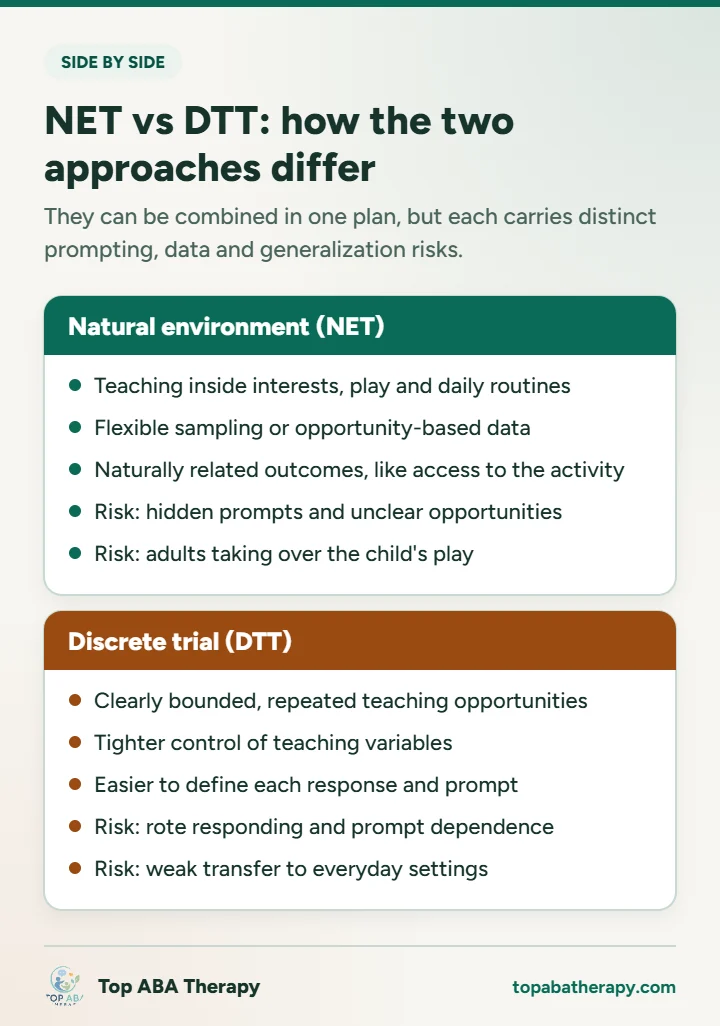
NET often emphasizes opportunities within interests, routines, play, and functional activity, using flexible sampling or opportunity data. DTT emphasizes bounded repetitions and tighter control of teaching variables. NET risks hidden prompts, unclear opportunities, or adult capture of play; DTT risks rote responding, prompt dependence, and weak transfer. For the structured counterpart in more depth, see how discrete trial training works.
Which ethical limits and provider questions matter in NET?
Naturalistic does not automatically mean neurodiversity-affirming
A session can look playful while targeting eye contact, quiet hands, typical play, generalized compliance, or suppression of harmless self-regulation. Staff can use preferred interests primarily as leverage while ignoring refusal.
Common limitations and risks
Risks include vague opportunities, subjective data, interrupted play, hidden prompts, skills tied to one routine, child-led language masking adult control, continuous family implementation, contrived rewards presented as natural outcomes, ignored assent, missing accommodations, and inconsistent staff judgment.
Direct observation and feedback are important because a written plan cannot capture every moment in a fluid interaction.
What should you ask a provider about natural environment teaching?
Goals, implementation, and evidence
Ask why the context matters, how the person selected the goal, how interests remain freely available, and how someone can pause or leave. Define opportunities, responses, prompts, outcomes, staff training, direct supervision, privacy, and safety. Require honest sampling limits plus measures of spontaneity, generalization, maintenance, burden, adverse effects, fading, and exit. For a broader intake list, use our questions for ABA providers.
Caregiver participation should have boundaries
Caregiver coaching may help embed communication and support in routines, but the provider should define what is useful, optional, feasible, and evidence-based. Training should account for language, disability, work, siblings, culture, resources, and the right to have ordinary family time.
Avoid DIY clinical application
Everyday responsive interaction is not owned by ABA, and families do not need a clinical label to follow interests or offer choices. A formal NET plan, however, requires assessment, clear goals, competent prompting and consequence decisions, data, consent, risk review, and supervision.
Do not apply internet examples to high-risk behavior, feeding, toileting, medical issues, trauma, physical prompting, or crisis situations. Seek appropriately qualified support and interdisciplinary input.
Verify the actual method
Browse Top ABA Therapy by provider, place, service setting, insurance topic, comparison, or educational question. A profile stating “naturalistic” or “play-based” cannot establish real choice, staff competence, safeguards, or current availability. Ask for an observable description and watch practice when possible.
Frequently asked questions about natural environment teaching
What does NET mean in ABA?
NET means natural environment teaching, an approach that embeds planned learning opportunities in relevant activities, interests, play, relationships, and routines while retaining defined goals and measurement.
Is natural environment teaching always child-led?
No. Staff may still arrange materials, cues, prompts, and consequences. Observe who controls access, whether choices are genuine, and how refusal changes the interaction.
How does NET differ from DTT?
NET emphasizes opportunities inside functional activity; DTT uses more clearly bounded repetitions. They can be combined, but each has distinct measurement, prompting, generalization, and burden risks.
How can a provider collect data during play or routines?
Providers can sample defined opportunities, responses, prompts, duration, latency, or products. Reports should disclose missed opportunities, sampled contexts, observer effects, and limits on precision.
Can parents use natural environment teaching at home?
Everyday responsive interaction, such as following your child’s interests and offering real choices, needs no clinical label. A formal NET plan is different: it needs assessment, defined goals, data and qualified supervision. If your provider offers caregiver coaching, ask which routines it targets, what is optional, and how family time stays protected.
The bottom line
Natural environment teaching works best when “natural” describes the whole interaction, not just the room. Look for goals that matter in daily life, real choice and access, prompts that are defined and faded, and data that shows which settings were actually sampled. Treat refusal as communication and ask to observe practice before accepting a label like play-based. When you are ready to compare programs, search ABA providers in your area and bring these questions to every intake call.