Quick answer: School-based ABA can mean behavioral support in an educational program or separate clinical services delivered on campus. These arrangements have different purposes, funding, consent and staff responsibilities. Ask which system authorizes the service, who supervises it and how it supports the student’s educational access. Insurance approval does not grant school access.
What can school-based ABA mean under an IEP, FBA, or BIP?
The phrase “school-based ABA” hides several different arrangements. This overview shows the main routes and what to verify for each:
| Route | What it does and what to verify |
|---|---|
| School evaluation | Identifies educational needs; ask which assessments and observations inform the team. |
| IEP services | Documents agreed educational supports; a diagnosis alone does not specify a particular ABA program. |
| FBA and behavior plan | Examines the context of a barrier and records the support plan and review process. |
| Private ABA at school | Requires school permission and coordination; insurance and school obligations remain separate. |
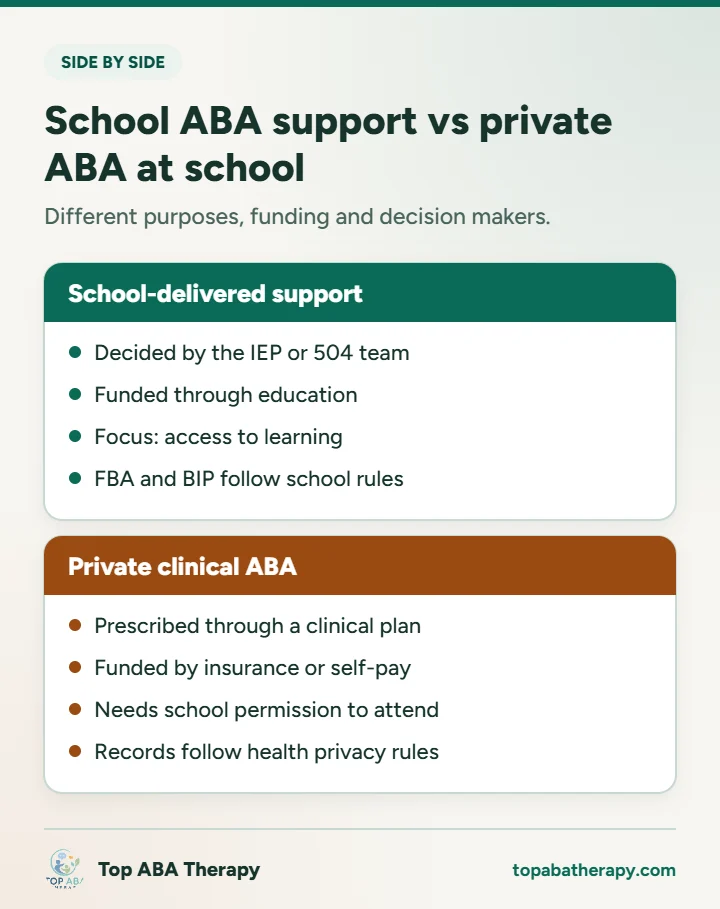
Four arrangements commonly sit behind the label. School-delivered support operates through education processes to address access, participation, instruction, and educational benefit. A professional contracted by the school works within the contract and educational program. An outside clinical provider needs both a clinical and payer pathway and permission to operate on campus. Consultation across teams should use defined, permission-based information sharing to reduce duplication or conflict.
IEP teams and positive behavioral supports
Under IDEA, an individualized education program is developed by an IEP team for an eligible student. When a student’s behavior impedes that student’s learning or the learning of others, federal regulations require the IEP team to consider the use of positive behavioral interventions and supports and other strategies to address the behavior.
What are an FBA and BIP?
Functional behavioral assessment
The U.S. Department of Education describes a functional behavioral assessment, or FBA, as a process for understanding the function or purpose of specific behavior that interferes with learning and the factors associated with when it occurs or does not occur. Data can include observation, interviews, records, environmental conditions, curriculum access, communication, and what happens before and after the behavior.
Behavioral support or intervention plan
An FBA may inform a behavioral support plan or behavioral intervention plan, often abbreviated BSP or BIP. The plan commonly identifies the behavior and its function, changes to antecedents or environment, skills to teach, positive supports, responsible personnel, implementation procedures, and progress measures.
IDEA discipline situations have specific rules
IDEA contains particular FBA and BIP requirements in some disciplinary change-of-placement circumstances. Those rules should not be generalized into a claim that federal law requires an FBA or BIP in precisely the same manner for every student or every behavioral concern. Families facing discipline, restraint, seclusion, placement, or due-process issues should obtain current state-specific information and qualified legal or advocacy help.

How do educational and clinical services differ?
Educational teams focus on the student’s access to and benefit from education under applicable law. Clinical ABA providers operate within healthcare, professional, organizational, and payer systems. Their assessments may ask different questions, use different service definitions, and produce different records.
Can a private ABA provider work at school?
Possibly, but access depends on the individual situation, school or district rules, applicable law, safety and visitor requirements, the student’s educational program, scheduling, privacy, space, staff roles, and payer authorization. An insurance approval generally establishes only what the plan will cover under its terms; it does not itself grant access to school property or dictate the IEP.
Consent, student voice, and privacy
Consent requirements vary with the action, law, and pathway. Obtain the school’s procedural notices and the clinical provider’s consent and privacy documents. Ask which records fall under education-record rules, health privacy rules, contracts, or state law; avoid assuming every school or provider record is governed identically.
Classroom observation can involve other students. Minimize identifying information and recording, control access and retention, and do not use classmates as unconsenting treatment materials.
How should families evaluate and coordinate school-based care?
- Which educational concern, outcome, evaluation, and data inform the decision?
- Would an FBA help identify function and environmental factors?
- How will the student and family participate?
- Which positive, proactive supports and skills will be considered?
- Who implements, supervises, trains staff, and checks the plan?
- How will progress, participation, removals, unwanted effects, and review dates be tracked?
Questions for an ABA provider serving schools
- Is the organization school-employed, contracted, or separately payer-funded?
- Who is clinically accountable, and what school-specific competence do staff have? (See what a BCBA is responsible for.)
- How will services protect instruction, peer relationships, and the educational program?
- What direct supervision will occur on campus?
- Which data enter school records, provider records, or both?
- How are credentials, visitors, incidents, closures, absences, and generalization handled?
Use the general ABA provider selection guide to check competence, ethics, supervision, safety, outcomes, and transitions beyond the school-specific questions.
Red flags in school behavioral support
- defiance labels replace analysis of communication, instruction, environment, disability, or unmet need;
- restrictive responses precede positive and less intrusive supports;
- the plan lacks responsible staff, training, measurement, or review;
- the student or family is excluded from meaningful participation;
- either system claims it automatically controls or replaces the other;
- quiet compliance or appearance outranks access, autonomy, learning, communication, safety, or well-being.
How school-based care relates to other settings
School is one environment. Home, center, community, speech-language, occupational, medical, mental-health, and other supports may address different goals. Use the setting comparison and ABA process guide to plan permission-based coordination without maximizing service hours.
Verify before relying on a directory listing
A school-service claim does not prove a current district agreement or opening. Confirm geography, contracting model, ages, staff qualifications, supervision, payer participation, waitlist, and whether service means in-school care, after-school care, or consultation.
Legal and educational rules are fact-specific: this guide distinguishes common pathways but cannot determine a student’s IDEA or Section 504 rights, school-access dispute, discipline protections, or state-law requirements. Use current notices and qualified local help for an individual matter.

Frequently asked questions about school-based ABA
Is an FBA the same as an ABA assessment?
Not necessarily. An FBA in school examines the function and context of behavior that interferes with learning, while a clinical ABA assessment may serve a healthcare treatment plan and payer process. Clarify the purpose, authority, data, team, and document being created.
Does an IEP team have to use ABA?
IDEA requires an IEP team to consider positive behavioral interventions and supports when behavior impedes learning, but that rule does not prescribe one commercial ABA program or provider. The team must address the eligible student’s individualized educational needs through applicable processes.
Can insurance authorization put a private ABA provider in school?
No. Authorization may establish what a payer will cover, but school property access, scheduling, safety, privacy, records, and educational-program decisions remain separate. The parties need an explicit arrangement before outside services begin on campus.
Can a school BIP replace all clinical ABA services?
Not automatically. Educational and clinical pathways can address different needs, use different standards, and operate under different authorities. Coordination should identify overlap without assuming either plan controls every environment.
The bottom line
School-based ABA works best when everyone knows which system authorized the service, who is accountable for it and how it supports the student’s learning. Clarify the pathway, get permissions and data-sharing rules in writing, and keep the student’s voice at the center of every plan. If you also need clinical services outside school, compare ABA therapy providers near you and ask how they coordinate with schools.