

Quick answer: Without insurance coverage, possible ABA funding routes include self-pay arrangements, Medicaid or CHIP where eligible, public early-intervention or school services, and limited charitable assistance. Availability varies. First obtain a complete written estimate and compare suitable supports; a payment plan should not determine treatment goals or recommended hours.
What does self-pay ABA actually cost?
Define the care before calculating the bill
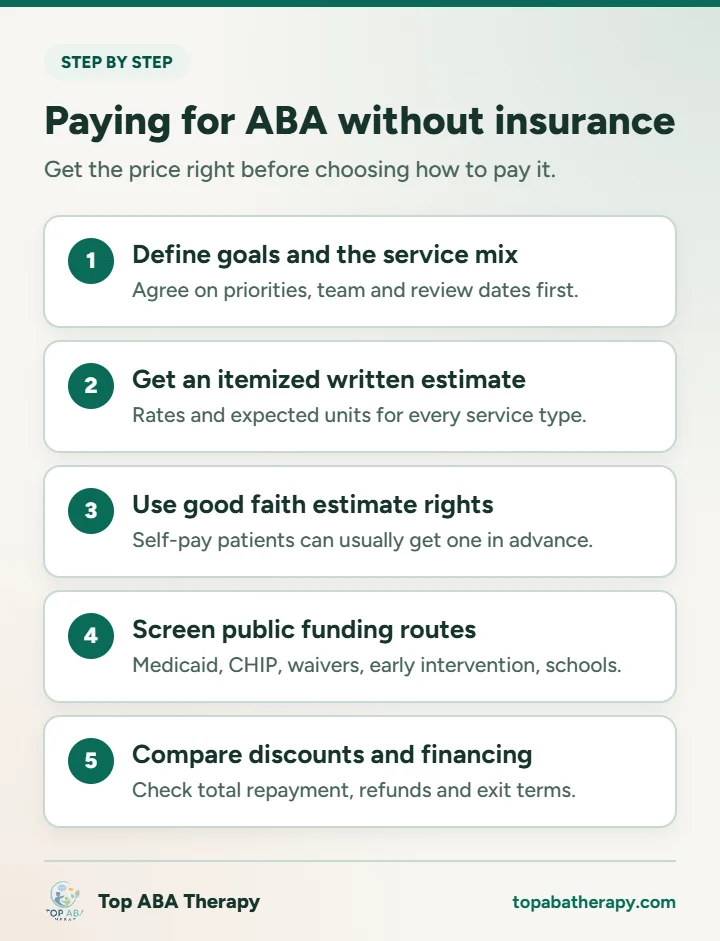
Identify the person-valued goals, assessment, service types, team, setting, proposed frequency, review dates, caregiver role, progress measures, and transition criteria. A provider’s available package is not automatically appropriate, and more hours are not inherently better.
Request an itemized written estimate
An hourly headline omits the service mix. Request rates and expected units for intake, assessment, reassessment, reports, direct work by role, caregiver training, group service, telehealth, supervision, protocol changes, travel, materials, technology, facilities, records, meetings, and coordination. Add deposits, cancellations, minimum sessions, holidays, payment methods, refunds, collections, and change notices.
Do not multiply a public hourly rate by a universal hours recommendation. Both the price and appropriate mix vary. Ask what factual or clinical event can change the schedule or rate and how much advance notice the contract requires. Our ABA therapy cost guide walks through a realistic budget formula.
Use current good faith estimate rules when applicable
CMS explains that providers generally must give eligible uninsured or self-pay people a good faith estimate in specified circumstances under the No Surprises Act. Current federal guidance covers availability, expected charges, model materials, and a patient-provider dispute process when a bill is sufficiently higher than the estimate.
Treat discounts and financing as contracts
Prompt-pay discounts, income-based scales, scholarships, training clinics, groups, packages, or limited pro bono care may exist. Request written eligibility, financial-data requirements, scope, duration, renewal, waitlist, privacy, funding source, and termination rules. Aid must not reduce competence, supervision, consent, communication access, safety, outcome tracking, complaint rights, or transition planning.
Payment plans, medical credit, loans, and crowdfunding change timing; they do not lower the clinical price unless a genuine discount exists. Compare cash and financed prices, interest, deferred interest, fees, term, total repayment, credit effects, refunds, default, collections, arbitration, data sharing, and any provider referral benefit. Significant debt deserves independent financial or legal advice. Scarcity and an uncertain developmental “window” should not be sales pressure.
Which ABA funding routes should families screen?
Recheck what “without insurance” means
The phrase may mean no active policy, an excluded benefit, unaffordable cost sharing, out-of-network care, denied authorization, or a provider that will not bill the plan. Those problems have different options. Check employer or Marketplace enrollment events, eligible family coverage, continuation, network exceptions, and appeals. For applicable job-based plans, request plan documents and ask whether EBSA assistance is relevant. If you do have a plan, first confirm whether your insurance covers ABA therapy after all.
Compare funding sources by the question they answer
| Possible route | What to verify | What it cannot establish by itself |
|---|---|---|
| Medicaid, CHIP, waiver, or state disability program | Eligibility, service scope, enrolled provider, authorization, waitlist, cost, renewal, and appeal | Automatic ABA coverage, one modality, immediate capacity, or clinical fit |
| IDEA Part C or school system | Eligibility, evaluation, individualized plan, education or early-intervention need, consent, and responsible agency | General payment for a private clinical prescription |
| Provider discount or payment plan | Written price, qualification, privacy, duration, total repayment, refund, and exit | Appropriate intensity, safe staffing, or a lower total cost |
| Grant or charitable aid | Legal organization, geography, expense, limit, selection, payment route, publicity, and data use | Guaranteed award, tax treatment, or continuing support |
| Employer or tax-related benefit | Current plan rules, eligible expense, documentation, timing, and qualified advice | Universal reimbursement, deduction, or eligibility |
Medicaid, CHIP, IDEA, and state programs
Medicaid and CHIP eligibility, delivery systems, and covered services vary by state. Ask the official agency about child, income, disability, waiver, buy-in, spend-down, or other pathways without assuming one applies. For eligible Medicaid members under 21, EPSDT creates a federal framework for Medicaid-coverable services necessary to correct or ameliorate identified conditions. State medical-necessity, enrollment, authorization, access, and review rules still matter. See how to check Medicaid coverage for ABA in your state.
Grants, tax questions, and crowdfunding
Grants may fund evaluation, AAC, equipment, respite, transportation, camp, or another expense instead of ongoing ABA. Verify the legal organization, official domain, geography, eligibility, application period, payment recipient, publicity demands, data retention, maximum, frequency, and what happens if the provider changes. Never pay an unverified party to “unlock” guaranteed aid.
Stack funding without duplicate payment
When multiple sources contribute, specify which source pays which provider, service, date, and remaining cost. Disclose other coverage when required. Keep award letters, estimates, invoices, receipts, explanations of benefits, and refunds. Do not submit the same expense twice unless the written rules explicitly allow coordination.
Cost reduction should preserve safeguards. A clinician can prioritize goals, adjust the service mix, reduce travel, remove duplication, use consultation or groups when suitable, and accelerate transition when evidence supports it. Financial pressure must not produce unqualified staff, hidden supervision, unsafe caregiver substitution, lost AAC access, or do-it-yourself high-risk procedures.
When you look up funding resources, check the official source, the date the information was last confirmed and the application window. No directory or website can guarantee aid, so verify every program directly with the organization that runs it.


Frequently asked questions about ABA therapy without insurance
How much does self-pay ABA cost?
There is no defensible national total for one family. Cost depends on service mix, professional roles, setting, frequency, duration, travel, fees, discounts, and household burden. Request an itemized estimate for the actual proposed plan.
Does a provider have to give a good faith estimate?
Federal rules generally require one for eligible uninsured or self-pay people in specified circumstances. Coverage type and timing matter. Use current CMS guidance and ask the provider how the person was classified.
Can Medicaid pay for ABA when a family has no private insurance?
Possibly, if the person is eligible and the requested service meets applicable federal, state, plan, provider, authorization, and medical-necessity requirements. EPSDT does not make every ABA request automatic.
Can a school pay for private ABA therapy?
Schools provide eligible education services through education law and individualized team processes. They do not automatically fund a private clinical prescription. Ask the school system about evaluation, educational need, available supports, and procedural rights.
The bottom line
ABA therapy without insurance is manageable when you start with the right care plan, insist on an itemized estimate and good faith estimate rights, and screen every public and charitable route before borrowing. Keep funding sources separate, protect clinical safeguards and revisit the plan as goals are met. To compare self-pay options locally, find ABA therapy providers near you and request written estimates.