

Quick answer: ABA therapy has no universal US price. Your cost depends on the service, clinician, billing units, location, coverage, network and remaining deductible or cost sharing. Request a written provider estimate and check it against the exact plan’s benefits. A billed hourly rate is not necessarily what an insured family pays.
How do you build an ABA therapy cost estimate?
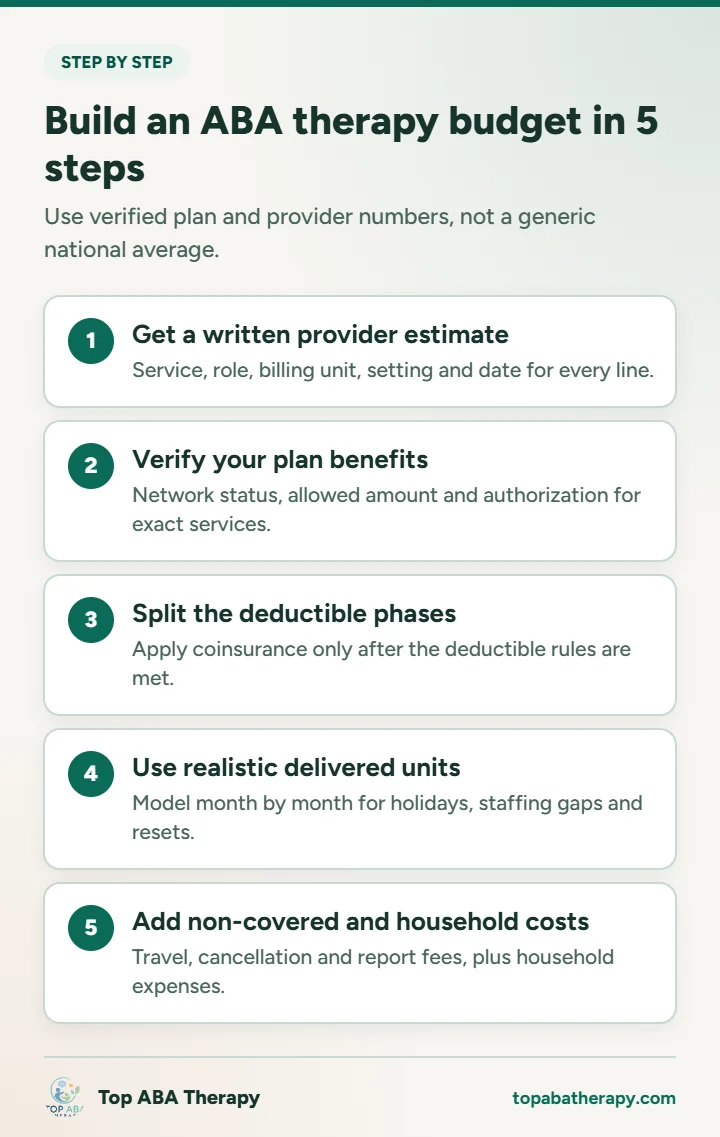
An hourly quote is incomplete unless it states which service, professional role, billing unit, setting, market, price type, and date it covers. A monthly or annual figure must also use realistically delivered units and the family’s benefit phase. Multiplying a generic internet average by a recommended schedule does not produce a defensible budget.
- Per service or unit: use the provider’s current written self-pay charge or the plan’s allowed amount for the exact covered service.
- Per month: multiply each relevant amount by expected delivered units, then add separately disclosed non-covered and indirect expenses.
- Per year: model costs month by month to account for deductible resets, authorization periods, reassessment, holidays, staffing gaps, and plan changes.
Public fee schedules answer a different question. Health.mil publishes maximum allowed amounts for the TRICARE Autism Care Demonstration, and state Medicaid programs publish their own rates. Those amounts describe program reimbursement under defined conditions. They are not universal retail prices and do not establish what a family will owe.
| Number to verify | Why it changes the estimate |
|---|---|
| Provider charge or cash estimate | Starting amount for self-pay or non-covered service |
| Plan allowed amount | Basis commonly used for in-network cost sharing |
| Remaining deductible | Amount the member may owe before later cost sharing begins |
| Copayment or coinsurance | Member share after applicable deductible rules |
| Authorized and expected units | Converts a unit amount into a weekly or monthly total |
For a monthly model, calculate each service separately and add the results. A simple structure is: expected delivered units multiplied by the applicable unit amount, plus known non-covered fees and material household expenses. Build a range by changing delivered units, not by inventing a cheaper or more expensive hourly rate. That makes the assumptions visible when staffing, school holidays, illness, or authorization delays change actual use.

How does ABA cost work with insurance?
The provider’s billed charge, the plan’s allowed amount, the insurer’s payment, and the family’s responsibility are four different numbers. Ask the provider for anticipated service descriptions and billing units. Then ask the plan how it treats those services for the exact member, network, location, and rendering professionals. When the plan will not quote an allowed amount before a claim, document that limitation and calculate a range from the best plan-specific information available. Our guide on how to verify your plan’s ABA coverage lists the exact questions to ask.
Calculate the deductible and post-deductible phases separately. If the deductible could be met during the month, split the expected services at that point instead of applying one percentage to the entire month. Also check whether medical and behavioral-health services share accumulators, whether individual and family deductibles interact, and whether in-network and out-of-network expenses accumulate separately.
Consider a hypothetical method example, not a price estimate. If an allowed amount were $100 per hour, expected use were 10 hours per week, and post-deductible coinsurance were 20%, the weekly allowed total would be $1,000 and the illustrative post-deductible member share would be $200. If $1,500 of deductible remained, early claims could create much higher responsibility. Actual numbers must come from the plan and provider.
Financial note: Authorization is not a guarantee that every claim will be paid, and an expired authorization may not be extended retroactively. Keep written estimates, benefit documents, authorizations, explanations of benefits, and call references.
What changes self-pay, Medicaid, and total cost?
For self-pay care, request a written estimate separating assessment, reassessment, direct services by role, treatment planning, protocol modification, caregiver guidance, groups, travel, reports, and cancellation fees. Ask about the expected weekly quantity, estimated duration, rate-change policy, refund terms, and any minimum commitment. Setting can affect the quote too, so ask whether in-home and center-based ABA are priced or staffed differently.
- Provider organization, location, and billing identifiers.
- Responsible clinician and planned service roles.
- Service descriptions, billing units, frequency, and estimated duration.
- Cash charge for each service and when that charge can change.
- Network status for the exact plan, location, and professionals.
- Allowed amount or the plan’s process for obtaining it.
- Remaining deductible and the services to which it applies.
- Copayment or coinsurance for each service category.
- Individual and family out-of-pocket accumulators.
- Authorization services, units, dates, and renewal requirements.
- Travel, cancellation, report, balance-billed, or non-covered amounts.
- Estimate date, expiration, contact name, and call reference.
Medicaid works differently. For eligible children and youth under 21, the EPSDT benefit requires states to cover medically necessary services, and CMS has addressed how that applies to autism services in the FAQ listed in the sources. Covered ABA services, authorization rules, enrolled providers, and any permitted cost sharing still vary by state and managed-care plan. Our state-by-state Medicaid ABA guide explains how to confirm the details for your program.

How can families lower or manage ABA therapy costs?
You cannot negotiate clinical need, but you can reduce surprises and avoid paying more than necessary.
- Stay in network where possible. Confirm network status for the organization, the location, and the rendering clinicians, not just the company name.
- Know your out-of-pocket maximum. Ask how much of it remains and whether ABA services count toward it.
- Check secondary coverage. If a child has more than one plan, such as employer coverage plus Medicaid, ask both how they coordinate benefits.
- Ask about tax-advantaged accounts. Check with your HSA or FSA administrator whether ABA expenses qualify under your plan’s rules.
- Get payment terms in writing. If a provider offers a payment plan or reduced rate, document the terms and how they can change.
- Appeal denials promptly. Ask for the denial reason and the appeal deadline in writing, and keep copies of everything you submit.
Also ask your child’s school what support is available through an IEP or 504 plan. School services follow different rules and are not a substitute for clinical care, but they are part of the full picture when you plan the week.
Frequently asked questions about ABA therapy cost
How much does ABA therapy cost per hour?
No authoritative universal US rate exists. Ask for the charge or allowed amount tied to the exact service, provider role, billing unit, setting, market, and date.
How much is ABA therapy with insurance?
Family responsibility depends on eligibility, benefit rules, network, authorization, allowed amount, deductible, copayment or coinsurance, and the applicable out-of-pocket maximum. Obtain plan-specific written information before care begins.
How much does ABA therapy cost without insurance?
Use a provider’s written estimate by service and expected quantity. Add any assessment, report, travel, cancellation, or household costs separately so a headline hourly rate does not hide the full budget.
Does Medicaid make ABA therapy free?
Not necessarily. State eligibility, covered services, managed-care rules, authorization, provider enrollment, and permitted cost sharing vary, so families must check the current state program and plan.
Why is my ABA bill different from the estimate?
Common reasons include a different number of delivered units, a deductible or coinsurance that applied differently than expected, an out-of-network clinician, an expired authorization, or a service the plan does not cover. Compare the explanation of benefits with the provider’s itemized bill, then call both with your estimate and call references in hand.
The bottom line
ABA therapy cost is not a single number you can look up; it is a calculation you build from your plan, your provider’s written estimate, and the hours your child will realistically receive. Separate the deductible and post-deductible phases, model the year month by month, and keep every estimate and authorization on file. With those numbers in hand, you can compare providers fairly and plan with fewer surprises. When you are ready, compare ABA therapy providers near you.