

Quick answer: Medicaid may cover medically necessary autism-related behavioral services, with details determined by the state, eligibility and service pathway. Members under 21 also have federal EPSDT protections. Verify the requested service, enrolled provider, authorization and appeal route with the state program or managed-care plan rather than assuming every ABA service is covered.
How do EPSDT and state Medicaid rules affect ABA coverage?
The Centers for Medicare & Medicaid Services describes EPSDT as a comprehensive Medicaid benefit for eligible people under 21. States must make Medicaid-coverable services available when they are medically necessary to correct or ameliorate a condition identified through screening and diagnosis. The May 2026 EPSDT coverage guide also stresses individualized decisions: utilization controls can exist, but a state cannot substitute a flat service or monetary cap for considering the needs of a particular child.
Why the answer changes by state, plan, and age
Medicaid is jointly financed and administered through federal and state systems. States organize benefits and delivery within federal requirements, and many members receive care through managed-care organizations. Two people with the same diagnosis can therefore encounter different provider networks, authorization procedures, forms, service definitions, and appeal routes. If your child also has private coverage, ask both plans how they coordinate benefits, and use our guide to checking private insurance for ABA for the commercial side.
| Decision point | What can differ | Evidence to obtain |
|---|---|---|
| Member pathway | Income, disability, age, waiver, state-plan, and managed-care eligibility | Active status, effective dates, program, and renewal date |
| Requested care | Assessment, direct service, caregiver guidance, group, setting, and telehealth rules | Current benefit definition and medical-necessity policy |
| Provider access | Enrollment, specialty, credentials, location, and network participation | Exact organization, service location, and rendering professional |
| Authorization | Records, units, dates, review interval, and continuation criteria | Written approval and renewal requirements |
| Review rights | Managed-care appeal, fair hearing, expedited review, and continuation rules | Current notice, instructions, and filing deadline |
Coverage is not authorization: a handbook can describe a benefit while the member, provider, location, requested service, or dates remain unapproved. Do not begin from a general coverage statement when a written member-specific decision is available.
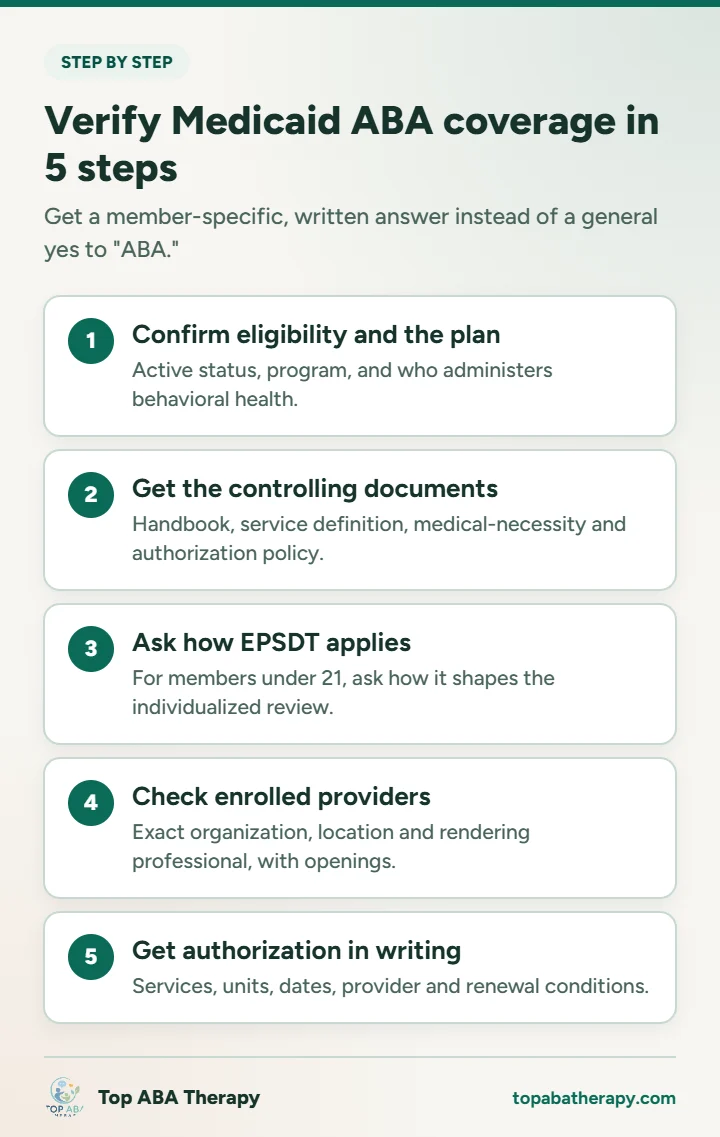
How do you verify a usable Medicaid ABA pathway?
Start by confirming active eligibility and the entity responsible for the behavioral-health benefit. Record the full program or plan name, effective dates, member contact route, and whether fee-for-service Medicaid or a managed-care plan will process the request. Then obtain the current handbook, provider manual section, service definition, medical-necessity policy, authorization criteria, and appeal instructions.
Follow the decision in order
Ask who may diagnose, refer, assess, and recommend the requested services under current state rules. One CMS FAQ explains that a formal diagnosis and treatment plan are not federal prerequisites for every EPSDT service in every context, but states still determine medical necessity and operational requirements. Use the rule for the requested benefit; do not turn a context-specific clarification into a universal promise.
The authorization packet may require eligibility details, clinical records, an assessment, baseline information, individualized goals, proposed procedures, measurement, requested service types and units, provider identifiers, coordination plans, and prior response data. The approval should identify the provider, location, services, quantity, dates, and review conditions. Compare it with the proposed schedule before care begins. Ask whether the reviewer applies a guideline, unit threshold, or standardized form, and where the process lets the clinician explain needs that do not fit the default. Request the version date and keep that policy with the member-specific decision. If any of these terms are unfamiliar, our walkthrough of each stage of ABA care explains what assessments and goals usually contain.
Ask questions that produce checkable answers
Use the member number and full plan name during the call, then ask:
- Which entity administers this member’s behavioral-health benefit?
- Which current benefit category could cover the requested assessment and treatment?
- How does EPSDT apply to this member if the member is under 21?
- Which medical-necessity policy and version will the reviewer use?
- What diagnosis, referral, assessment, treatment-plan, and progress records are required?
- Which provider enrollment, credential, license, specialty, and location rules apply?
- Are home, center, community, caregiver, group, school-related, or telehealth services handled differently?
- Is authorization required before assessment, treatment, or both?
- How are requested units, intensity, duration, reassessment, and renewal evaluated?
- Which transportation or scheduling supports are available to this member?
- What premiums or cost sharing, if any, may apply to the member and service?
- Which appeal, fair-hearing, expedited-review, and continuation rules govern an adverse decision?
Do not settle for a verbal yes to “ABA.” Ask the representative to identify the controlling document and where the answer appears. When a provider supplies a billing description, compare it with the plan’s benefit language because two parties may use the same general term for different services. If an answer conflicts with a written policy, request clarification in writing and preserve both records.
Separate provider availability from benefit language
Coverage on paper does not guarantee that an enrolled provider nearby has suitable staffing, competence, setting, or capacity. Ask the plan for providers accepting new clients, the date its directory was checked, available care coordination, transportation support when applicable, and the escalation process when its network cannot supply timely access. Once you have names, use our checklist for comparing ABA providers to vet each one.
Act on a denial or reduction notice
Read the notice as soon as it arrives. Identify the action, effective date, reason, evidence used, appeal or fair-hearing options, deadline, expedited route, and any continuation-of-benefits rule. Request the policy and records behind the decision, then address the stated reason with qualified treating professionals; do not merely resubmit the same packet.

What can families do while waiting for Medicaid ABA services?
Even after coverage is confirmed, a start date can depend on staffing and openings. A few steps keep momentum without committing to a provider that is not a good fit.
- Ask several enrolled providers to add your child to their waitlists, and note the date and expected timing each one gives.
- Ask the plan whether care coordination or case management is available and how to request it.
- Keep the diagnostic report, referral, and any authorization paperwork together so intake can move quickly.
- Ask your child’s school about evaluations and supports available through an IEP or 504 plan.
- Ask providers whether caregiver guidance can begin before full services, if appropriate and covered.
Recheck eligibility and renewal dates while you wait. A lapse in Medicaid enrollment can delay or interrupt an authorization even after a provider is found.

Frequently asked questions about Medicaid and ABA
Does EPSDT guarantee ABA therapy for every Medicaid-enrolled child?
No. EPSDT requires coverage of Medicaid-coverable services that are medically necessary for an eligible member under 21, but CMS does not designate ABA as an automatic treatment for every autistic child. The state must apply its individualized medical-necessity process to the requested service.
Can a provider’s Medicaid logo confirm participation?
No. Verify enrollment and network status for the exact organization, location, rendering professionals, service, and plan. Participation can differ across states, managed-care products, offices, and service categories.
What should written authorization show?
Look for the approved services or billing categories, units or frequency, dates, provider and location, and renewal conditions. If the proposed schedule does not match the approval, ask the provider and plan to reconcile the difference before treatment starts.
Does Medicaid cover ABA therapy for adults?
Adult coverage requires a separate state-specific analysis because EPSDT applies to eligible members under 21. Ask about state-plan services, waivers, home- and community-based programs, managed-care benefits, eligibility rules, provider networks, and any transition requirements.
The bottom line
Does Medicaid cover ABA therapy? It can, especially for eligible members under 21 through EPSDT, but the usable answer comes from your state program or managed-care plan, not from a general statement. Confirm eligibility, get the controlling policy, verify an enrolled provider with real openings, and keep every authorization and notice in writing. If a decision goes against you, act on the appeal or fair-hearing deadline right away. When you are ready to build a shortlist, start your search for ABA therapy near you.
Sources
- Early and Periodic Screening, Diagnostic, and Treatment (EPSDT) Guide for States: Coverage in the Medicaid Benefit for Children
- State Medicaid & CHIP Toolkit for Children’s Behavioral Health Services and the Early and Periodic Screening, Diagnostic and Treatment (EPSDT) Requirements
- Early and Periodic Screening, Diagnostic, and Treatment