

Quick answer: Many health plans cover some medically necessary autism-related behavioral services, but coverage depends on the exact benefit and requested care. Confirm the provider, location, network, diagnosis requirements, authorization and family cost with the plan. An insurer’s name or a state mandate alone cannot confirm an individual claim.
Which plan details and mandates affect ABA coverage?
Employer-sponsored plans, individual or Marketplace policies, Medicaid programs, and other public coverage may include ABA-related benefits. No plan category or company name proves that a particular member, provider, setting, service, or number of hours is covered. Two products administered by the same insurer can use different networks, exclusions, clinical policies, and cost sharing.
- the full plan name, group, and plan year;
- whether coverage comes from an employer, Marketplace, individual policy, Medicaid, or another source;
- whether an employer plan is fully insured or self-funded;
- the network name and any separate behavioral-health administrator;
- the state governing the insurance contract where applicable.
When member services cannot identify the funding arrangement, ask the employer benefits office or plan administrator. The insurer name on the card may identify the claims administrator without identifying who bears the claims risk. That distinction affects which state insurance protections apply and where a complaint or appeal may need to go.

What separate gates must ABA coverage pass?
A benefit, network contract, and authorization answer different questions. One cannot substitute for another. Ask the provider for anticipated service descriptions and billing identifiers, then verify how the plan handles each service.
| Coverage gate | Question to verify | Evidence to keep |
|---|---|---|
| Eligibility | Is the member active on the service dates? | Portal record or eligibility confirmation |
| Benefit | Does the plan include the requested service category? | Benefit document and call reference |
| Medical necessity | Which individualized criteria and records apply? | Current clinical policy and required documentation |
| Network | Are the organization, location, and professionals participating? | Plan-specific network confirmation |
| Authorization | Is approval required before assessment or treatment? | Written approval with dates, units, services, and identifiers |
| Claim rules | Do coding, referral, credential, setting, and telehealth rules fit? | Provider and plan confirmation |
| Cost sharing | Which deductible, copayment, coinsurance, and maximum apply? | Current accumulators and benefit details |
Diagnosis wording alone does not prove coverage or medical necessity for one person. If a member does not have an autism diagnosis, ask which benefit category, indication, clinical policy, and appeal rights apply. Do not pursue a diagnosis solely to obtain reimbursement; diagnosis is a clinical decision.
How do authorization, cost sharing, and appeals work?
Prior authorization is a pre-service coverage decision for stated services, units, dates, providers, and locations. ABA requests may require diagnostic records, an assessment, an individualized plan, goals, measurements, provider credentials, requested units, and service dates. Read the approval instead of treating it as a yes-or-no checkbox.
Confirm authorized services, start and end dates, provider identifiers, conditions for beginning care, progress-report deadlines, remaining units, renewal timing, and what requires a modified request. Do not assume an expired authorization will extend or that retroactive approval is available.
For covered services, a family may owe deductible, copayment, or coinsurance until an applicable out-of-pocket maximum is reached. HealthCare.gov explains that cost sharing generally excludes premiums, balance billing, and non-covered services. Use the plan’s allowed amount, not a generic national hourly price. The ABA therapy cost guide provides a calculation method.
Coverage note: Authorization does not guarantee payment of every claim. Eligibility, coding, provider status, delivered units, setting, documentation, and plan terms may still affect adjudication.
What should you do if ABA coverage is denied?
A denial, a reduced number of approved units, or a stalled authorization is not always the final word. Work through the problem in writing and keep a copy of everything.
- Get the denial in writing, including the specific reason, the clinical policy used, and the appeal deadline.
- Share the letter with the provider and ask what documentation or correction would address the stated reason.
- Ask whether the provider can request a conversation between its clinician and the plan’s reviewer.
- File an internal appeal before the deadline, with the assessment, treatment plan, goals, and any supporting letters.
- If the internal appeal is upheld, ask whether your plan qualifies for an independent external review.
- For complaints, contact your state insurance department, or for a self-funded employer plan, the U.S. Department of Labor.
Keep a dated log of calls, names, and reference numbers. If the plan asks for information you already sent, the log makes it easy to show when and how it was submitted.

How should you verify the provider and recheck coverage?
Confirm the responsible clinician’s BACB certification and any required state license. Match the exact organization, service location, and rendering professionals to the insurer’s records. A clinician can be appropriately credentialed but out of network, and a network directory can be stale. If the payer directory and phone representative disagree, save both records and request a written network determination for the exact service location and rendering professionals. Do not infer one status from the other. If you are unsure who should deliver which service, review the difference between BCBA and RBT roles before the call.
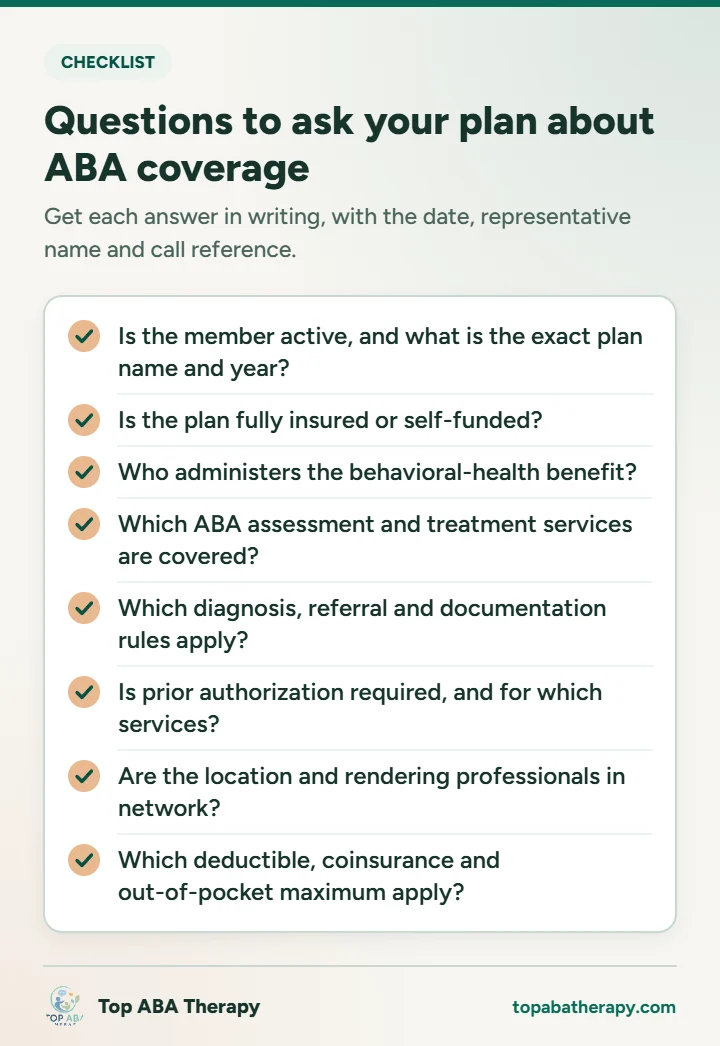
- Is the member active, and what is the full plan name and plan year?
- Is the plan fully insured or self-funded?
- Who administers the behavioral-health benefit?
- Which requested assessment and treatment services are benefits?
- Which diagnosis, referral, medical-necessity, and documentation rules apply?
- Is authorization required before assessment, treatment, or both?
- Are the organization, location, and rendering professionals in network?
- Which deductible, copayment, coinsurance, and maximum apply?
- Which exclusions, limits, setting rules, and renewal dates apply?
- What are the internal appeal, external review, and complaint routes?
Frequently asked questions about ABA insurance
Which insurance companies cover ABA therapy?
Many national and regional insurers administer plans that may cover ABA-related services, but a company list cannot answer for one member. Verify the exact product, funding arrangement, network, service, and provider.
Does an autism coverage mandate apply to every plan?
No. Mandates differ by state and may not reach self-funded employer plans or every public program, service, age, provider type, or clinical circumstance. Check the current law and plan funding.
What if the provider says it accepts my insurer?
Ask whether the exact location and rendering professionals participate in your specific network. Then confirm benefits, authorization, and cost sharing directly with the plan.
Does insurance cover ABA therapy for adults?
Sometimes. Coverage for adults depends on the plan’s benefit language, any age limits in state mandates or plan terms, and medical-necessity criteria. Ask the plan whether age limits apply to ABA services, and request the clinical policy that would govern an adult’s request before scheduling an assessment.
Can an insurer limit ABA therapy hours?
Yes. A plan can authorize fewer hours than the treatment plan requests based on its medical-necessity criteria, and some plans apply age or visit limits where state law allows. Ask for the criteria in writing, request a peer-to-peer review if hours are cut, and file a written appeal if the authorization does not match the documented need.
The bottom line
Does insurance cover ABA therapy? Often, but only your exact plan can answer for your child. Verify eligibility, benefits, medical-necessity rules, network status, authorization, and cost sharing one at a time, and keep written proof of each answer. If something is denied, use the appeal routes the plan must disclose rather than giving up. Once coverage is confirmed, browse verified ABA providers near you and check that each one participates in your network.