
Quick answer: ABA careers include technicians, assistant and independent behavior analysts, clinical leadership, training, research and operational roles. Choose the work you want to do before choosing a credential. Compare actual duties, current eligibility, supervision, education costs, workload, pay and applicable legal requirements; similar job titles can describe different responsibilities.
Credential and employment note: Requirements change. Use the current BACB handbook, state authority, employer documents, school or facility rules, and payer requirements for the exact role and jurisdiction. This article is not certification, licensing, wage, classification, immigration, tax, or employment-law advice.
Which ABA roles and credentials lead to which work?
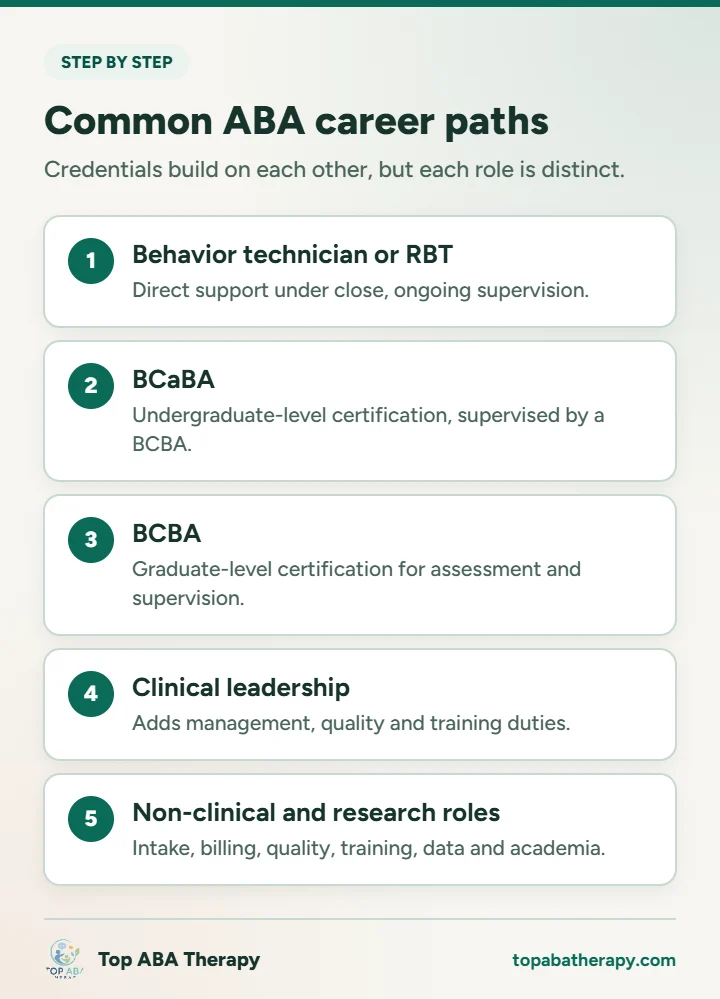
| Role | Credential and responsibility boundary |
|---|---|
| Behavior technician / RBT | Direct support under supervision; RBT is a defined certification, not a generic job title. |
| BCaBA | Undergraduate-level behavior-analytic certification requiring supervision. |
| BCBA | Graduate-level certification; assessment, planning and supervision within competence and law. |
| Clinical leader or owner | Additional management duties; ownership alone does not confer clinical authority. |
Separate titles, credentials, licenses, and degrees
A credential is awarded under defined standards. A license grants legal authority under a jurisdiction. A degree is an educational award. A job title is chosen by an employer and can be inconsistent. “Behavior technician,” “behavior specialist,” “case manager,” “consultant,” and “clinical director” do not identify one national credential or scope.
Understand the core service credentials
- Behavior technician: an employer-defined direct-service role. The worker may or may not hold RBT certification. Verify training, competence, supervision, permitted duties, and any credential claim.
- RBT: a BACB paraprofessional certification for behavior-analytic service delivery under direction and close, ongoing supervision. It is not independent practice.
- BCaBA: an undergraduate-level BACB certification practiced under the supervision of a BCBA or qualified FL-CBA. Duties still depend on competence, jurisdiction, payer, setting, and employer.
- BCBA: a graduate-level BACB independent-practitioner certification. BCBAs may assess, design, analyze, supervise, and train within competence, while state licensure and other rules can still apply.
- BCBA-D: a doctoral designation for an eligible BCBA, not a separate certification or automatic proof of research, teaching, or specialty competence.
The guides to what an RBT does, what a BCBA does, and BCBA versus RBT explain service-facing boundaries in more detail.
When an employer advertises a credentialed role, check the worker’s current certification through the appropriate official source and then check any separate state license. These records answer narrower questions than an interview does: they can help establish identity and status, but they do not show whether a person is competent for a particular population, receives useful supervision, follows ethical practice, or will fit a specific team. Ask those questions independently.
Direct-service work can be meaningful and demanding
Technicians may work in homes, clinics, schools, communities, hospitals, residential programs, or other authorized settings. Work can include preparing materials, implementing assigned procedures, supporting communication, collecting defined data, documenting sessions, reporting risk, and receiving feedback.
BCBA and BCaBA work varies by setting and competence
BCaBAs may assist with assessment, program development, coaching, technician supervision where permitted, and coordination under qualified oversight. A prospective employer should show who supervises, which decisions require approval, whether the payer recognizes the role, and how responsibilities match current rules.
Careers extend beyond direct clinical work
ABA organizations employ intake coordinators, authorization specialists, schedulers, recruiters, credentialing teams, billers, compliance and privacy staff, quality analysts, trainers, data engineers, product managers, customer support, facilities, and executives. These roles can shape access and safety even without delivering treatment.
How should you choose an education and supervision path?
Work backward from the target role
Before enrolling or paying a training company:
- define the work, population, setting, and jurisdiction you want;
- read the current official handbook in full and note future transition dates;
- check credential availability, state licensing, and title restrictions;
- map degree, coursework, supervised experience, competency, exam, application, fees, and maintenance;
- ask the relevant authority, not only a recruiter, to resolve eligibility;
- compare cost, debt, scheduling, accessibility, completion, exam outcomes, faculty, fieldwork support, and graduate placement;
- build a fallback if requirements, employment, supervision, or life circumstances change.
Treat supervision as education and employment quality
Supervision shapes clinical judgment, ethics, skill, client protection, and whether experience qualifies. Obtain a written agreement covering roles, activities, observation, feedback, documentation, contingencies, fees, conflicts, and termination.
Ask how the organization protects supervision time after cancellations, audits fieldwork records, exposes trainees to analytical work, manages supervisor loads, supplies backup, and responds when a supervisor leaves. Never accept “all work hours count” without applying the current handbook to actual activities and documentation.
Evaluate research, academic, and school routes separately
Research jobs can involve study design, measurement, analysis, implementation science, teaching, supervision, publication, or grants. Faculty roles may require doctoral education, a research record, teaching, funding, and institutional-review knowledge. A BCBA-D designation alone establishes none of those qualifications.
School roles may include analyst, specialist, technician, consultant, teacher, psychologist, special educator, paraprofessional, or administrator. State, district, bargaining agreement, and role requirements vary. Clinical credentials do not replace required education credentials. Our guide to school-based ABA explains why clinical and educational authority remain distinct.

How should you evaluate an ABA job and employer?
Price the whole work arrangement
Compare employee or contractor classification, guaranteed versus scheduled hours, cancellations, nonbillable work, overtime, on-call duties, travel and mileage, benefits, leave, retirement, training, credential and license support, continuing education, supervision cost, repayment agreements, caseload, productivity, bonuses, equipment, and remote-work expense.
A high hourly rate can yield less than a lower one after unpaid notes, cancellations, travel, missing benefits, or inconsistent schedules. Calculate realistic annual earnings using the employer’s actual pattern. State wage and classification rules vary, so seek qualified advice for a dispute. Our pay guides for RBT salary and BCBA salary show how to model real earnings.
Make ethical fit a threshold
Ask how the organization selects goals, responds to assent and dissent, supports AAC, treats harmless autistic behavior, limits caregiver burden, governs restrictive practices, reviews incidents, protects staff who raise concerns, and handles transitions. Observe whether job advertising matches practice.
Red flags include guaranteed certification, candidate fees hidden as training, unpaid required labor, impossible productivity, vague supervision, punishment-centered language, pressure to alter data, billing without service, unsafe lone work, discriminatory assignments, or retaliation for clinical concern. A signing bonus cannot offset unlawful, unsafe, or unethical conditions.
Interview the employer with evidence questions
Ask why the role is open and how long the prior worker stayed; what a normal week contains; which duties require a credential or license; who supervises and backs up; how caseloads change; what happens when authorization exceeds staffing; how cancellations, travel, notes, meetings, and training are paid; which metrics drive reviews and bonuses; and what evidence shows the advertised advancement path occurs.

Frequently asked questions about ABA careers
Do you have to become an RBT before becoming a BCBA?
Not universally. The credentials have separate official eligibility paths. RBT work can provide useful experience, but candidates should follow the current BCBA requirements for their circumstances.
Can a BCBA practice independently everywhere?
BACB describes the BCBA as an independent-practitioner certification, but state licensing, employer scope, payer enrollment, facility rules, competence, and other law may still limit practice.
Is BCBA-D a higher clinical certification?
No. It is a doctoral designation for an eligible BCBA. It does not create a different BCBA certification or prove specialty, research, or teaching competence.
Can you work in ABA part-time?
Yes. Many RBT and behavior technician roles are part-time, often concentrated in after-school hours. BCBA roles are more often full-time, but part-time and contract work exists. Before accepting, ask about guaranteed hours, pay for cancelled sessions, drive time between clients, and how supervision hours are scheduled.
The bottom line
The best ABA careers start with the work you want to do, then the credential, education and supervision that lead there. Compare real duties, pay, workload and ethics for every role, verify requirements with the BACB and your state, and choose employers that invest in supervision. To see which ABA organizations operate near you, browse ABA providers near you.