

Quick answer: “ABA therapist” is a broad job title, not one universal credential. It may refer to a technician, RBT, BCaBA, BCBA, trainee or another role. Verify the individual’s credential, applicable license, duties, competence and supervisor. A title alone does not show who may assess, design or independently change treatment.
Which roles can sit behind the ABA therapist title?
“ABA therapist,” “behavior therapist,” and “behavior interventionist” often come from employers, job boards, or public shorthand. Certification, state license or registration, degree, payer enrollment, job title, and competence are separate facts. Initials should be expanded and checked.
| Possible role | What must be resolved before relying on the title |
|---|---|
| Technician or RBT | Active credential if claimed, assigned supervisor, training, delegated tasks, observation, and ongoing oversight |
| BCaBA | Active assistant-level certification, qualified supervisor, state authority, competence, and delegated assessment or supervision duties |
| BCBA | Active graduate-level certification, state license or registration where required, population and procedure competence, employer and payer authority |
| Trainee | Current employed role, permitted tasks, fieldwork status, supervisor, and whether any certification or license is already active |
| Separately licensed professional | License, behavioral competence, service scope, supervision, payer rules, and whether the professional title is represented accurately |
| Uncredentialed employer role | Education, training, background requirements, exact duties, legal scope, close supervision, and transparent disclosure |
Credential and competence answer different questions
An active credential establishes that the person met and maintains that issuer’s requirements. Competence asks whether the person can safely perform the particular assessment, teaching procedure, communication support, setting, population, and risk task. A BCBA credential does not confer medical, speech-language, occupational-therapy, psychotherapy, nutrition, or universal behavior-analysis expertise.
A technician may have deep practical skill while still lacking authority to make independent assessment or treatment decisions. Job titles should never erase the accountable supervisor or turn delegated work into unsupervised practice.

What does an ABA therapist do during a typical session?
Session details vary by role, setting and plan, but direct-care work usually follows a recognizable pattern. Knowing it helps families ask better questions and helps applicants picture the job.
- Review the plan. Check current goals, procedures and any updates from the supervising clinician.
- Build rapport and check in. Notice the person’s mood, comfort and readiness, and adjust the start of the session.
- Teach within the approved plan. Run planned teaching opportunities, using the prompts and supports the plan specifies.
- Watch assent and safety. Respond to distress, refusal, pain or requests for a break.
- Record data. Capture the defined measures accurately, including missed or refused opportunities.
- Communicate and document. Share relevant observations with caregivers and the supervisor, and complete the session note.
A direct-care worker should not invent new procedures mid-session. When something unexpected happens, the right move is to keep everyone safe, document it and contact the supervisor.
Who implements, supervises, and changes a plan?
Direct staff may prepare accessible materials, implement an approved plan, teach meaningful skills, collect defined data, report observations, support communication, and protect safety and dignity. Duties depend on the verified role, training, delegation, setting, payer rules, and law. For a closer look at direct-care work, see RBT duties and boundaries.
Supervision is observable work
The BACB characterizes RBT practice as occurring under close, ongoing supervision by a responsible qualified supervisor. Effective oversight includes direct observation where required, feedback, competence checks, review of data and procedural fidelity, client-specific direction, risk response, and timely availability. A signature or standing group meeting cannot show all of that.
Put authority and escalation in writing
Name who interprets assessment, selects goals with the client, changes procedures or hours, supervises each staff member, handles medical or communication concerns, reviews incidents, corrects records, and receives complaints. A concern about the supervisor needs a route beyond that supervisor. Our guide to what a BCBA does day to day explains the supervising clinician’s responsibilities.
Review how feedback reaches the client and family. The direct worker may observe changes that never appear in aggregate graphs, such as growing fatigue, a new refusal form, lost AAC access, or a prompt that is becoming intrusive. The system should preserve those observations, protect staff who report concerns, and require the accountable clinician to respond. Supervision fails when it improves paperwork while filtering out inconvenient experience.
How do families and applicants verify credentials?
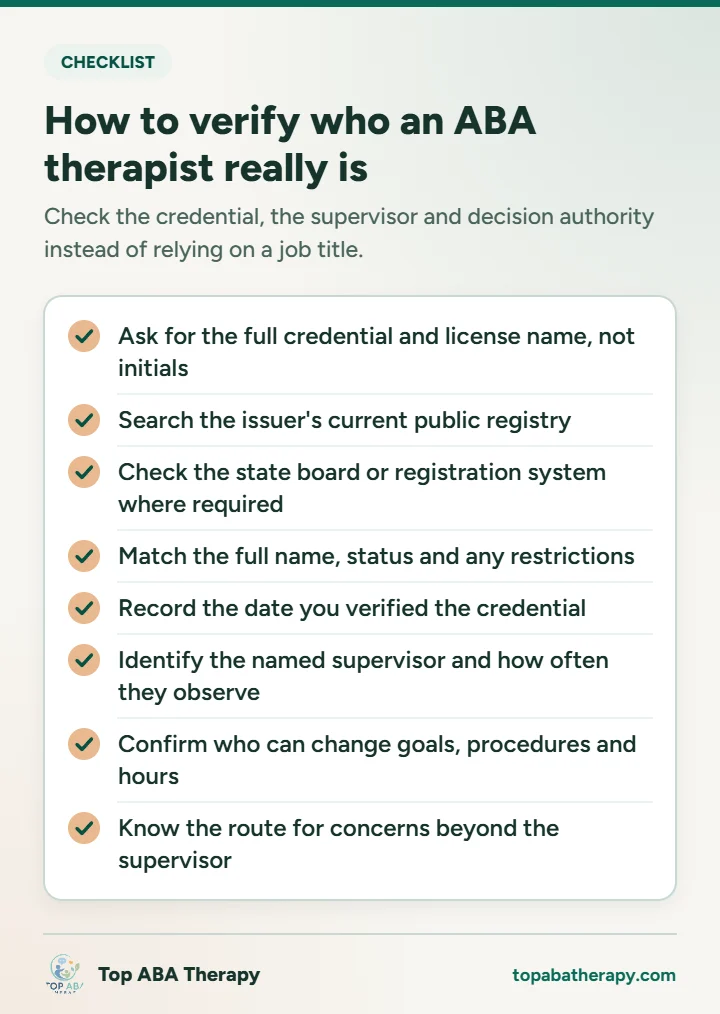
Ask for the exact credential and license name, not initials alone. Search the issuer’s current public registry where available, then check the applicable state board or registration system. Match the full name and status. Record the evidence date because credentials, restrictions, and state authority can change.
Verify claims without oversharing
Use public registries and authorized organization contacts. Families should not send diagnoses, treatment records, insurance identifiers, or birth dates merely to check a professional credential. Employers need lawful hiring and screening processes that protect applicants and clients.
If a claim cannot be corroborated, mark it unconfirmed and ask for clarification. Do not infer a credential from a degree, job title, lapsed badge, conference attendance, or the employer’s general list of services. The BACB handbooks describe current certification and maintenance requirements; state rules may add or differ.

Which questions and red flags reveal the real role?
Families can ask who owns assessment, goals, methods, intensity, data review, and change decisions; how the person communicates with the client; how assent and refusal work; what training fits this need; which adverse effects are tracked; and how to report a concern outside the immediate team.
Observe practice too. A trustworthy worker explains their role, seeks direction when conditions change, responds to pain or distress, protects communication and privacy, reports uncertainty, and respects lawful consent and ongoing assent. Warmth matters, but it cannot replace technical and ethical accountability. If something feels off, compare it with our list of warning signs in ABA programs.
Job applicants should price the whole role
Ask who pays for training, exams, renewals, background checks, travel, notes, meetings, cancellations, supervision, and fieldwork administration. Clarify employee or contractor classification, guaranteed and billable hours, availability expectations, safety support, caseload, mileage, documentation time, benefits, and wage consequences when a client cancels. Then run the numbers with our ABA therapist pay comparison.
Frequently asked questions about ABA therapists
Is ABA therapist a professional credential?
Not by itself. It is often an employer or public-facing title. Ask whether the person is an RBT, BCaBA, BCBA, trainee, separately licensed professional, technician, or another role.
Can an ABA therapist diagnose autism?
The generic title grants no diagnostic authority. Diagnosis depends on the professional’s actual license, scope, competence, setting, and applicable law.
Does a BCBA need supervision?
The BACB hierarchy treats BCBAs as independent practitioners, but employment, payer, law, competence, consultation, and risk may still require oversight or collaboration. A BCBA supervising others also carries active responsibilities.
What is the difference between an ABA therapist and a BCBA?
A BCBA is a specific graduate-level certification from the BACB, while “ABA therapist” is a general job title. Some people called ABA therapists are BCBAs, but many are RBTs or technicians who implement plans under a qualified supervisor. Ask which credential the person holds and who supervises their work.
Is an ABA therapist the same as a behavior therapist?
Not necessarily. Both are informal job titles rather than credentials, and either may describe an RBT, a behavior technician, a BCaBA, or a BCBA. Ask which credential the person holds, who supervises the case, and look the credential up in the BACB registry or the state licensing board.
The bottom line
So, what is an ABA therapist? It is a job title that can describe an RBT, BCaBA, BCBA, trainee or another role, and the title alone tells you little about authority or accountability. Expand the initials, check the registry and any state license, and get the supervisor and decision-making responsibilities in writing. Families should judge practice as well as credentials, and applicants should define the role before accepting it. Families and professionals can browse ABA providers near you and ask these questions of every team.