

Quick answer: ABA red flags include ignored communication or refusal, coercive goals, undisclosed restrictions, weak supervision, unreliable data, suspicious billing and retaliation. Ask for evidence and a clear corrective response. Immediate danger, suspected abuse or falsified records requires a faster response than an ordinary unanswered intake question.
Which ABA red flags need the fastest response?
Not every failure proves misconduct, and not every concern belongs in the same channel. A scheduling error and an undisclosed restrictive procedure carry different risks. Start with immediacy, possible harm, recurrence, available evidence, and whether the provider responds openly.
| Situation | Proportionate first move |
|---|---|
| Vague claim, inconsistent answer, or ordinary documentation error | Ask for dated evidence, a responsible contact, a correction deadline, and written confirmation |
| Poor fit, distress, nonresponse, or implementation drift | Pause the affected activity when appropriate and request review by the accountable clinician |
| Credential, supervision, privacy, billing, discrimination, or retaliation concern | Preserve records and identify the provider, payer, regulator, employer, or other body with jurisdiction |
| Injury, suspected abuse, dangerous restraint, medical emergency, or imminent threat | Prioritize immediate protection and follow applicable emergency, protective, law-enforcement, or mandated-reporting duties |

Where do ABA therapy warning signs appear?
Marketing and intake
Guaranteed outcomes. No provider can know before assessment that treatment will cure autism, produce speech, eliminate behavior, or meet a fixed deadline.
Fear-based urgency. “Your window is closing” pressures families to sign before they understand the methods, alternatives, credentials, burden, and cost.
A fixed package before assessment. Identical hours, goals, or settings may reflect provider capacity, not individual need.
“Positive only” without details. Ask what follows an error, refusal, distress, or attempt to leave. Pleasant language may conceal planned ignoring, blocking, response cost, physical prompting, or restraint.
Pressure to sign incomplete forms. Get copies of consent, financial, privacy, recording, attendance, release, and dispute terms. Question blanks, incorporated policies, future changes, and withdrawal rules.
Goals, communication, and autonomy
Goals focus on looking nonautistic. Eye contact, quiet hands, typical play, or “indistinguishability” needs a person-valued function. Harmless autistic behavior should not be suppressed for appearance.
General obedience is called safety. Universal adult compliance can increase vulnerability. Safety also requires refusal, boundaries, reporting discomfort, and trusted help.
Effective communication is restricted. Removing AAC, delaying it until speech is attempted, or rejecting gestures can undermine autonomy and safety. Honor accessible communication.
Health or context is dismissed. Behavior data cannot rule out pain, illness, trauma, sensory barriers, communication breakdown, or environmental mismatch. Accommodate, coordinate, or refer.
There is no assent process. The plan should define approach, refusal, avoidance, shutdown, distress, gesture, or AAC-based withdrawal and the staff response. A legal signature does not erase the person’s communication.
Procedures and safety
Restrictive procedures are undisclosed. Families need plain-language notice of any extinction, planned ignoring, response cost, blocking, physical prompting, restraint, seclusion, punishment, or crisis procedure.
Restraint or seclusion is normalized. Emergency protection is not routine treatment. Ask what rules apply, which alternatives were tried, who authorizes staff, how incidents are reported, and how recurrence is reduced.
Essentials become bargaining chips. Food, water, toileting, pain relief, communication, sleep, safety, and necessary regulation are not rewards to withhold.
Staff persist through distress. Pain, fear, overload, fatigue, inaccessible tasks, or the method itself remain possible. A slogan does not end the inquiry.
Incidents disappear into internal notes. Response, notification, investigation, correction, required outside reporting, and record access should be clear.
Staffing, data, money, and privacy
No one identifies the accountable clinician. Get the decision-maker’s name, role, credential, applicable license, employer, and contact route.
Technicians change treatment independently. An RBT works under ongoing supervision. New goals, material procedures, risk decisions, and plan interpretations need an accountable clinician.
Supervision exists on paper. Signatures do not prove observation and useful feedback. Ask how often the supervisor watches this person and technician together.
Turnover stays hidden. Rotation can disrupt trust, learning, safety, and data. Substitutes need person-specific preparation and demonstrated competence.
Caseload blocks BCBA access. No universal number proves quality. The clinician still needs time to assess, observe, analyze, train, communicate, and review incidents.
Attendance is presented as progress. Hours and sessions are process measures. Reports need baseline, prompts, context, generalization, maintenance, lived experience, possible harm, and a decision.
Nonresponse automatically produces more hours. Stalled or worsening outcomes should trigger review of goals, health, communication, environment, implementation, staff skill, burden, and fit.
Charges do not match service. Compare attendance, duration, clinician, location, code, authorization, invoice, and explanation of benefits. Blank or retroactive signatures, misstated service details, or cloned notes need investigation.
Privacy boundaries are vague. Ask about devices, messages, recordings, storage, marketing, training, research, retention, vendors, breach response, and the privacy contact. Treatment consent does not cover every reuse.
There is no complaint or exit route. Retaliation, hidden conflicts, complaints sent only to the person involved, and indefinite treatment weaken accountability.
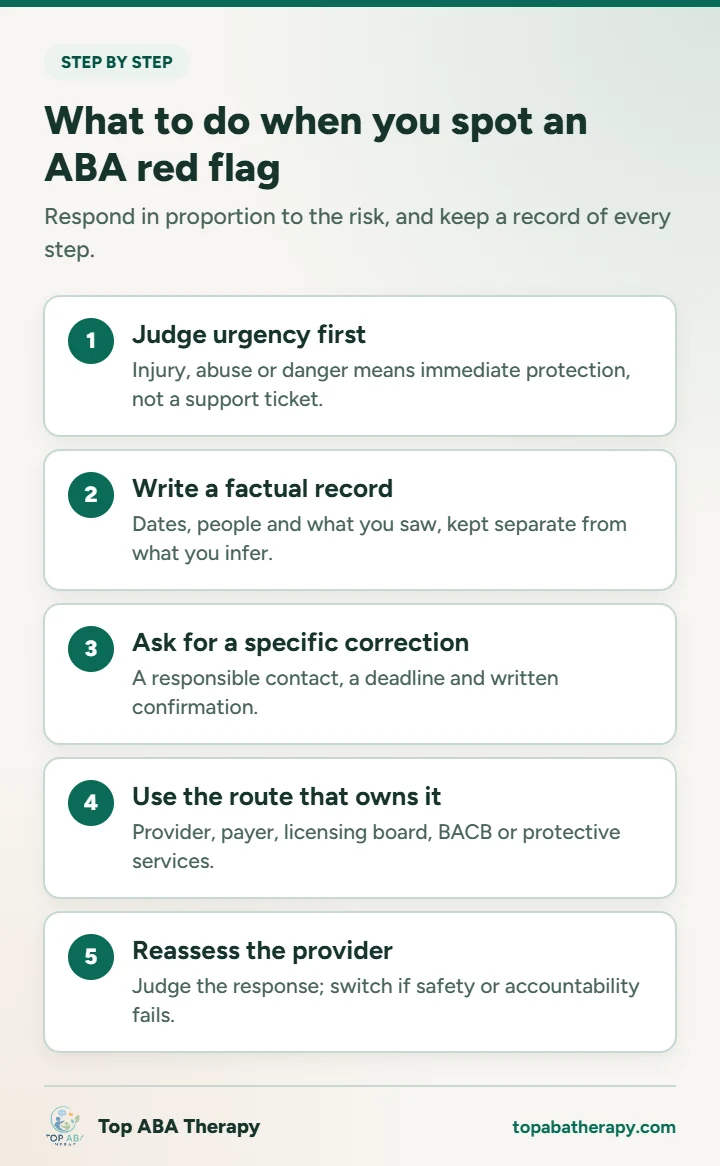
How should you document and escalate a concern?
Build a factual record
Write a chronology with dates, times, places, participants, direct observations, exact statements when reliably recorded, injuries, immediate actions, requested corrections, responses, and related documents. Separate what you observed from what you infer. Preserve originals and metadata when lawful, and avoid publishing identifiable health information while a concern is under review.
Relevant records may include the treatment plan, consent forms, policies, data, graphs, session notes, incident reports, credential and supervisor details, authorizations, attendance, bills, explanations of benefits, and correspondence. Do not record secretly until applicable law and policy have been checked.
Use the route that owns the problem
Start inside the organization only when that is safe and appropriate: the treating BCBA, clinical director, privacy officer, compliance contact, or leadership may be able to correct an error. A payer may have utilization, grievance, appeal, fraud, or case-management channels. Credential and scope issues may belong to state licensing bodies or the BACB within their respective jurisdiction. If the concern is a coverage or billing decision, our guide to verifying ABA insurance coverage explains the appeal routes.
Other routes can include Medicaid program integrity, HHS oversight, school or district processes, IDEA or Section 504 procedures, civil-rights channels, protective services, an ombudsman, disability-rights organizations, legal aid, or qualified counsel. Each has different authority and proof requirements. Federal healthcare exclusion records can answer one narrow eligibility question; they do not certify quality or resolve every complaint.
Keep immediate protection separate
For imminent danger, serious injury, a medical emergency, suspected abuse, or a crime, internal customer service may be the wrong first stop. Follow applicable emergency and protective routes. After safety is addressed, preserve records and seek qualified help with reporting duties and deadlines.
When should you switch ABA providers, and how?
Consider switching when a serious concern is not corrected, when safety or accountability fails, or when trust cannot be rebuilt. A careful transition protects progress and avoids an unnecessary gap in support.
- Request copies of the treatment plan, assessments, data, and progress reports in writing.
- Ask your insurer or Medicaid plan whether a new provider needs a new authorization and what it requires.
- Shortlist replacements before ending services when it is safe to do so, using our guide to finding a new ABA provider.
- Share relevant records with the new team, with your written permission.
- Explain the change to your child in a way they can understand, and keep familiar routines steady.
If the concern involves safety, do not wait for a replacement before acting.

What should families verify before choosing a provider?
Ask who chooses goals, how assent and refusal change a session, which practices are prohibited or specially reviewed, how health and environmental explanations are handled, and how benefit and harm are measured. Confirm who makes clinical decisions, how credentials and licenses are checked, what direct supervision looks like, how substitutes are trained, and which incident rules apply.
The provider-selection framework turns those topics into a pre-enrollment review. Top ABA Therapy can date and corroborate public directory fields, route corrections, and label paid enhancements. It cannot inspect a private treatment plan, endorse clinical quality, determine misconduct, or guarantee current availability. A paid relationship must never suppress a correction or safety report.
Frequently asked questions about ABA therapy red flags
Does one red flag mean an ABA provider is unethical?
Not necessarily. Consider severity, recurrence, evidence, impact, and the response after clarification. Some errors are correctable; coercion, retaliation, record falsification, suspected abuse, dangerous restrictions, and immediate safety threats require more urgent action.
Is refusal or distress always proof that treatment is harmful?
No, but it is information that must be understood. Pain, fear, sensory overload, task difficulty, fatigue, communication barriers, relationship problems, and the procedure itself may contribute. Persistent distress should never be dismissed as mere noncompliance.
Can a provider guarantee that insurance will pay?
No provider can guarantee a member-specific payment outcome. Network status, benefits, medical necessity, authorization, coding, documentation, location, and plan terms can all affect a claim. Verify through official payer channels and keep reference numbers.
Who should supervise an RBT?
The BACB sets current supervision requirements for RBT certification, while employers, payers, state rules, and the service plan may add obligations. Ask for the responsible supervisor’s identity, credential, applicable license, direct-observation pattern, and escalation route.
The bottom line
ABA therapy red flags are signals to ask for evidence, not automatic verdicts, but some demand immediate action. Triage by risk, keep a factual record, and use the route that actually owns the problem. Judge a provider by how it responds: openness and specific corrections build trust, while defensiveness, retaliation, or missing accountability are reasons to move on. When you need a better fit, start your search for ABA therapy near you.