
Quick answer: Telehealth ABA uses technology for selected coaching, consultation, observation, assessment or treatment activities. Suitability depends on the person, goal, communication access, safety, privacy and available support. Confirm the clinician’s authority in the client’s location, coverage and backup plan before relying on remote care.
Which ABA activities and people may fit telehealth?
Telehealth is a delivery modality, not one treatment protocol. The actual service should be identified precisely.
| Remote activity | Verification question |
|---|---|
| Consultation or coordination | Who participates, what is the scope, and what record is created? |
| Caregiver coaching | Is the role voluntary, accessible, realistic, and checked for competence? |
| Observation or assessment component | Can the camera and remote method answer the clinical question safely? |
| Direct treatment | Can the person communicate, engage, pause, and receive needed local support? |
| Staff supervision | Do applicable rules allow it, and what can the supervisor directly observe? |
| Asynchronous records or recordings | Who authorizes, stores, accesses, retains, and responds to the data? |
Who may benefit from remote delivery?
Telehealth may reduce travel, support specialized consultation, or reveal home routines. It may fit goals addressed through caregiver coaching or remote observation. It may fit poorly when technology or privacy is inaccessible, risk needs local support, the assessment requires in-person information, the person rejects video, or caregiver work would be excessive. Define outcomes and triggers for in-person, hybrid, referral, pause, or discontinuation. If you are weighing remote care against other settings, our comparison of in-home vs center-based ABA covers the in-person options.
Caregiver coaching is not unpaid staffing
Coaching may involve modeling a strategy, observing practice, giving feedback, and adapting a routine. It should build chosen skills without transferring professional duties to the household. Clarify who must be present, preparation time, provider or payer requirements, accommodations, and the alternative when participation is infeasible. The service recipient’s communication, assent, preferences, and dignity remain central. Families who prefer hands-on support at home can compare this with in-home ABA therapy.
Virtual ABA for toddlers and young children
For a toddler, remote care often coaches a willing caregiver within ordinary routines instead of requiring prolonged screen attention. Ask what the child experiences, how play and breaks remain child-led, what caregiver time is expected, and what distress or missing information triggers in-person care.

How do location, privacy, and emergency planning govern telehealth?
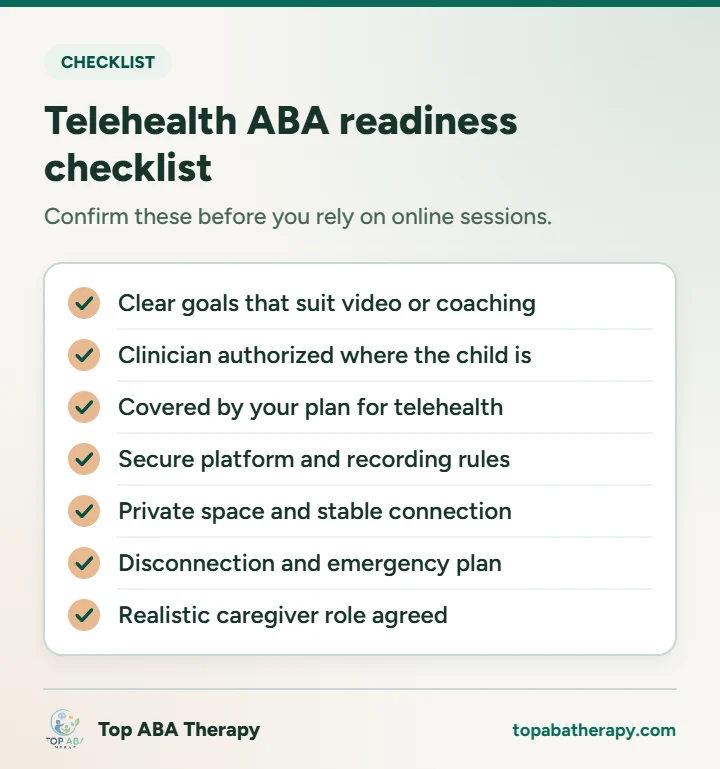
Telehealth.HHS.gov explains that an appointment occurs where the patient is physically located. Before service and travel, verify that location; professional credentials and required state authorization; any compact, registration, or exception; liability coverage; payer enrollment and billing rules; and the organization’s relocation policy. A BACB credential or home-state license alone does not answer every requirement.
Privacy and security require more than a familiar video app
Covered healthcare providers and plans must follow applicable HIPAA requirements. HHS says covered entities must use compliant telehealth vendors and enter business associate agreements when required. Ask about the platform, data collection, participants, recording, storage, access logs, retention, and breach process. Other state, consumer-health, or education-record rules may also apply.
Protect the physical environment
Both sides need suitable privacy. Identify everyone present, control screen and room access, and avoid recording unless necessary and authorized. Treatment consent does not automatically authorize recording, training, marketing, or third-party storage.
Protect devices and accounts
Use supported software, device locks, unique credentials, multi-factor authentication where available, updates, encrypted connections, and secure records portals. Shared devices can expose notifications, downloads, history, or passwords, so providers should supply accessible instructions.
Every telehealth plan needs a failure and emergency workflow
HHS guidance recommends documenting current location, local resources, a nearby support person when appropriate, permitted provider contacts, and disconnection steps. Match identity, callback, outage, power-loss, fallback, and stop procedures to risk and policy. An emergency plan does not make telehealth suitable for every risk, and families should never be assigned actions beyond their competence.
How should access, assessment, and delivery mode be evaluated?
A functioning camera is only one part of access. Evaluate bandwidth, data limits, device size and mounting, audio, charging, captions, interpreters, language, screen-reader and keyboard support, sensory and communication access, realistic privacy, technical help, and low-bandwidth alternatives. The setup should not require unsafe or continuous device handling.
How remote assessment differs from in-person assessment
Video can reveal routines and environmental context, but the camera frame may omit important events. Internet delay can affect timing. People may behave differently on camera, and a caregiver may unintentionally prompt or interpret. Some assessment tools or procedures may not be validated, authorized, safe, or practical remotely.
Telehealth, in-person, or hybrid?
Telehealth may fit when remote observation or coaching directly serves the goal, the person can access and prefers the modality, agreed caregiver participation is feasible, risks fit a documented remote plan, and the technology yields usable information. In-person or hybrid review becomes more important when hands-on or environmental assessment is essential, video creates distress or exclusion, local support is needed, or camera limits, latency, language, accessibility, or privacy undermine the service.

How do you verify a telehealth ABA provider and coverage?
Coverage changes by plan, state, service, professional, modality, and location. Ask whether the exact service is covered by live video, audio-only, or asynchronous exchange; which credentials, licenses, locations, and billing descriptions qualify; whether authorization or an originating-site rule applies; how assessment, caregiver guidance, supervision, and direct treatment differ; and what happens when technology forces a modality change. Our ABA insurance verification call script helps you ask these questions in order.
Questions to ask a telehealth ABA provider
Clinical and ethical fit
- Why is remote delivery recommended for these goals?
- How were the person’s preferences and assent assessed?
- Which activities are remote, in person, or excluded?
- How will progress, generalization, maintenance, and adverse effects be measured?
- What triggers a modality change or referral?
Operational safeguards
- Who is the accountable clinician and where is each professional authorized to practice?
- Which platform, vendors, recordings, and data flows are used?
- What accessibility, interpreter, and technical support are available?
- Who must be physically present with the client?
- What are the disconnection, emergency, complaint, and incident procedures?
Use how to choose an ABA provider to assess credentials, competence, supervision, outcomes, safety, and transition beyond the technology itself.
Verify directory claims before scheduling
A “telehealth available” field may not apply to every state, payer, age, service, goal, clinician, or time slot. Confirm current jurisdiction, service type, credential, license, availability, platform, language, accessibility, authorization, and cost directly.
A directory listing helps you find options, but it cannot establish clinical fit, legal authority in your state, privacy compliance, coverage or appointment availability, so confirm each of those directly.
Location can change the legal answer mid-trip: telehealth generally occurs where the client is physically located. Tell the provider before travel or relocation and obtain a new authorization and state-licensing determination when required.
Frequently asked questions about telehealth ABA
Is telehealth ABA therapy just a video session with a child?
No. It may involve caregiver coaching, consultation, observation, selected assessment components, direct interaction, staff supervision, or secure asynchronous exchange. The provider should name the exact service and explain why remote delivery fits it.
Can an ABA provider work across state lines by telehealth?
Not automatically. The client’s physical location, provider profession, state licensing or registration rules, any compact or exception, organizational policy, liability coverage, and payer requirements can all matter.
Does HIPAA require one specific video platform?
HHS does not identify one universal platform for every provider. A covered provider must use technology and vendor relationships that satisfy applicable HIPAA requirements, including a business associate agreement when required, and must also consider other privacy laws.
Must a caregiver participate in online ABA?
Some remote models rely on caregiver coaching, while others involve different services. Ask what presence and unpaid work are expected, whether participation is voluntary or payer-required, how competence is supported, and what alternative exists when the role is not feasible.
The bottom line
Telehealth ABA therapy can be a practical way to get caregiver coaching, specialist input or some direct support, but it only works when the goals, technology, privacy and safety planning genuinely fit your child and household. Ask why remote delivery is recommended, confirm authorization and coverage, and agree on what triggers in-person care. When you are ready, find ABA therapy providers near you and ask which offer telehealth in your state.