
Quick answer: ABA therapy for children should start with an individualized assessment and useful goals, such as communication or daily-living skills. Look for qualified supervision, consent and assent, coordination with other services, and monitoring of benefit and harm. Avoid cure claims, guaranteed results and a fixed schedule proposed before assessment.
How should ABA for children begin?
Four decisions shape a good start, and each has a simple check you can apply:
| Decision | A useful check |
|---|---|
| Goal | A meaningful communication, access or daily-life outcome for this child. |
| Schedule | How proposed sessions fit sleep, school, play, other services and family capacity. |
| Participation | How the child communicates willingness, refusal and a need for a break. |
| Review | Progress outside sessions, burden, adverse effects and criteria for changing care. |
The first step is not assigning a technician or selecting a package. A qualified clinician should assess the child’s strengths, needs, communication, preferences, development, relevant routines, medical and safety context, and environments. Family priorities matter, and the child should participate in ways accessible to them.
Meaningful goals change with age and context
Age bands can prompt questions, but they should not become rigid treatment templates. For toddlers, goals often center on play, early communication and shared routines; for school-age children, on classroom participation, friendships and self-care; and for preteens, on independence, self-advocacy and choices about their own support.
Communication should be functional and multimodal
Communication goals may involve speech, gestures, signs, pictures, writing, augmentative and alternative communication, or a combination. The objective is reliable access to expressing needs, choices, questions, preferences, pain, refusal, and social connection rather than speech at any cost.
Assent belongs in everyday treatment
Parents or legal representatives may provide consent, but ethical care also attends to the child’s assent and withdrawal when applicable; assent can be communicated through approach, participation, choice, words, an AAC device, gestures, affect, avoidance, or distress.
Distress is information: do not let a behavior label replace review of pain, illness, sensory conditions, inaccessible communication, fear, fatigue, demands, relationships, or the treatment method itself.

How should families choose settings, intensity, and coordination?
ABA can occur at home, in a center, at school, in community settings, or through telehealth when appropriate. Setting quality depends on fit and implementation, not marketing. Compare the trade-offs in our guide to in-home vs center-based ABA, and see school-based ABA if services may happen at school.
How many hours should a child receive?
There is no single weekly total appropriate for every child. Intensity should be justified by individualized goals, baseline skills, health, sleep, school, play, family life, other services, learning opportunities, response, and potential burden.
Coordinate home, school, and clinical teams
A child may have an IEP or 504 plan and receive speech-language, occupational, physical, medical, mental-health, or other supports. Coordination can reduce contradictory strategies and duplicate assessment, but it requires permission and clear roles.
How should outcomes and pediatric ABA providers be evaluated?
Session accuracy is not enough. Providers should measure whether skills improve access and participation, transfer across people and settings, persist over time, and remain useful without unnecessary prompts.
Caregiver involvement should be defined and sustainable
Caregiver collaboration can help select goals, adapt routines, practice strategies, identify side effects, and support generalization. It should be accessible in the family’s language and adapted to disability, employment, other children, resources, culture, and priorities.
Ask what participation is required by the clinical plan, provider, or payer; how competence is supported; and what occurs when an adult cannot attend. Parents are partners and caregivers, not default technicians responsible for delivering a clinic’s prescribed weekly workload.
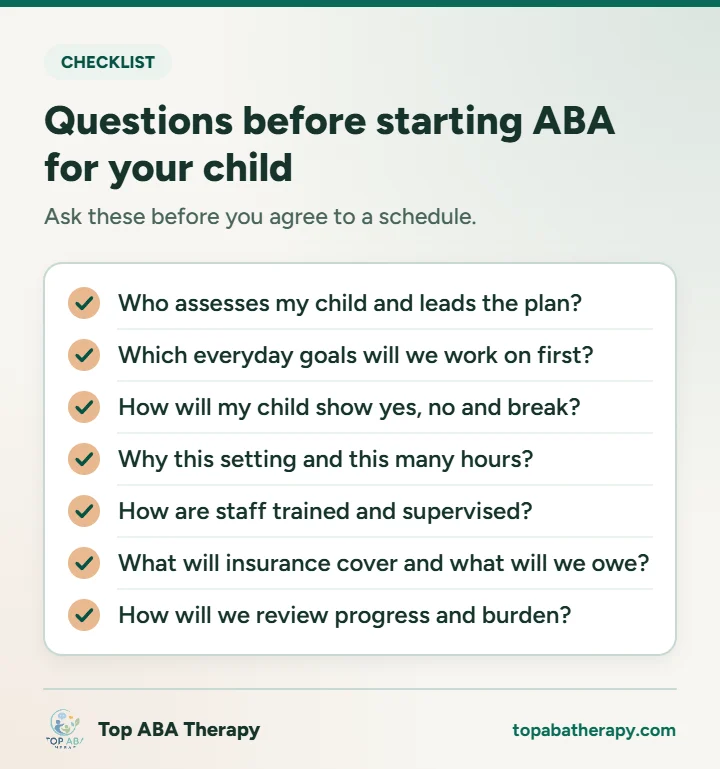
How to evaluate a pediatric ABA provider
Competence and accountability
- Who assesses the child and owns clinical decisions?
- What experience matches the child’s communication, age, goals, and other needs?
- Which credentials, licenses, checks, and payer enrollments apply?
- How are direct observation, staff training, and competence checks handled?
Ethics and treatment design
- How are goals chosen with the child and family?
- How are consent, assent, refusal, dignity, and privacy handled?
- Which procedures are prohibited or require special review?
- How are health, communication, environment, progress, unwanted effects, and quality of life reviewed?
Operations
- What are the setting, schedule, substitution, and cancellation rules?
- What will insurance cover, and what can the family owe?
- How are incidents, complaints, records, transition, referral, and discharge handled?
Our detailed ABA provider selection guide turns these questions into a verification workflow.
Common red flags
- cure, normalization, or guaranteed-independence promises;
- a fixed schedule or long contract before assessment;
- staff who cannot explain the rationale or accountable clinician;
- distress dismissed without reviewing pain, communication, environment, or method;
- communication systems or outside professionals discouraged;
- hidden supervision, unstable staff, or no measurement of generalization, burden, transition, or discharge.
Cost and coverage are separate from clinical fit
Verify network status for the exact organization, location, and professionals. Ask whether assessment, direct treatment, caregiver training, group services, telehealth, and supervision are covered and authorized separately. Obtain the approved units and dates in writing and compare them with the proposed schedule. Our insurance verification call script makes this easier.
Review the plan as the child grows
Children’s skills, preferences, environments, relationships, health, school demands, and goals change. Predetermined review points should examine whether the service is useful, acceptable, sustainable, and still within the provider’s competence.

Frequently asked questions about ABA therapy for children
What goals can ABA therapy address for a child?
Possible goals include functional communication, self-advocacy, play, learning access, daily routines, participation, relationships, or safety. A provider should connect every goal to assessment and a benefit valued by the child and family, not to age or diagnosis alone.
Should ABA try to stop stimming?
Harmless self-regulation should not be targeted merely because it looks autistic. If a movement creates injury or a concrete barrier, examine pain, sensory and environmental factors, communication, risk, alternatives, and the person’s perspective before selecting any intervention.
How can a nonspeaking child show assent or refusal?
Communication may use an AAC device, signs, gestures, movement, affect, approach, avoidance, or behavior. The team should define each person’s signals, make refusal accessible, and explain how distress changes the session or plan.
Is more ABA always better for children?
No. Hours should follow individualized goals, response, sleep, health, school, play, other services, family capacity, preferences, burden, and review criteria. More time can increase opportunity or create fatigue and displacement, depending on the person and plan.
The bottom line
ABA therapy for children works best when it starts with a real assessment, focuses on goals that make daily life easier for the child, respects assent and refusal, and keeps families as partners rather than unpaid staff. Review progress, burden and fit regularly as your child grows. When you are ready, find ABA therapy providers near you and bring these questions to your first call.