
Quick answer: What is ABA therapy? Applied behavior analysis is a broad approach that uses observation, measurement, and learning principles to support useful skills or change behaviors that create barriers in daily life. It is not one fixed program. Responsible ABA is individualized around the person’s communication, preferences, safety, dignity, goals, and quality of life.
What does ABA therapy include?
The National Academies defines ABA as individual behavioral practices, such as reinforcement and prompting, or combinations of practices used to support socially important health and behavioral outcomes. Two services called ABA can therefore look very different. One may teach an accessible way to request a break during a daily routine. Another may address communication, learning, safety, play, and daily living across a larger weekly schedule. For a stage-by-stage walkthrough, see how ABA therapy works in practice.
| Stage | What responsible care should make visible | A useful family question |
|---|---|---|
| Assessment | Strengths, communication, preferences, routines, barriers, health, and context | What was considered, and what was outside the assessor’s scope? |
| Goals and plan | A meaningful outcome, method, measure, safeguards, and review point | How does this goal improve the person’s life? |
| Sessions | Structured or natural practice with real choices, breaks, and communication access | How are assent, refusal, distress, and pain handled? |
| Review | Progress, burden, adverse effects, generalization, and client experience | What finding would make the team change or stop the plan? |
| Transition | Fading prompts, maintaining useful skills, coordinating support, and discharge | How will care avoid unnecessary dependence? |
How a functional communication goal can work
Suppose a person has no reliable way to request a break during a noisy activity. A clinician observes what happens before distress, checks for health and environmental factors, and teaches an accessible spoken, signed, pictured, or device-based request. Adults then honor that request consistently. The valuable outcome is not simply quieter behavior; it is more agency, clearer communication, and a safer interaction.
Who provides ABA therapy, and where does it happen?
Most ABA programs use a tiered team. A Board Certified Behavior Analyst (BCBA) assesses, writes the plan, and supervises. Registered Behavior Technicians (RBTs) often deliver many of the direct sessions under that supervision, which is why it helps to understand how BCBA and RBT roles differ. Some states also license behavior analysts, so the credentials to verify depend on where you live.
Services can take place at home, in a clinic or center, at school, in the community, or through telehealth caregiver coaching. Each setting changes what can be practiced: home sessions fit daily routines, while a center may offer more peer interaction and on-site supervision. If you are weighing options, start by comparing in-home and center-based ABA against your child’s goals rather than the provider’s default schedule.
Which goals are appropriate, and what does the evidence show?
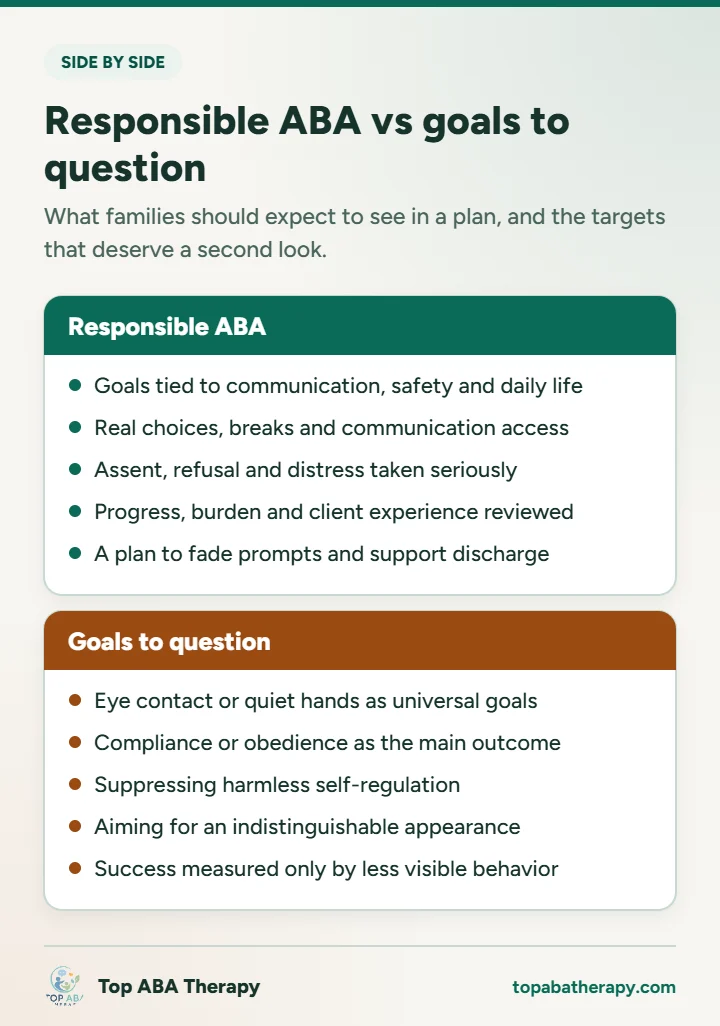
ABA goals may address communication, daily living, safety, participation in valued activities, caregiver responses, or using a skill across people and settings. A measurable target is not automatically a good target. Eye contact, quiet hands, obedience, indistinguishable appearance, or suppression of harmless self-regulation should not be treated as universal outcomes.
Evidence note: Group research cannot decide whether one program is appropriate for one person. Evidence must be combined with professional competence, the person’s characteristics and preferences, family context, other available supports, ongoing measurement, and the burden of care.
A practical test is to ask what will be different in daily life if a goal is met. Stronger goals tend to read like these:
- Requests a break, help, or a preferred item using speech, signs, pictures, or a device.
- Completes part of a morning routine with fewer prompts and less stress for everyone.
- Stays beside a trusted adult when crossing a parking lot.
- Joins a valued activity, such as a family meal or a playground visit, for longer and with more enjoyment.
Each goal should name how progress will be measured, who will practice it, and when the team will review whether it is still worth the time.
Why is ABA criticized, and how should families evaluate care?
Autistic people and other advocates have raised concerns about historical punishment, compliance-centered teaching, suppression of harmless autistic behavior, weak consent or assent, goals aimed at appearing nonautistic, and research that overlooks lived experience and quality of life. These concerns identify harms that services must prevent. They should not be dismissed as confusion about therapy.
- Who chooses goals, and how can the client participate?
- How do you respond to refusal, distress, pain, fatigue, or sensory overload?
- Which goals would you decline because they could cause harm or lack social meaning?
- Who designs the plan, who provides sessions, and how often does qualified supervision occur?
- What outcomes do you measure beyond task completion or reduced visible behavior?
- When would you reduce hours, refer out, transfer, pause, or discharge?

How do families get started with ABA therapy?
If ABA is being considered, a few steps keep the process anchored to your family’s priorities rather than a provider’s default package.
- Write down two or three changes that would make daily life easier or safer, in your own words.
- Ask the referring clinician whether a diagnosis, prescription, or referral is needed for coverage or intake.
- Confirm benefits before intake. Our guide to checking whether your plan covers ABA lists the questions to ask.
- Contact at least two providers and ask each one the same questions from the list above.
- Request the assessment report and proposed plan in writing, and ask how each goal was chosen.
- Agree on a review date, and decide in advance what progress or concerns would change the plan.
You can also ask to observe a session or speak with the supervising BCBA before agreeing to a schedule.
Frequently asked questions about ABA therapy
What happens in a typical ABA session?
There is no universal session. A session may combine natural routines, structured practice, communication support, caregiver coaching, data collection, and breaks, depending on the setting and written plan.
Is ABA therapy covered by insurance?
Often, but it depends on the plan. Many private plans and state Medicaid programs cover ABA for autism when medical necessity criteria are met, yet rules on diagnosis, age, prior authorization, and cost sharing differ. Call the member services number on the insurance card and ask about ABA benefits, in-network providers, and authorization before intake.
How long does ABA therapy last?
There is no fixed length. Plans are typically reviewed at set intervals, and duration depends on goals, progress, and the person’s experience of care. A responsible plan explains how skills will be maintained, how support will be faded, and what would lead to transition or discharge.
What does ABA stand for?
ABA stands for applied behavior analysis. It applies principles of learning and behavior to goals that matter in everyday life, such as communication, self-care, safety, and participation. In clinical services, a Board Certified Behavior Analyst designs and supervises the program, and trained technicians often deliver many of the sessions.
Where did ABA therapy come from?
ABA grew out of behavioral research in the mid-20th century. A 1968 paper by Baer, Wolf, and Risley defined the core dimensions of applied behavior analysis, and Ivar Lovaas’s research brought it into early autism intervention. Modern practice has shifted toward assent-based, naturalistic, and family-centered care.
Is ABA therapy evidence-based?
ABA-based interventions have research support for teaching communication, daily living, and other skills, particularly for autistic children, and many insurers recognize them. The evidence varies in quality and does not guarantee results for one person, so look for individualized goals, regular data review, and plan changes when progress stalls.
The bottom line
So, what is ABA therapy? It is a flexible, measurement-based approach that can support communication, daily living, and safety when goals are chosen with the person rather than imposed on them. The label alone tells you little; the plan, the people delivering it, and how they respond to refusal and distress tell you much more. Ask for goals in writing, verify who supervises, and review progress on a set schedule. When you are ready to compare options, find ABA therapy providers near you.
Sources
- Applied Behavior Analysis in Children and Youth with Autism Spectrum Disorders: A Scoping Review.
- The Comprehensive Autism Care Demonstration: Solutions for Military Families, Chapter 5: Evidence Base for Applied Behavior Analysis
- The Comprehensive Autism Care Demonstration: Solutions for Military Families, Interactive Report