
Quick answer: ABA can cause harm. Autistic people report coercion, distress, loss of autonomy and lasting effects, while some people and families report useful gains. Evaluate the specific goals, methods, provider and alternatives. Ignored refusal, appearance-based goals, unjustified restrictions and failure to monitor adverse effects are serious concerns.
Why do ABA experiences and criticism differ so sharply?
People describe very different ABA experiences because “ABA” covers very different practices. Start by separating the concerns critics raise from what a specific provider actually does:
| Concern | What a provider should be able to explain |
|---|---|
| Compliance-centered goals | Why each goal improves the person’s life rather than appearance or adult convenience. |
| Distress or refusal | How the team recognizes, investigates and responds to these signals. |
| Harmless autistic behavior | Why it should not be suppressed merely for looking different. |
| Unclear harms monitoring | Which adverse effects, burden and client experiences are reviewed alongside progress. |
ABA may describe historical aversives, intensive packages, discrete trials, naturalistic teaching, caregiver coaching, communication training, school plans, or organization-specific services. That variety does not erase patterns. Defenders sometimes substitute an ideal modern program for the practice someone experienced, while critics may use ABA to describe a wider system of power and normalization. Review both the testimony and the provider’s exact operations. If you need a neutral starting point, our overview of what ABA therapy is and how it is delivered explains the main methods.
Autistic criticism is evidence that must not be dismissed
The Autistic Self Advocacy Network opposes ABA and centers autistic goals, rights, autonomy, and quality of life. Autistic writers and research participants describe forced compliance, suppressed self-regulation, controlled access, ignored distress, boundary violations, masking, and dehumanization.
Historical change does not prove current safety
Practice may evolve toward collaboration, assent, naturalistic teaching, and person-centered goals, but “modern ABA” is not a protected quality standard. Contemporary language can coexist with compliance goals, ignored withdrawal, leverage over access, or adult-defined measures. Verify the goal, procedure, staff, and organization.

Where can harm occur in ABA practice?
Harm can enter through goals that prioritize appearing nonautistic, power that rewards generalized obedience, or assessment that treats distress only as behavior to remove. It can also enter through deprivation, disproportionate control of essentials, intrusive prompting, suppression of harmless self-regulation, schedules that displace childhood or adult life, and restrictive crisis practices without necessity or oversight.
Assent is more than the absence of protest
Legal consent may come from a representative, but ethical treatment also attends to assent and withdrawal. Speech, AAC, gesture, movement, affect, avoidance, shutdown, escalation, or refusal to approach may communicate no. Define the signal and response: pause, check pain, change the environment, offer choices, alter the goal, reduce demand, switch methods, or stop. Urgent risk or limited capacity calls for greater safeguards, not an exemption from dignity.
Masking and normalization goals
Masking can mean suppressing movement, communication, sensory needs, or identity to satisfy expectations. Eye contact, quiet hands, typical play, or stillness may teach concealment instead of a useful skill. Ask who benefits, tie goals to the person’s access, autonomy, relationships, health, safety, or chosen participation, and consider accommodation first.
Restrictive and punishment-based practices require direct questions
A positive-reinforcement claim does not rule out response cost, planned ignoring, blocking, escape extinction, physical prompting, restraint, or seclusion. Ask for written definitions and policy. For any restrictive procedure, establish:
- the serious risk or outcome and assessed medical, sensory, communication, trauma, skill, and environmental factors;
- less intrusive alternatives already attempted;
- who authorizes, implements, observes, and stops it;
- applicable consent, assent, legal, payer, licensing, and organizational rules;
- benefit, harm, incident, fidelity, review, fading, complaint, and independent-review evidence.
What can evidence, safeguards, and red flags tell us?
Average improvement under studied conditions does not prove every program works, every goal is ethical, every person benefits, or long-term and adverse effects were measured. The 2025 National Academies report describes heterogeneous services and evidence, short follow-up, limited adverse-event reporting, and challenges applying group results to one person. Effectiveness and ethics must each pass.
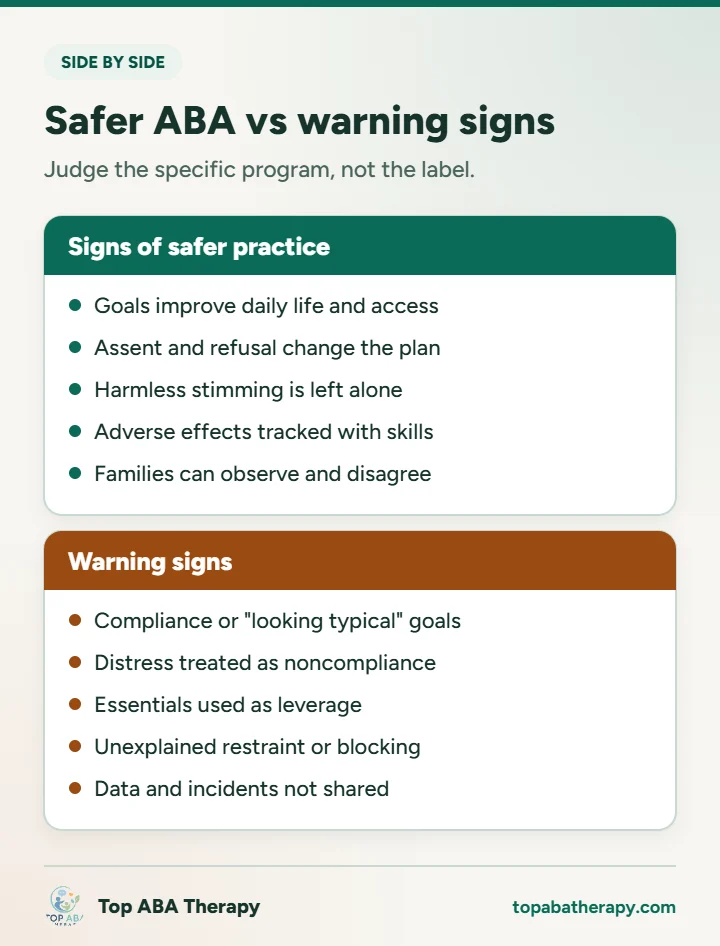
Signs a provider is taking criticism seriously
- autistic people have paid roles in governance, training, goal review, or design;
- the provider names prohibited practices, not only promoted values;
- goals emphasize communication, access, autonomy, relationships, safety, and daily life;
- staff recognize assent, withdrawal, pain, sensory needs, and communication;
- adverse effects and quality of life sit beside skill data;
- observation, disagreement, complaints, alternatives, referrals, step-down, and discharge are normal.
These signs reduce uncertainty; they do not guarantee safety. Organizational policy must match direct observation and individual experience. Our longer list of ABA therapy warning signs covers what to watch for after care starts.
Red flags that justify stopping and reviewing
- guaranteed outcomes or dismissal of criticism as misunderstanding;
- pressure to start before methods, credentials, costs, and complaint routes are disclosed;
- obedience, eye contact, quiet body, or typical appearance without functional benefit;
- removing communication or using food, water, toilet access, comfort, relationships, or regulation as leverage;
- unexplained prompting, blocking, restraint, seclusion, punishment, extinction, or persistence through distress;
- injury, fear, sleep disruption, regression, shutdown, or avoidance dismissed as expected;
- no accountable supervisor, weak observation, chronic turnover, or withheld data and incident information.
If there is immediate danger or suspected abuse, use appropriate emergency, protective, licensing, law-enforcement, or legal resources for the situation and jurisdiction. A directory cannot investigate or resolve an emergency.
Alternatives and complements deserve equal scrutiny
Consider speech-language and AAC support, occupational or physical therapy, developmental approaches, mental-health care, medical evaluation, education, accommodation, community programs, caregiver support, or combinations. Apply the same tests for goals, consent, competence, evidence, adverse effects, burden, cost, and transition. The choice is not simply ABA or nothing.

How can families and autistic people make a safer decision?
Define the desired change
Describe what would improve the person’s life and who identified that outcome. Separate safety or access barriers from differences that mainly make observers uncomfortable.
Compare methods and alternatives
Ask what will be done, what the person experiences, how choice operates, and what less intrusive or nonbehavioral options exist. Request evidence relevant to the actual goal, population, method, setting, and provider. Bring a written set of questions to ask an ABA provider so every option is judged the same way.
Establish stop and review rules
Write down signs of benefit, distress, adverse effects, burden, nonresponse, and loss of trust. Define who can pause treatment and how an independent review or referral occurs.
Reassess power over time
Increase the person’s control over goals, schedules, data, records, providers, and continuation as possible. Supported decision-making and accessible communication can make participation real rather than symbolic.
A directory listing, including ours, is a discovery tool, not an endorsement or a safety certificate. Use listings to find options, then verify goals, methods, supervision and safeguards directly with each provider.
Immediate safety comes first: injury, suspected abuse, illegal restraint or seclusion, deprivation of essentials, or imminent danger may require emergency, protective, licensing, legal, or medical help outside the provider’s complaint process.
Frequently asked questions about ABA and harm
Why do some autistic adults describe ABA as harmful?
Accounts include coercion, ignored distress, compliance training, suppression of harmless traits, control of communication or preferred items, bodily-boundary violations, masking, and lasting fear or loss of autonomy. Experiences vary, but variation is not a reason to dismiss them.
Does positive reinforcement make ABA safe?
No single technique establishes safety. Examine the goal, what access is controlled, whether refusal is meaningful, how prompting works, what burden occurs, who holds power, which adverse effects are measured, and whether the person can stop.
Is all stimming an appropriate treatment target?
No. Harmless self-regulation should be accommodated, not suppressed for appearance. When movement involves injury or a concrete barrier, review pain, sensory conditions, communication, environment, alternatives, assent, and the person’s own priorities.
What is masking in autism intervention?
Masking or camouflaging can involve hiding natural movement, communication, sensory needs, or identity to satisfy social expectations. Ask whether a goal expands access and chosen participation or merely trains the person to look less autistic.
The bottom line
So, is ABA therapy harmful? It can be, and autistic testimony shows how. It can also be delivered with assent, meaningful goals and real accountability. The difference lies in the specific team, goals and safeguards, so judge each program on what it actually does, keep the right to pause or stop, and compare alternatives with the same scrutiny. When you are ready to compare options, find ABA therapy providers near you and ask every one of them these questions.
Sources
- The Views of Autistic Adults on Early Autism Interventions: A Mixed-Methods Systematic Literature Review.
- Social Validity of Pivotal Response Treatment for Young Autistic Children: Perspectives of Autistic Adults.
- For Whose Benefit?: Evidence, Ethics, and Effectiveness of Autism Interventions – Autistic Self Advocacy Network