
Quick answer: To become an RBT, check current BACB eligibility, complete compliant training and the competency assessment, submit the application and pass the exam. Use the requirements that apply to your application date. Certification also brings ongoing supervision, ethics and maintenance obligations; it does not authorize independent practice.
Credential note: BACB requirements, forms, fees, jurisdiction, exam content, and transition rules can change. The current BACB RBT Handbook and portal control. State authorities, employers, facilities, and payers may add separate requirements.
What should you confirm before starting the RBT path?
Know what the credential permits
The Registered Behavior Technician is a paraprofessional certification in behavior analysis. RBTs help deliver behavior-analytic services under the direction and close, ongoing supervision of an RBT Supervisor and/or RBT Requirements Coordinator who is responsible for their work.
Check jurisdiction and local employment conditions
BACB certification availability has geographic limits and transition dates. Verify your residence in the current handbook. Then check whether your state regulates behavior technicians, restricts titles, requires registration or licensing, or imposes additional screening. Employer, school, facility, and payer rules can add another layer.
Also test whether the daily work suits you. Direct service may involve repeated practice, careful data collection, fast transitions, travel between homes, collaboration with caregivers or teachers, and following a plan even when progress is uneven. Ask to observe the setting or review a realistic sample schedule without client-identifying information. A polished recruitment page cannot show whether staff get preparation time, safe staffing, useful feedback, or a respectful way to pause and escalate concerns. Reading how ABA services are structured gives useful context for where the RBT fits.
Confirm current eligibility and screening rules
The RBT Handbook checked for this article on August 16, 2026 describes age, education, criminal-background-check, abuse-registry-check, training, and competency requirements. It also defines who may attest to requirements and how recent documents must be. Read the current version for exact dates and conditions instead of relying on a recruiter or course seller.

What are the steps to become an RBT in 2026?
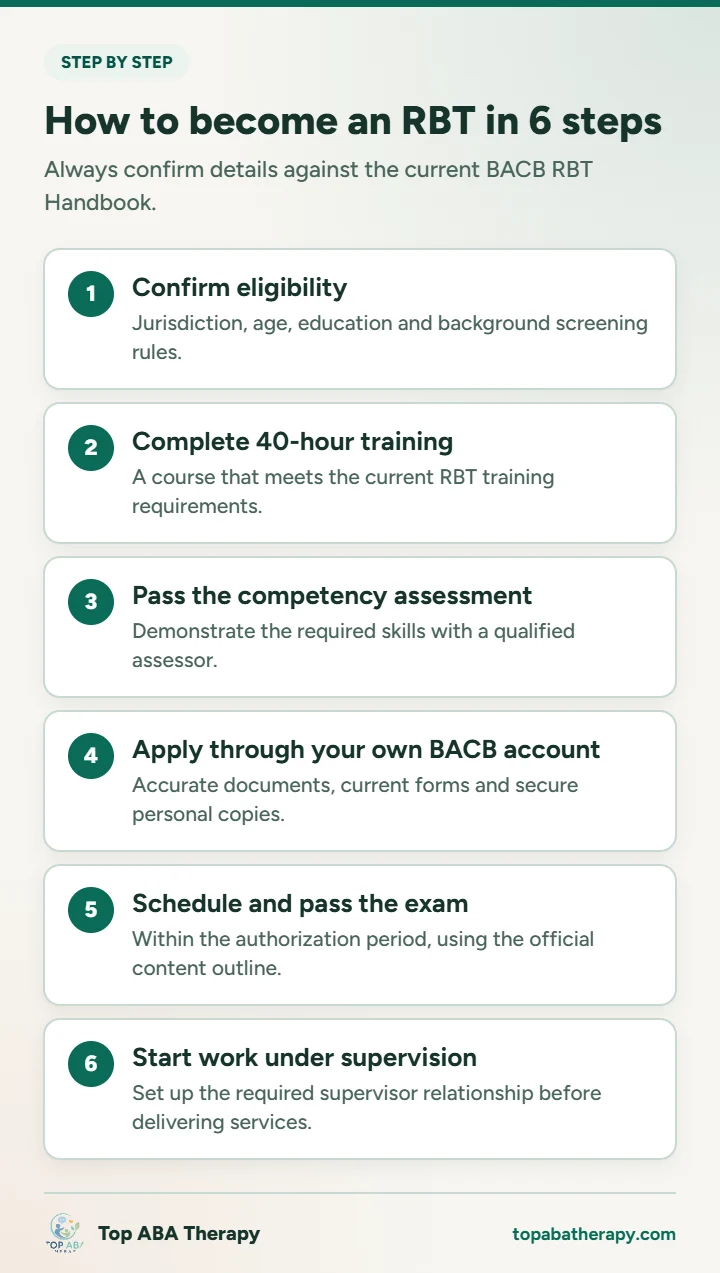
The sequence matters because training, checks, assessments, applications, and exam authorizations can have different timing rules. Build the plan from the current handbook and preserve your evidence as you go.
| Stage | What to complete or verify |
|---|---|
| Scope and eligibility | Confirm jurisdiction, age, education, screening, and any state or employer requirements |
| Training | Complete a course that meets the current RBT 40-Hour Training Requirements and Curriculum Outline |
| Competency | Demonstrate the required skills with a currently qualified assessor using the current packet |
| Application | Create and control your BACB account, upload accurate documents, and respond to action items |
| Examination | After approval, schedule through the authorized testing process and pass the current exam |
| Practice setup | Establish the required supervisor or coordinator relationship before delivering services |
| Maintenance | Follow supervision, ethics, reporting, account, professional-development, and renewal rules that apply to you |
Create your own BACB portal account with the legal name used on identification and an email you will retain after changing jobs. Do not give an employer, recruiter, trainer, or supervisor control of the password, multifactor authentication, or recovery method. Before submission, verify current forms, dates, signatures, signer qualifications, readable files, accurate disclosures, and secure personal copies.
After application approval, follow the official instructions to schedule the exam within the authorization period. Prepare from the current test content outline and official policies. Do not buy recalled questions or share exam content. If you need disability-related accommodations, begin the official process early enough for review.
How do you choose training, assessment, and an employer?
Minimum compliance matters, but it does not tell you whether a course prepares you for supervised work. Look for practice, feedback, ethical scenarios, dignity, assent, communication access, accurate data collection, professional boundaries, safety, and clear escalation. Ask what happens if the certificate contains an error or you need more help with a skill.
Questions to ask a training provider
- Does the course state that it meets the current RBT 40-hour training requirements, and who oversees it?
- How much practice and feedback is included, beyond recorded content?
- Who can complete the competency assessment, and is it included or arranged separately?
- How are certificate errors corrected, and how long do records remain available?
Questions to ask a potential employer
- Who will be my supervisor, and how often will they directly observe my sessions?
- How much paid training and shadowing happens before I work with a client without the supervisor present?
- Is paid time provided for supervision, notes, and travel between sessions?
- What happens when a session feels unsafe or a client is distressed, and who do I call?
- Does the employer cover or reimburse training, the competency assessment, or exam fees?
Compare offers on these answers, not only on the hourly rate. Understanding how the RBT role differs from a BCBA’s also helps you spot a job description that asks you to work outside your scope.

What happens after the RBT exam?
Passing the exam does not permit unsupervised services. Before working as an RBT, make sure the required supervisor and/or Requirements Coordinator relationship is correctly established and the employer has a workable supervision plan. A registry relationship alone does not prove that direct observation, feedback, documentation, backup, and ethical support occur in daily practice.
In the first months, focus on the basics that protect clients and your credential:
- Learn each client’s plan, communication methods, and assent signals before working without close support.
- Record data accurately and on time, and ask when a definition is unclear.
- Use supervision actively: bring questions, request feedback, and ask to see skills modeled.
- Escalate safety concerns, plan changes, and family requests to your supervisor instead of improvising.
- Track your own maintenance and renewal requirements in your BACB account.
Many RBTs also use this period to decide whether to pursue further study. Seeing what a BCBA does day to day can clarify whether that path fits your goals.
Frequently asked questions about becoming an RBT
Is the 40-hour course the RBT certification?
No. It is one required component of the application path. The BACB makes the certification decision after the applicable requirements, application, and examination steps are completed.
Can an RBT work without supervision?
No. The RBT is a paraprofessional credential designed for service delivery under close, ongoing supervision and the required responsible relationship.
How long does it take to become an RBT?
There is no universal duration. Training rules set only part of the timeline; checks, assessment access, application completeness, processing, exam availability, accommodations, remediation, and hiring also matter.
Does the BACB require fingerprinting from every applicant?
The RBT Handbook reviewed for this article did not describe fingerprinting as a universal BACB requirement. A state, employer, school, facility, or payer may still require it, so check every layer that applies to the job and location before you start the application.
The bottom line
Knowing how to become an RBT starts with the current BACB handbook: confirm eligibility, complete compliant training and the competency assessment, apply through your own account, and pass the exam. Then choose an employer that will supervise you well, because the credential only works inside that relationship. Treat the first months as structured learning and keep your own records. When you are ready to research organizations, see which ABA providers operate near you.