
Quick answer: No single behavior or diagnosis proves a child needs ABA. Loss of skills, communication barriers, major distress or safety concerns can justify prompt evaluation, but the assessment should consider health, development and environment broadly. Choose support around the child’s actual needs and preferences rather than an online checklist or a predetermined therapy.
Clinical boundary: This guide does not diagnose a child, prescribe ABA, or replace pediatric, developmental, emergency, mental-health, educational, or other qualified assessment. Seek emergency or urgent help for immediate danger, serious injury, breathing or swallowing problems, suspected poisoning, sudden neurologic change, severe dehydration, abuse, suicidal risk, or another acute crisis.
Which signs call for broad evaluation?
| Observed difficulty | Useful next step |
|---|---|
| Communication access | Ask for an appropriate communication evaluation and accessible supports. |
| Pain, sleep or a sudden change | Seek medical evaluation rather than assuming a behavioral cause. |
| Participation in everyday routines | Describe the actual barrier, context and the child’s priorities. |
| A proposed ABA referral | Compare the defined goals, alternatives, burden, consent and review process. |
Loss of established skills deserves prompt attention
Contact the child’s healthcare professional when language, movement, self-care, play, social connection, toileting, feeding, or another established ability disappears or changes markedly. Document when the change began, whether it was sudden or gradual, illnesses, injuries, medication changes, sleep, unusual movements or possible seizures, major stressors, and the exact skills affected.
Regression has multiple possible explanations. An ABA intake cannot rule out neurologic, medical, sensory, psychiatric, traumatic, or developmental causes. A team may eventually recommend teaching support, but first it needs a sufficiently broad picture of why the change might be occurring and whether another response is urgent.
Communication, distress, and safety concerns need context
Evaluation can be useful when a child cannot reliably communicate pain, hunger, fear, refusal, a break, or another urgent need. Ask whether the child has access to speech, sign, gesture, pictures, writing, or augmentative and alternative communication across every important setting. Difficulty expressing a need is not evidence that the child has no preference.
Feeding, sleep, toileting, and daily-living concerns can also cross professional scopes. Swallowing, gastrointestinal, dental, neurologic, motor, sensory, medication, and trauma questions may require relevant clinicians. Skill teaching can be useful after those issues are identified, but behavioral language must not hide a condition that needs medical care.
Developmental differences are a reason to screen, not a therapy prescription
The CDC distinguishes developmental monitoring, standardized screening, evaluation, and diagnosis. Monitoring follows development over time. Screening uses a validated process to identify whether further evaluation may be needed. Neither step names one required therapy. If your child is very young, our guide to family-centered early intervention explains how ABA can sit alongside other early supports.
Examine the child’s whole environment and experience
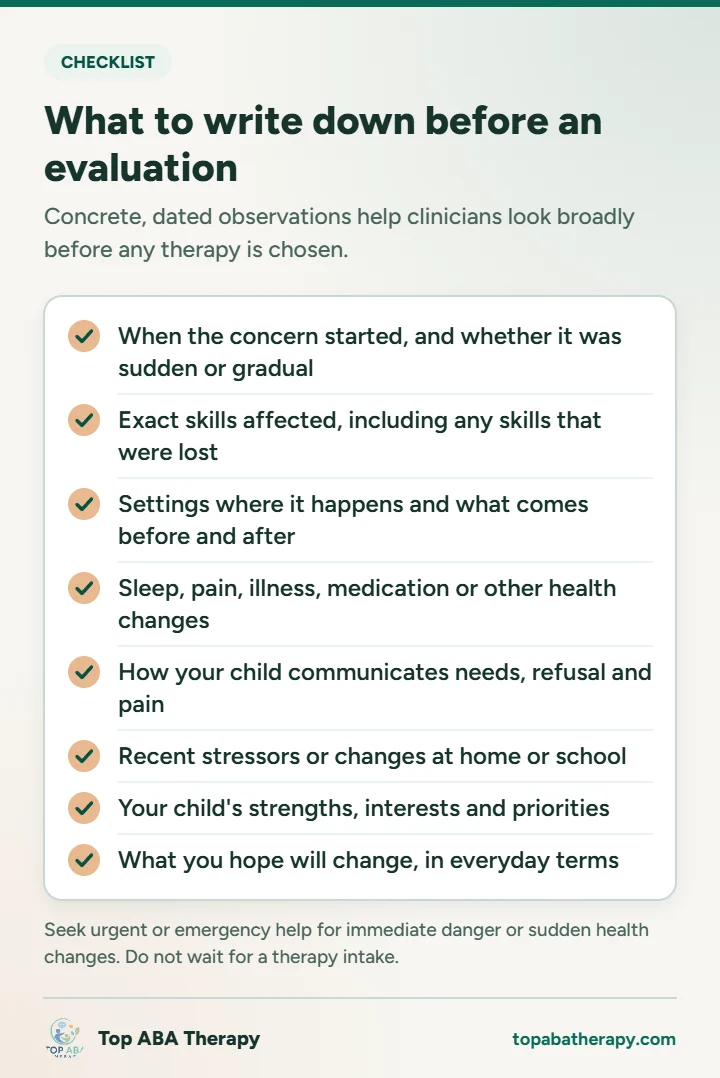
Write down concrete observations, timing, settings, recent changes, strengths, and what happens before and after a concern. Include physical health, pain, hearing, vision, sleep, nutrition, medication, movement, communication access, processing time, anxiety, grief, trauma, attention, sensory conditions, predictability, task difficulty, bullying, discrimination, relationships, and caregiver or school capacity.
NICE guidance for autistic people under 19 recommends assessing physical health, mental health, communication, and environmental factors around behavior that challenges. It then places function-informed psychosocial intervention within that wider response. The guidance is from the United Kingdom, so its service and legal routes do not transfer directly to the United States, but its clinical framing is useful.

When might ABA be one reasonable option?
Fit begins with a specific, person-valued goal
ABA may be worth comparing when the child has a meaningful skill or safety goal, medical and environmental contributors have been considered, behavioral expertise plausibly fits the question, and progress can be measured without reducing the child’s life to a graph. Goals might involve requesting help, accessing a break, learning a chosen daily-living routine, or preparing gradually for a medically necessary procedure. If the approach itself is new to you, see how ABA therapy works from assessment onward.
Assent, communication, and quality of life are decision evidence
A defensible program protects the child’s reliable way to agree, refuse, pause, request help, or report pain. It does not remove AAC or basic needs, target harmless self-regulation for appearing unusual, make eye contact or stillness a proxy for progress, or define obedience as the central outcome. It should monitor distress, adverse effects, family burden, school access, rest, relationships, and quality of life alongside skill data. Our review of ABA criticism and safety evidence covers these safeguards in more detail.
How should families compare ABA with other supports?
Match the lead professional to the actual question
Begin with one or two functional priorities. For diagnosis or a developmental profile, use qualified pediatric, developmental, or psychological assessment. For speech, language, or AAC, seek communication expertise. For mobility, sensory access, or daily activities, consider occupational or physical therapy. For mental health, trauma, or family wellbeing, use appropriately licensed mental-health support. For school access, involve the educational team and applicable disability processes.
Run a time-limited, reviewable decision process
Before services begin, write the baseline, child-valued goal, proposed support, expected signs of benefit, possible adverse effects, review date, and conditions for changing course. Ask how results will be explained in plain language and how the child’s experience will influence decisions. Keep school, play, rest, family life, community participation, and other care visible in the schedule.
What should you do next if you are concerned about your child?
A concern is a reason to gather information, not to commit to a specific therapy. A practical sequence looks like this:
- Start a dated log. Record what you see, where and when it happens, what comes before and after, and your child’s strengths.
- Talk with your child’s healthcare professional. Ask about developmental screening and whether hearing, vision, sleep, pain or other health factors should be checked.
- Request the right evaluation. Diagnosis, communication, motor, mental-health and school concerns each have their own qualified evaluators.
- Name one or two priorities. Describe them in everyday terms, such as asking for help or getting through a medical visit.
- Compare options against those priorities. If ABA is proposed, weigh it alongside the other supports above.
Questions to ask before accepting an ABA recommendation
- Which specific goals would ABA address, and why is it a good fit for them?
- Were medical, communication and environmental factors considered first?
- How will my child’s assent, distress and preferences be monitored?
- How many hours are proposed, and how was that number reached?
- When will progress be reviewed, and what would lead you to change course?
Frequently asked questions about signs and ABA fit
Does an autism diagnosis mean a child needs ABA?
No. A diagnosis can support access to evaluation and services, but the right plan depends on individualized needs, goals, preferences, health, environment, evidence, alternatives, and family circumstances.
Is delayed speech a sign that ABA is required?
No single communication difference selects a therapy. A child may need hearing, developmental, speech-language, AAC, medical, educational, behavioral, or coordinated assessment.
Should regression wait until an ABA assessment?
No. Loss of established skills deserves prompt medical and developmental attention because multiple causes are possible. Seek urgent help when the clinical situation requires it.
Can ABA help with dangerous behavior?
Behavior-analytic assessment and support may be one part of a multidisciplinary plan. Immediate safety, medical causes, pain, communication, trauma, sensory context, and environmental conditions also need attention.
The bottom line
There is no single list of signs a child needs ABA therapy. Loss of skills, communication barriers, distress and safety concerns are reasons for prompt, broad evaluation, and ABA is one option to compare once health, communication and environment have been considered. Choose supports around specific goals your child would value, insist on assent and quality-of-life safeguards, and set a review date before anything begins. If ABA is on your shortlist, browse verified ABA providers near you and compare them with the questions above.