

Quick answer: ABA intake usually moves from inquiry and service screening through records, benefits checks, consent, assessment, plan review, authorization and staffing. The order varies by provider and payer. Completing intake does not guarantee treatment will start; request a named contact, current status, missing requirements and written next steps.
What happens before an ABA clinical assessment?
| Intake stage | Keep this information |
|---|---|
| First contact | Service area, ages, setting, waiting-list status and intake contact. |
| Benefits check | Exact plan, provider and location, network and authorization requirements. |
| Assessment | Consent, assessor credentials, documents needed and assessment fee. |
| Starting sessions | Written plan, assigned staff, schedule, supervision and complaint route. |
Inquiry should collect very little
An initial form or call needs enough information to route a request: contact method, general location, age range, requested service or setting, payer category, schedule range, language or accessibility needs, and a brief nonemergency description may be sufficient. It should identify the legal organization, relevant location or service area, inquiry status, expected response, and official contact.
Do not assume a public form or chatbot is suitable for diagnostic reports, insurance cards, detailed behavior histories, school records, or identity documents. Ask which system receives the submission, who can access it, whether it creates a clinical record, and how sensitive material should be sent later. An automated reply must not imply that a clinician has reviewed the case.
Prescreening tests scope, not treatment need
A provider may prescreen geography, age, service setting, payer, schedule, referral requirements, accessibility, clinical scope, and urgent safety concerns. This limited review can establish whether intake should continue; it is not a diagnosis, full assessment, or treatment recommendation.
If the request is declined, ask which criterion was used and whether the answer applies to the organization, one location, one service, or current capacity. Providers should offer accessible communication, avoid discriminatory assumptions, and explain appropriate referral routes when a need falls outside competence. A waitlist is never a substitute for urgent medical, mental-health, emergency, or protective help.
Verify benefits independently
The provider may call the insurer, but the member should also verify the exact billing entity, location, rendering professional when relevant, and plan. Ask whether those parties are in network; which diagnosis, referral, assessment, and medical-necessity rules apply; whether assessment and treatment need separate authorization; which settings, modalities, codes, units, and dates are covered; and how cost sharing works. Our ABA insurance verification call script lists every question in order.
Read consent before sending the full record
Intake documents may address evaluation, treatment, privacy, records, releases, telehealth, recording, finances, attendance, transportation, emergencies, incidents, complaints, arbitration, research, and marketing. Ask which terms are required for evaluation, payment, or operations; which are optional; whether releases can be limited; and how permission is withdrawn. Never sign a blank or backdated form. Keep the completed version.

What happens from assessment through authorization?
A clinical assessment should fit the person and question
A qualified professional should examine strengths, communication, preferences, routines, environments, health and safety context, current support, meaningful priorities, baseline, and barriers. Methods may include interviews, observation, records, skill or preference measures, standardized tools, or components of functional assessment. Not everyone needs every tool.
The proposed plan needs an understandable review
Before the plan becomes an insurance attachment, families should see the goals, baseline, rationale, methods, setting, schedule, proposed intensity, caregiver role, and staff model. The discussion should cover assent, privacy, safety, incident response, any restrictive procedure, progress measures, treatment integrity, generalization, maintenance, social validity, possible adverse effects, transition, step-down, referral, and discharge.
Authorization is a coverage decision, not clinical consent
When required, the provider submits requested services, dates, units, credentials, assessment findings, treatment plan, and supporting records to the payer. Requirements vary by plan and service. A written decision should identify what was approved, reduced, or denied and any conditions or review dates.
Compare an approval with the actual proposed schedule. Approval does not compel a family to accept care, create staff capacity, guarantee claim payment, or prove the plan is the best choice. If the request is denied or reduced, read the current notice immediately for the reason, evidence, effective date, deadline, appeal route, expedited option, and any continuation rule. Generic web timelines cannot replace the member’s documents. Our ABA prior authorization guide explains how to read and track an approval.
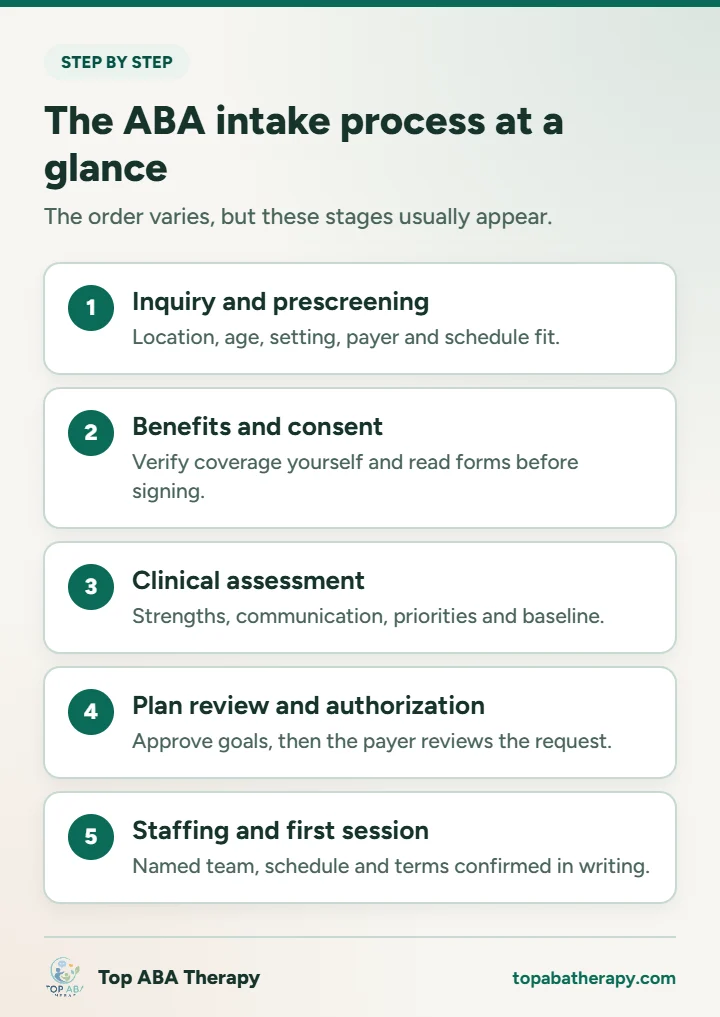
What must be confirmed before ABA care starts?
A real team must exist
Clinical acceptance and authorization can precede staffing. Confirm the accountable BCBA or other qualified clinician, applicable license, relevant competence, direct technicians, supervisor availability, individual training, background requirements, substitution rules, and continuity plan. The BCBA vs RBT comparison explains clinical decision accountability and supervised implementation.
Schedule and financial terms need to match reality
The written schedule should identify start date, days, times, setting, responsible staff, supervision, caregiver sessions, travel, holidays, cancellation, makeup, attendance thresholds, and communication channels. The financial agreement should explain the billing entity, network status, estimate, member cost sharing, noncovered items, late charges, travel, records fees, payment methods, refunds, collections, and notice of changes.
Do not accept an unsustainable schedule only because the opening is scarce. Count travel, preparation, caregiver participation, school or work, other healthcare, sleep, play, relationships, and community life. Ask what happens to authorization and the queue if the offered schedule is declined.
Run a first-session readiness check
Before service, verify the legal entity and location, official contacts, responsible clinician, staff identity, agreed goals and methods, consent and assent process, authorization or self-pay terms, schedule, supervision, cancellation rules, privacy, recording, devices, emergencies, incidents, complaints, and planned review dates. Make communication, accessibility, allergy, medical, personal-care, and safety information available only to the people who need it.
Treat silence and ambiguity as unresolved states
If records are “incomplete,” ask for the exact missing item and accepted version. If benefits remain unresolved, call both provider and payer. If authorization is pending, confirm receipt, reference number, requested information, and deadline. If authorization exists but no date does, identify the staffing or schedule constraint. The ABA waitlist guide helps track those provider-location-service queues.
A directory can help you shortlist providers, but only the provider can complete clinical intake and only your plan can approve coverage. Keep your own simple log of each stage, contact and date so you always know what is next.

Frequently asked questions about the ABA therapy intake process
How long does ABA intake take?
There is no reliable universal timeline. Records, assessment capacity, family availability, payer rules, authorization, staffing, and schedule fit vary. Ask each provider for the current stage, remaining gates, owner, evidence, and next date.
Does submitting an ABA intake form make someone a patient?
Not necessarily. A form may create only an inquiry. Ask when the organization considers a clinical relationship established, which documents govern it, and what status confirmation you will receive.
Will benefits verification guarantee insurance payment?
No. A benefits quote is not authorization or final claim adjudication. Verify network, authorization, service, setting, credentials, units, dates, documentation, member costs, and exclusions under the actual plan.
Can a provider assess before prior authorization?
Sometimes, but payer and plan rules differ, and assessment may have its own authorization. Confirm coverage and financial responsibility before a billable assessment instead of assuming treatment authorization will pay for it later.
The bottom line
The ABA therapy intake process moves faster and safer when you know each stage, who owns it and what is still missing. Verify benefits yourself, read consent carefully, review the plan before it goes to the payer and confirm a real team and schedule before the first session. When you are ready to begin, find ABA therapy providers near you and ask each one to walk you through its intake steps.