

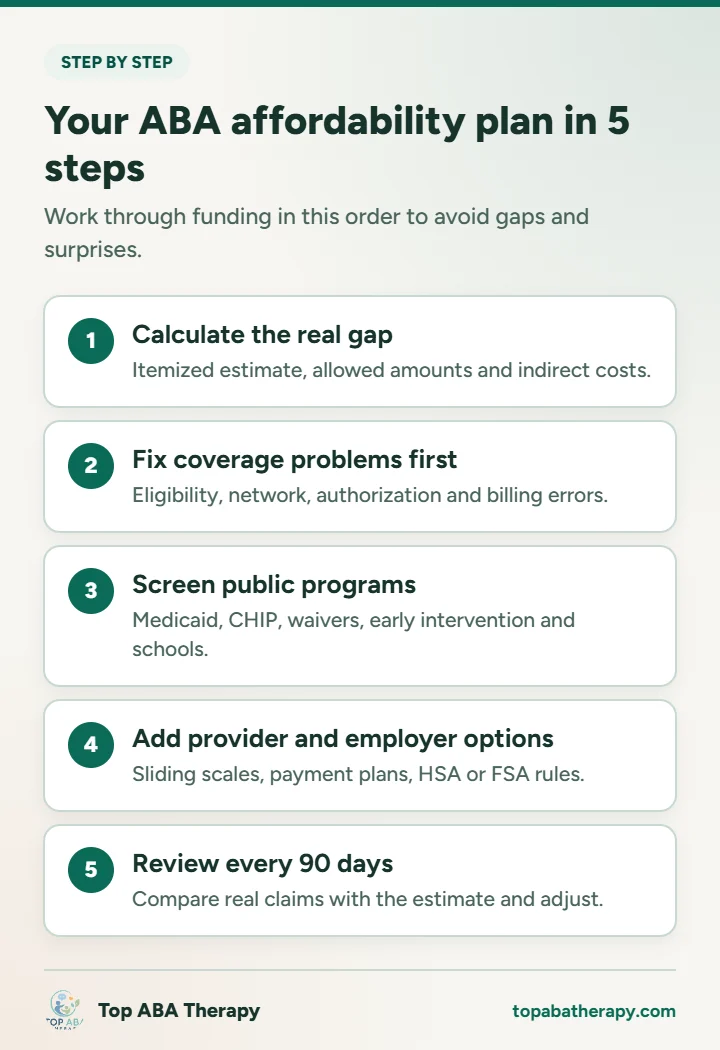
Quick answer: To make ABA more affordable, first establish your actual family cost after benefits and eligible public programs. Obtain a written service estimate, verify coverage and authorization, check errors and compare suitable funding or provider options. Consider travel and lost work too; a low advertised hourly rate may not mean the lowest household cost.
Scope note: This guide provides general educational steps, not a coverage, Medicaid, school-service, grant, tax, reimbursement, or affordability guarantee. It is not individual medical, insurance, education, tax, financial, benefits, or legal advice.
How can families calculate the real ABA affordability gap?
Separate services and price bases
Ask the provider to itemize assessment, direct treatment, protocol modification, caregiver guidance, group services, reassessment, travel, cancellations, supplies, and administrative charges. Ask the plan for the allowed amount and member responsibility for those same services. A provider’s billed charge, negotiated allowed amount, self-pay rate, and final member balance may all differ. Our ABA therapy cost guide explains each of these prices.
Record the remaining individual and family deductible, copayments, coinsurance, out-of-pocket accumulators, authorized quantity, benefit maximums if applicable, noncovered services, and out-of-network rules. Then add travel, missed work, sibling care, meals, technology, and other household costs. Indirect costs do not appear on an explanation of benefits, but they can decide whether the schedule is workable.
Reconcile the estimate with real documents
Compare the provider estimate, member benefit document, written authorization, and explanation of benefits. For each line, capture member, product, organization, site, rendering professional, service, date, quantity, billed charge, allowed amount, adjustment, plan payment, and member amount. Mark missing evidence instead of filling it with an assumption.

Which coverage problems and public programs should families check?
Classify the insurance problem first
A large balance may arise from inactive eligibility, an excluded benefit, wrong network, expired authorization, mismatched provider identifier, setting restriction, missing record, coding error, coordination of benefits, filing problem, or medical-necessity decision. Those causes need different fixes.
Build the response around the stated decision. The file may need plan language, policy, authorization history, individualized assessment, treatment plan, medical-necessity reasoning, progress evidence, provider qualifications, and a dated contact timeline. Do not submit a generic appeal and assume volume will replace relevance. Our ABA denial and appeal guide walks through the process step by step.
Check Medicaid and CHIP without assuming the answer
Eligibility, benefits, enrollment, managed-care rules, authorization, and permitted cost sharing vary by state and member. CMS has explained that states determine medical necessity for eligible people within federal requirements, including EPSDT for people under 21, and has not imposed one national ABA program design. See how to check Medicaid coverage for ABA in your state.
Understand IDEA boundaries
IDEA governs early intervention, special education, related services, and a free appropriate public education for eligible children. The IFSP or IEP team determines services from the child’s developmental or educational needs under the applicable program. IDEA does not promise private ABA, a named model, or a clinic schedule because a family requests it.
| Funding layer | What to verify before counting it |
|---|---|
| Private plan | Exact benefit, network, authorization, allowed amount, cost sharing, appeal rights, and renewal |
| Medicaid or CHIP | Member eligibility, covered request, managed-care product, enrolled provider, approvals, and coordination |
| IDEA services | Individual evaluation, IFSP or IEP team decision, educational or developmental purpose, and program rules |
| Provider option | Written self-pay rate, assistance criteria, payment terms, clinical fit, and effect on insurance claims |
| Employer or tax account | Plan eligibility, permitted expense, substantiation, timing, limits, and current tax guidance |
| Grant or charity | Verified sponsor, open period, permitted use, payment route, privacy terms, and effect on other benefits |
Which provider, employer, tax, and charitable options deserve review?
Ask providers for written options
Providers may offer in-network sites, self-pay rates, good-faith estimates, financial assistance, sliding scales, payment plans, telehealth, group formats, caregiver guidance, or continuity arrangements during authorization gaps. None should be assumed. Ask for criteria, available dates, deposit, interest, late fee, cancellation rule, refund terms, and effect on insurance submissions. If there is no coverage at all, read ABA therapy without insurance for self-pay strategies.
Verify employer and tax options independently
An employer may offer an HSA-compatible plan, FSA, benefits advocate, paid leave, employee assistance, dependent-care benefits, or disability resources. Each program has its own eligibility and substantiation rules. Ask the plan administrator which document controls and obtain the answer in writing.
IRS Publication 502 states that therapy received as medical treatment may qualify under its medical-expense rules. The publication also warns that it does not determine FSA reimbursement. HSA, FSA, deduction, dependency, timing, and documentation questions need current plan terms and, where necessary, qualified tax advice. Do not promise that one ABA expense is reimbursable or deductible.
Treat grants as uncertain supplements
Grants may be local, competitive, diagnosis- or age-limited, restricted to defined expenses, or temporarily closed. Verify the sponsor, registration where relevant, application period, allowed use, selection process, payment method, data handling, conflicts, and effect on other benefits. Do not pay an application fee or send sensitive records before authenticating the organization.
A grant that pays once cannot safely fund a recurring schedule by itself. Keep it outside the base budget until an award is written, accepted, and compatible with the other funding sources.

How can families build a sustainable care and household plan?
Review every 90 days and before known changes
Track authorized, scheduled, delivered, billed, allowed, paid, and member amounts by service. Record provider and family cancellations, indirect household costs, deductible and out-of-pocket accumulators, claim disputes, appeal deadlines, renewal, reassessment, and expected changes in employer, plan, provider, school, or address.
Recalculate after the first real claims. Compare the original estimate with actual allowed amounts, service mix, cancellations, and indirect cost. Investigate the difference. One unusually low month cannot prove long-term affordability, and an initial deductible month should not be projected across the entire year.
Treat every directory detail and funding lead as a starting point, then verify coverage, public-program eligibility, provider terms and availability with the organization responsible for each one.
Frequently asked questions about affording ABA
Should I use the provider’s billed charge as my expected cost?
Not automatically. Ask for the plan’s allowed amount, member cost sharing, authorization, network status, and noncovered charges, then reconcile them with the provider estimate.
Can a denied claim still be corrected?
Sometimes. The next step depends on whether the issue is eligibility, benefit, network, authorization, documentation, coding, timing, or medical necessity. Read the actual notice.
Does Medicaid cover ABA in every state the same way?
No. Eligibility, benefits, managed care, provider enrollment, approvals, and program design vary. Use current state and member-specific information.
Can an IEP pay for private ABA therapy?
Do not assume that. The IEP team determines eligible educational services under IDEA. Medical coverage and school services have different authority and purposes.
The bottom line
Learning how to afford ABA therapy starts with your real cost after benefits, not the advertised rate. Fix coverage problems, screen Medicaid, CHIP and IDEA routes, add provider and employer options carefully, and treat grants as a bonus rather than the base of your budget. Review the plan every 90 days, then find ABA therapy providers near you and ask each one for a written estimate.