
Quick answer: Some ABA-based practices may help selected communication, learning or daily-living skills, but results vary. Evidence for one method or outcome does not validate every provider, goal or intensive program. Consider real-life usefulness, independence, preferences, burden, adverse effects and alternatives alongside reported improvements.
Which ABA benefits are reported, and what limits the evidence?
The 2025 National Academies report found a substantial ABA evidence base across multi-domain programs and focused practices. Studied outcomes include adaptive and daily-living skills, functional communication, selected language and learning measures, social participation, play, transitions, safety barriers, caregiver-supported routines, and programmed generalization. These are possible domains, not promises across different people, goals, methods, intensities, settings, or providers.
Benefit should mean improvement in the person’s life
A measured change becomes a benefit only when it improves communication, access, autonomy, relationships, health, safety, participation, enjoyment, or another person-valued outcome. Communication access or reduced injury after medical and communication review may matter; eye contact for appearance or suppression of harmless regulation may not. Evidence and ethics must both pass.
Evidence strength varies by outcome and study design
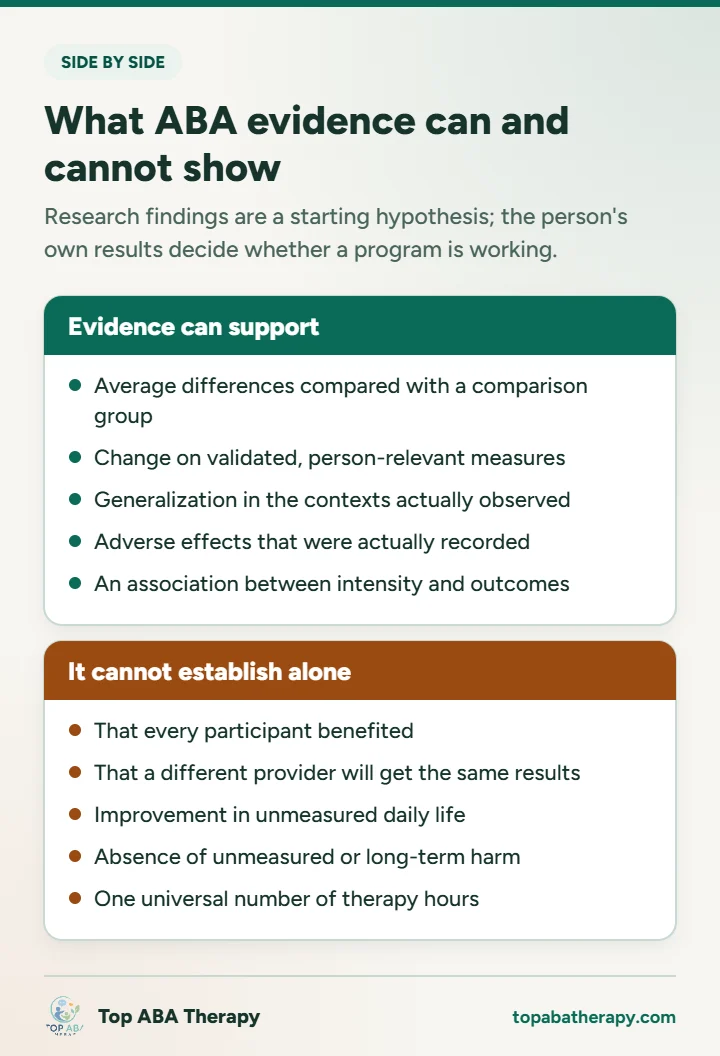
| Evidence can support | Evidence cannot establish alone |
|---|---|
| An average difference from a comparison | That every participant benefited |
| A stronger causal inference in a controlled design | Transfer to a different practice or provider |
| Change on a validated, person-relevant measure | Improvement in unmeasured daily life |
| Direct generalization and maintenance in observed contexts | Improvement everywhere else |
| Recorded adverse effects and participant experience | Absence of unmeasured or long-term harm |
| An association between intensity and outcomes | One universal number of hours |
A 2025 mixed-methods review found possible improvement across several developmental domains but rated much evidence low or very low quality and noted heterogeneity and bias. An updated early-childhood meta-analysis found some effects weakened when higher-risk outcomes were excluded and noted inadequate adverse-effect monitoring. Reviews differ because their interventions, designs, years, outcomes, and quality rules differ.
Multi-domain programs and focused practices are different
Multi-domain programs address several areas, while focused practices target a defined skill or barrier. Evidence for functional communication training does not validate every intensive package, and evidence for a package does not prove each component was necessary. Marketing should name the method and relevant evidence. That distinction matters when comparing claims. Our overview of common ABA methods and safeguards explains how specific practices differ.
Individual response varies
Communication, health, sensory experience, support needs, culture, age, environment, preferences, provider competence, staff continuity, resources, and treatment integrity all affect response. Group averages conceal responders, nonresponders, mixed outcomes, burden, and harm. Use research as an individualized hypothesis, then measure the person’s result; nonresponse should trigger review, not blame or automatic escalation.
Generalization and maintenance are common weak points
A skill shown with one staff member may not transfer to family, peers, materials, or community settings, and acquisition does not prove maintenance. Name where the skill matters, how prompts fade, how transfer is tested, and how long maintenance is observed. Combine real-world reports with direct measures when feasible.
Long-term and quality-of-life evidence remains incomplete
Many studies are short and omit autonomy, relationships, mental health, self-determination, employment, inclusion, and quality of life. Outcomes selected without enough autistic input may miss safety, exhaustion, refusal, understanding, or pursuit of personal interests. That does not erase measured benefit; it limits the claim to what and whose priorities were measured.
Adverse effects and acceptability need better measurement
Autistic people report coercion, compliance training, distress, masking, suppressed regulation, boundary violations, and lasting effects, while research often omits adverse events, burden, assent, and social validity. Absence of published harm is not proof of safety. Monitor approach and withdrawal, distress, injury, shutdown, sleep and health changes, communication loss, prompt dependence, generalized compliance, family burden, the person’s accessible report, complaints, and dropout. Our guide to ABA criticism and safety evidence looks at these concerns in more depth.
Intensity is not a universal dose
Hours are not a universal dose. Intensity should follow goals, baseline data, health, sleep, school or work, relationships, other services, capacity, response, burden, and preference. Require a goal-level rationale and criteria for increasing, reducing, changing, pausing, or ending care.
Implementation can differ from studied care
Studied efficacy can disappear through generic goals, insufficient assessment, staff working beyond competence, administrative supervision, turnover, inaccurate data, payer distortion, inaccessible caregiver guidance, poor coordination, or incentives favoring billed hours. Credential checks, direct observation, stable staff, transparent data, and organizational accountability are part of evidence-based care. Use our provider verification checklist to check those safeguards before intake.
How should evidence be applied to an ethical individual decision?
Treatment should respect dignity, privacy, communication, bodily autonomy, culture, consent, and assent. Goals should not focus on making an autistic person appear typical or rewarding unquestioning obedience. Environmental accommodation and alternatives should be considered before changing the person.
Potentially restrictive or punishment-based procedures require direct scrutiny, applicable legal and professional review, a serious and defined rationale, less intrusive alternatives, informed authorization, oversight, benefit and harm data, and fading criteria. A favorable average outcome from unrelated ABA research cannot justify a restrictive procedure.
ABA is not the only option
Depending on the goal, alternatives or complements may include speech-language services, AAC support, occupational or physical therapy, developmental and relationship-based approaches, mental-health care, medical evaluation, education support, environmental accommodation, peer support, caregiver services, or community programs.
Apply research to an individual decision
Define the exact claim
Replace “Does ABA work?” with: Does this specific practice, delivered by this team in this setting, help people sufficiently similar to this person achieve this meaningful outcome compared with realistic alternatives?
Rate applicability
Compare age, communication, support needs, goal, method, setting, intensity, outcome measure, follow-up, and provider competence. Mark differences and unknowns explicitly.
Establish a personal evidence loop
Record baseline, expected change, acceptable burden, adverse-effect indicators, generalization tests, review dates, and stop rules. Data should support shared decisions without pressuring continuation.
Preserve choice
Invite accessible feedback, second opinions, modifications, pauses, alternatives, and transition. Authorization to start is not irrevocable consent.
Questions to ask about a benefit claim
- Which exact intervention or practice produced the finding?
- Who participated, and how similar are they to the intended recipient?
- What comparison was used?
- Who selected and measured the outcome?
- Was the assessor blinded or independent where feasible?
- How large and durable was the change?
- Did it generalize to everyday life?
- Were quality of life, assent, burden, and adverse effects measured?
- How many people withdrew, and why?
- Can this provider implement the practice with comparable competence and fidelity?
What a directory can responsibly show
Top ABA Therapy connects directory discovery to locations, comparisons, careers, and education. Profiles can display dated source-backed facts about services, credentials, payers, policies, and availability, but they cannot establish individual effectiveness or fit.
Not measured does not mean absent: when a study omits adverse events, assent, treatment burden, quality of life, or long-term follow-up, describe those outcomes as unknown, never as safe or unchanged.


Frequently asked questions about ABA benefits and limitations
What are the main possible benefits of ABA?
Studies report potential change in selected adaptive, communication, language, learning, daily-living, participation, and safety-related outcomes. The applicable benefit depends on the defined practice, person, goal, comparison, implementation, and whether the change transfers into daily life.
What are the main limitations of ABA evidence?
Limitations include heterogeneous programs and participants, variable study quality, bias, short follow-up, group averages, incomplete generalization and maintenance data, limited adult evidence, and insufficient measurement of adverse effects, burden, assent, and quality of life.
Does ABA research prove a particular provider is effective?
No. Published evidence cannot establish that a specific organization selects ethical goals, hires competent staff, supervises directly, follows the studied practice, measures accurately, or produces the same outcomes. Those implementation facts need separate verification.
Is a larger number of ABA hours more effective?
No universal dose is established for every person and goal. Intensity should be justified individually and reviewed against progress, sleep, health, school or work, relationships, other supports, preference, adverse effects, and total burden.
Does ABA work for adults?
Most ABA research focuses on young children, and evidence for adults is more limited. Some focused practices may still help with specific, adult-chosen goals such as daily living or communication. Adults should lead goal selection, and any program should measure benefit, burden and quality of life rather than assume results from child studies transfer.
The bottom line
The benefits and limitations of ABA depend on the exact practice, goal, person and provider. Research supports possible gains in selected communication, learning and daily-living skills, but it is weaker on long-term quality of life, adverse effects and generalization, and it cannot vouch for any single program. Treat evidence as a hypothesis, measure your own results against person-valued goals, and keep the right to change course. When you are ready to evaluate options, compare ABA therapy providers near you using the questions in this guide.
Sources
- Project AIM: updated systematic review and secondary analysis (2023; reference correction 2026)
- Effectiveness and experiences of early intensive behavioral and naturalistic developmental behavior interventions for autism spectrum disorders: a mixed-methods systematic review and meta-analysis.
- Intensive behavioural interventions based on applied behaviour analysis for young children with autism: An international collaborative individual participant data meta-analysis.