

Quick answer: A Board Certified Behavior Analyst (BCBA) may assess needs, develop behavior-analytic plans, supervise staff, review data and revise or end services. The role depends on competence, employment and applicable legal and payer rules. Ask who holds clinical responsibility and how directly they oversee the care being delivered.
What does a BCBA own, and which rules limit the role?
| Work area | Typical BCBA responsibility |
|---|---|
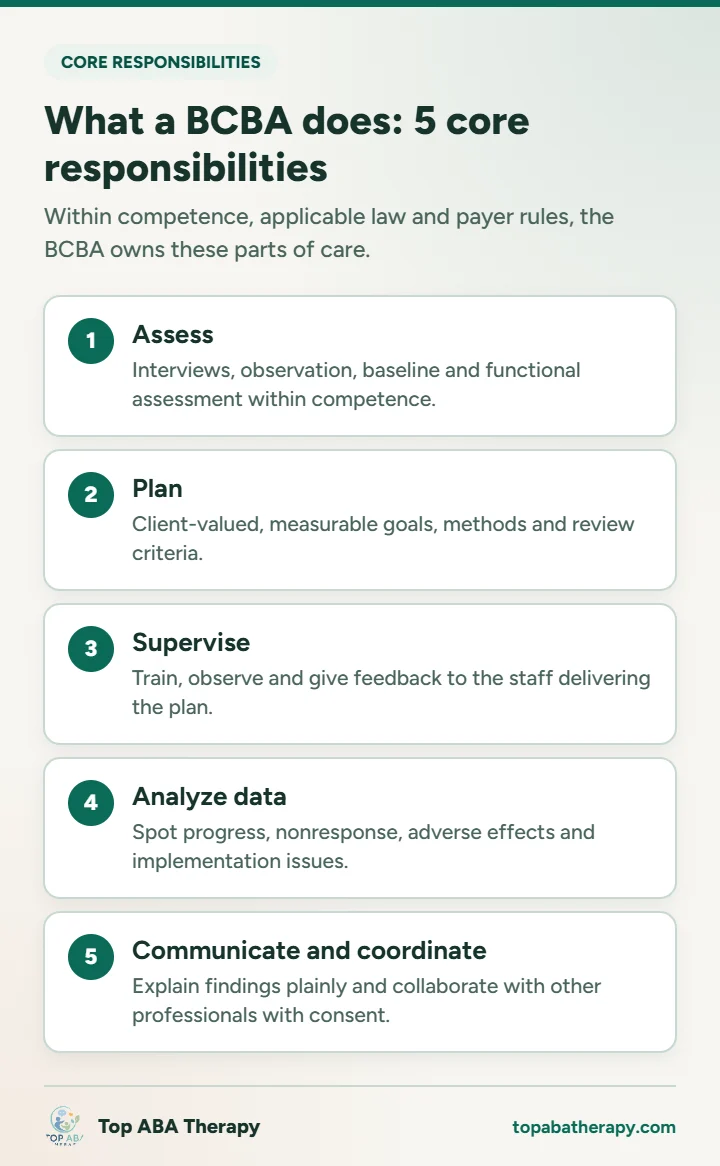
| Assessment | Select and interpret assessments within competence and applicable law. |
| Planning | Develop individualized goals, methods, measurement and review criteria. |
| Supervision | Train, observe and give feedback to staff delivering the plan. |
| Review and coordination | Use progress and safety data to adjust care and coordinate with consent. |
Certification, licensing, and employment answer different questions
The BACB states that BCBAs are independent practitioners who can provide behavior-analytic services and supervise others who implement behavior-analytic interventions. “Independent” in the certification hierarchy does not mean exempt from other requirements or free to practice every specialty.
Assessment responsibilities
The BCBA may conduct or oversee interviews, direct observation, record review, skill and preference assessment, baseline measurement, environmental analysis, and functional behavioral assessment as relevant; the purpose is to understand strengths, needs, context, communication, health and safety factors, and what outcomes matter to the client.
Assessment should remain within competence and be sufficient for the decision. A BCBA should refer or coordinate when medical, speech-language, occupational, psychological, education, trauma, feeding, or other expertise is needed. Behavioral data do not rule out pain or medical causes.
Treatment planning and goal selection
A BCBA may translate assessment into observable, measurable goals and procedures. Good planning does more than make behavior measurable. It asks whether the goal improves communication, access, autonomy, safety, relationships, daily life, participation, or another client-valued outcome. Our overview of the ABA care cycle shows where planning fits between assessment and review.
Direct service and supervision are separate duties
Some BCBAs provide substantial direct treatment. Others primarily assess, design, supervise, consult, or manage programs implemented by technicians.
Supervising direct staff
Effective supervision can include direct observation, modeling, behavioral skills training, performance feedback, review of written work and data, competency checks, problem-solving, and evaluation of service effects. The BACB has additional requirements for BCBAs serving in specified supervision, assessment, training, or oversight roles.
Supervising trainees is not identical to supervising services
A BCBA may supervise students accruing fieldwork toward certification, RBTs delivering ongoing services, BCaBAs, or staff without a BACB credential. Each relationship can have different requirements. The provider should identify whether a meeting serves client oversight, credential fieldwork, employee management, or several functions and document how it meets every obligation. For the full division of duties on a tiered team, see how BCBA and RBT responsibilities compare.
Data analysis and clinical decisions
The BCBA should review data often enough to identify progress, nonresponse, possible adverse effects, implementation problems, and changes in context. Data may support modifying goals, prompts, reinforcement, setting, schedule, teaching format, staff training, or service intensity.
How should a BCBA communicate, collaborate, and protect clients?
Communication with clients and families
A BCBA should explain assessment findings, proposed goals, procedures, risks, alternatives, data, progress, and financial or authorization boundaries in accessible language. Interpreters, AAC, visual supports, plain language, and other accommodations may be necessary.
Collaboration and professional boundaries
With appropriate permission, a BCBA may coordinate with physicians, psychologists, speech-language pathologists, occupational therapists, educators, mental-health professionals, case managers, and other supports. Collaboration should define the shared purpose, information exchanged, roles, records, and how conflicting recommendations are resolved.
Ethics and protection responsibilities
The BACB Ethics Code applies to BCBA and BCaBA certificants and applicants. Professional responsibilities include competence, integrity, confidentiality, informed consent, assessment, treatment, supervision, documentation, fees, public statements, and responsibility to clients and stakeholders.

Where do BCBAs work, and how can you evaluate the role?
Responsibilities change across settings
In a home, the work may involve routines, caregiver coaching, staff observation, generalization, privacy, travel, boundaries, and household safety. In a center, the BCBA may design programs, observe teams, train staff, and review shared-space, incident, or peer-consent issues. School work adds educational authority, IEP roles, contracted-service limits, and education records. Families weighing that setting can read what in-home ABA involves.
What accountability should not disappear through delegation
Organizations often use tiered teams, but accountability cannot disappear into delegation. Ask who approves assessment conclusions, goals, material changes, restrictions, intensity, transition, and discharge; who verifies implementer competence; and how the BCBA directly observes service. When an assistant or technician performs an assessment, training, or data task, the provider should identify that person’s qualifications, supervision, and the BCBA’s review.
How caseload affects practice
There is no single caseload number that proves safe practice because complexity, travel, staffing, setting, indirect duties, and support infrastructure vary. Still, a BCBA must have enough capacity to assess, observe, analyze, communicate, train, document, and respond.
Questions for families and job candidates
Questions families should ask the BCBA
Ask which credentials apply, what experience matches the person’s needs, which assessment and supervision the BCBA performs directly, how goals and assent shape decisions, and what findings trigger modification or discharge. Also request the complaint and second-opinion routes. Our provider vetting checklist adds organization-level questions.
Questions job candidates should ask
Candidates should compare caseload and geography, billable and nonbillable expectations, protected supervision time, high-risk consultation, funded development, leave coverage, clinical decision authority, compensation, classification, and restrictive-covenant terms.
Becoming and remaining a BCBA
BACB requirements change. As of the June 2026 handbook, pathways involve graduate education, behavior-analytic coursework or approved program structures, supervised fieldwork, application, and examination, followed by ongoing ethics and maintenance requirements. Transition guidance for upcoming requirement changes is already relevant to some candidates.
Do not use an undated article as an eligibility checklist. Read the current BCBA Handbook, applicable transition guidance, university information, state licensing rules, and payer or employer requirements. Only the BACB can make a formal determination about certification eligibility.
Verify the individual, not just the acronym
The Top ABA Therapy homepage connects provider profiles, careers, locations, settings, insurance, comparisons, and educational resources. Directory records should show last-checked credential evidence and uncertainty; they cannot guarantee current status, competence, employment, or outcomes.

Frequently asked questions about the BCBA role
Does a BCBA provide direct therapy sessions?
Sometimes. Some BCBAs deliver substantial direct service, while others focus on assessment, program design, supervision, consultation, and review. Ask which activities this BCBA will personally perform and how often the person receiving services will see them.
Does BCBA certification prove clinical quality?
No. Certification establishes a professional credential and maintenance duties. It does not prove specialty competence, current state authorization, manageable caseload, direct supervision, ethical implementation, individual fit, or outcomes.
How often should a BCBA observe an ABA session?
No single frequency establishes adequate oversight for every case. Complexity, risk, staff competence, setting, change, and applicable rules matter. Ask for the planned direct-observation schedule, what can trigger more observation, and how findings alter service.
Can a BCBA diagnose autism?
BACB certification alone does not authorize diagnosing autism. Diagnosis is typically made by qualified professionals such as developmental pediatricians, psychologists, psychiatrists, or neurologists, depending on state rules and payer requirements. A BCBA may contribute observations, so ask who made the diagnosis your plan relies on.
Does a BCBA need a state license?
Often, yes. Many states license behavior analysts separately from BACB certification, and practicing without a required license can be unlawful even for a certified BCBA. Check the state licensing board as well as the BACB certificant registry, and confirm the license covers the state where services are delivered.
The bottom line
What does a BCBA do? In short, the BCBA assesses, designs the plan, supervises the people who deliver it, analyzes the data, and owns the clinical decisions within competence and applicable rules. The credential is a starting point, not proof of quality, so verify it, ask how directly the BCBA oversees care, and expect clear explanations. Families and candidates alike can explore ABA providers near you to see how different organizations structure the role.