

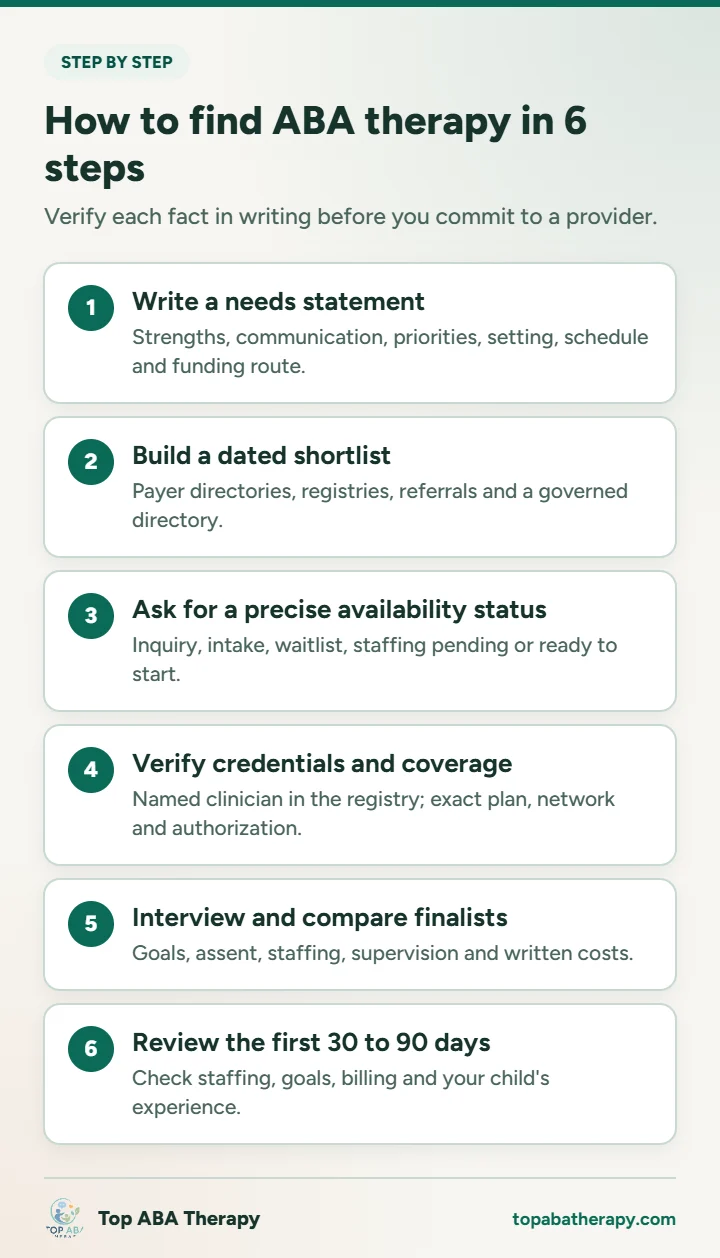
Quick answer: To find ABA therapy, write down your child’s needs first, then shortlist providers that serve your exact location. Ask each one for its current availability and start date, verify the named clinician’s credentials, and confirm network status and authorization with your plan. Compare goals, consent practices, staffing and written costs before committing, and set a date to review early services.
How do you define needs and build a current provider list?
| What to plan | Verify when you act |
|---|---|
| Provider | Current service location, staffing, age range and waiting list. |
| Health plan | Current benefit documents, network and authorization rules for your plan year. |
| Credentials | The named clinician’s active certification and applicable state authorization. |
| Care proposal | Person-valued goals, alternatives, schedule, costs and review criteria. |
Begin with the person, not a brand
Write a short needs statement with the service recipient whenever possible. Include strengths, interests, communication, accessibility, meaningful priorities, health or safety coordination, preferred settings, schedule, travel area, language, culture, funding route, and nonnegotiable boundaries for consent and dignity.
Do not assume every need calls for ABA. Speech-language, occupational, medical, mental-health, educational, AAC, peer, disability, or community supports answer different questions and may work alongside or instead of behavior-analytic service.
Search more than one current source
Use official payer and Medicaid directories, credential registries, referrals, state resources, medical or school contacts, disability organizations, and a governed directory. Record the source and date for every candidate. Search broadly enough to find plausible options, then narrow only when evidence supports the field.
Do not treat a search result as proof of an active business, an address as a service location, “serves this state” as service to the person’s ZIP code, a payer logo as exact-plan network status, “now enrolling” as assigned staff, or one clinician’s credential as organization-wide verification.
Ask for a precise availability state
Contact the exact location and service. Ask whether the provider is accepting inquiries, scheduling intake, maintaining a waitlist, waiting for staff, or ready to start after clinical, administrative, authorization, consent, and schedule conditions are complete.
Keep more than one viable route when possible. A family can ask whether a provider offers another setting, a smaller schedule, caregiver consultation, telehealth where appropriate, or referral to a different organization, but each alternative needs its own clinical and coverage review. Do not let a long waitlist pressure the family into accepting an unsuitable method, unsafe term, or unverified payment request.

What should you have ready before calling ABA providers?
A few minutes of preparation makes every call shorter and every answer easier to compare.
- The diagnostic report and any referral or prescription your plan or provider may require.
- The insurance or Medicaid card, with the member number and full plan name.
- Your short needs statement, including communication, priorities, and any health or safety considerations.
- Preferred settings, the days and times that work, and how far your family can travel.
- A simple log with columns for provider, location, date, contact name, availability status, and next step.
- The same short list of questions for every provider, so answers can be compared side by side.
Before sharing detailed records with anyone, confirm you are speaking with the actual provider organization.

How do you verify a provider, coverage, and clinical fit?
Confirm insurance with both parties
Call the number on the member card or use the official plan portal. Verify the exact provider entity, location, professional type, service, plan product, referral or prescription, documentation, network status, prior authorization, deductible, copay, coinsurance, out-of-pocket rules, exclusions, limits, and appeal route. Our guide to checking your plan’s ABA benefits walks through each question, and families with Medicaid can follow our Medicaid ABA verification steps.
Interview comparable finalists
Ask who will assess, supervise, and deliver care. Find out how the person participates in goals; how assent, dissent, breaks, AAC, sensory needs, culture, language, pain, medical factors, trauma, task demands, and environment are considered; and which methods or restrictive practices are prohibited or governed.
Do not bury criticism of ABA. Ask directly whether the organization targets harmless autistic traits, eye contact, quiet hands, masking, or compliance for appearance. Autistic people have described real harms in historical and current practice. A trustworthy provider can explain person-defined goals, communication access, consent, evidence limits, adverse-effect review, and how a client or family raises a concern without retaliation.
Use the questions in our provider-selection checklist consistently with every finalist. Do not average a missing safety threshold with convenient hours or a friendly intake call.
Normalize costs and intake terms
Request a written estimate separating provider charge, allowed-amount assumptions, expected payer contribution, estimated family responsibility, noncovered items, assessment, treatment, supervision, caregiver guidance, travel, cancellation, equipment, and indirect costs. Compare the same service, role, unit, setting, network, benefit phase, and estimate date. Our ABA cost budgeting guide shows how to turn those numbers into a realistic monthly estimate.
Read consent, privacy, financial responsibility, cancellation, communication, telehealth, recording, emergency, caregiver, restrictive-practice, grievance, discharge, records, and arbitration terms. Confirm who may change the plan, how consent can be withdrawn, what fees remain if staffing or authorization fails, and what happens at departure. Never sign blank, backdated, or inaccurate records.
How do you protect the search and review early services?
Treat urgency and unusual payment as risk signals
Pause when someone uses a lookalike domain, demands gift cards, cryptocurrency, a wire, or an unusual deposit; sends a check and asks for money back; promises coverage, recovery, or immediate placement; asks for extensive identity or medical data before entity and purpose are verified; refuses a written estimate or privacy notice; or pressures the family not to call the payer or official office.
Audit the first 30 to 90 days
Acceptance and attendance do not prove fit. Set a written review date. Check whether named staff and supervision match the proposal, communication access and assent are visible, goals remain meaningful, baseline and measurement are understandable, scheduled and billed services match delivery, burden and adverse effects are discussed, caregiver participation is sustainable, incidents receive follow-up, and transition criteria exist.
Ask the service recipient in an accessible way. Look at everyday sleep, distress, communication, autonomy, school or community participation, recovery time, and lost preferred activity alongside target data. Decide whether to continue, adapt, reduce, pause, transfer, or stop with the responsible team; do not let sunk cost become a clinical reason.
Keep your search current. Availability, waitlists, network status and staffing change quickly, so recheck each finalist before you commit and again if your start date slips. Date every note you take so you always know how fresh an answer is.
Frequently asked questions about finding ABA therapy
Does a directory match mean a provider will accept the client?
No. A result can identify a plausible option based on supported fields. Clinical acceptance, authorization, staffing, schedule, consent, and a start date remain separate.
How can I tell whether a provider has an opening?
Ask the exact location and service for its current dated state: inquiry, intake, waitlist, staffing pending, or start readiness. Request the next step and dependencies.
Does an NPI prove that a provider is licensed or good?
No. An NPI is an identifier. It does not establish state authority, credential status, employment, specialty competence, quality, safety, or availability.
Should I trust a payer directory?
Use it as one source, then verify the exact provider entity, location, plan product, service, and date with the plan and provider. Directory information can lag.
How long are ABA therapy waitlists?
Waitlists vary widely by location, setting, funding source, age range, and staffing, and a quoted wait can change quickly. Ask each provider for a dated estimate, what the wait depends on, and whether a different setting, schedule, or caregiver consultation could start sooner. Keep searching while you wait.
The bottom line
Knowing how to find ABA therapy is mostly about verification: start from your child’s needs, build a dated shortlist from several sources, and confirm availability, credentials, coverage, and costs in writing before you commit. Then hold the first months of service to a written review date. A careful search can take a little longer, but it protects your child from a poor fit and your family from surprise bills. Ready to begin? Compare ABA providers in your area.